

A hair transplant in Turkey is often marketed through a single number: a price, a graft count or the name of a technique. Those details can be useful, but none of them can answer the most important questions on their own: What is causing the hair loss? Is there enough stable donor hair? What level of coverage is realistic? Who will perform each clinical stage? What does the quotation include, and what happens after the patient returns home?
Hair transplantation is a surgical procedure that moves a person’s own follicular grafts from a donor area to an area of thinning or baldness. It is not a universal answer for every form of hair loss, an unlimited source of grafts or a guarantee that future hair loss will stop.
A responsible plan should begin with diagnosis, donor-area assessment and realistic goals – not a promised graft number or a fast package. It should also explain the difference between an initial remote review and the treatment plan confirmed after an in-person clinical examination.
Venoramed is a medical marketplace and coordination platform. It does not diagnose hair loss, determine candidacy, recommend a graft number or guarantee a cosmetic or medical outcome. A final plan must be made by an appropriately qualified clinician after individual assessment.
For broader travel-planning context, read Venoramed’s guide to medical tourism in Turkey.
What does a hair transplant actually involve?
Hair transplantation generally involves harvesting follicular grafts from a donor area – most often the scalp – and placing them into a recipient area affected by hair loss. A graft is not automatically equal to one hair; it can contain one or more follicles. That is why a headline graft number alone does not explain expected coverage or density.
Follicular Unit Excision, usually called FUE, is one method of harvesting individual follicular units. Although it is often described as minimally invasive, it is still surgery: the donor and recipient areas require planning, small skin incisions are involved and the procedure needs appropriate clinical oversight. ISHRS patient guidance explains why marketing terms should not hide the surgical nature of the treatment.
The right question is not simply, ‘How many grafts can I get?’ A better question is, ‘What plan protects my donor area while addressing my current hair loss and possible future change?’
Start with diagnosis, candidacy and the likely pattern of hair loss
Before a hair transplant is considered, the cause and pattern of hair loss should be assessed. Some people have stable pattern hair loss; others may have active, diffuse, scarring, inflammatory or medically related hair loss that needs a different evaluation or treatment pathway first.
A clinician may consider factors such as:
- The pattern, speed and duration of hair loss.
- Family history and the possibility of further progression.
- Scalp health, visible inflammation, scarring or previous procedures.
- Medical history, medications, allergies and relevant health conditions.
- Hair characteristics such as density, calibre, curl and contrast with the scalp.
- The current recipient area and the amount of coverage being requested.
- Whether the donor area appears stable enough for harvesting.
The NHS overview of hair transplantation similarly notes that transplantation is not suitable for every type of hair loss. An online photo review can help start a conversation, but it should not be treated as a definitive diagnosis or final surgical plan.
Before booking, ask:
- What type of hair loss is suspected, and what still needs an in-person assessment?
- Is there any reason to delay surgery or obtain further medical evaluation?
- How might future hair loss affect the plan?
- What are the alternatives if surgery is not appropriate now?
- Which parts of the plan are provisional until examination?
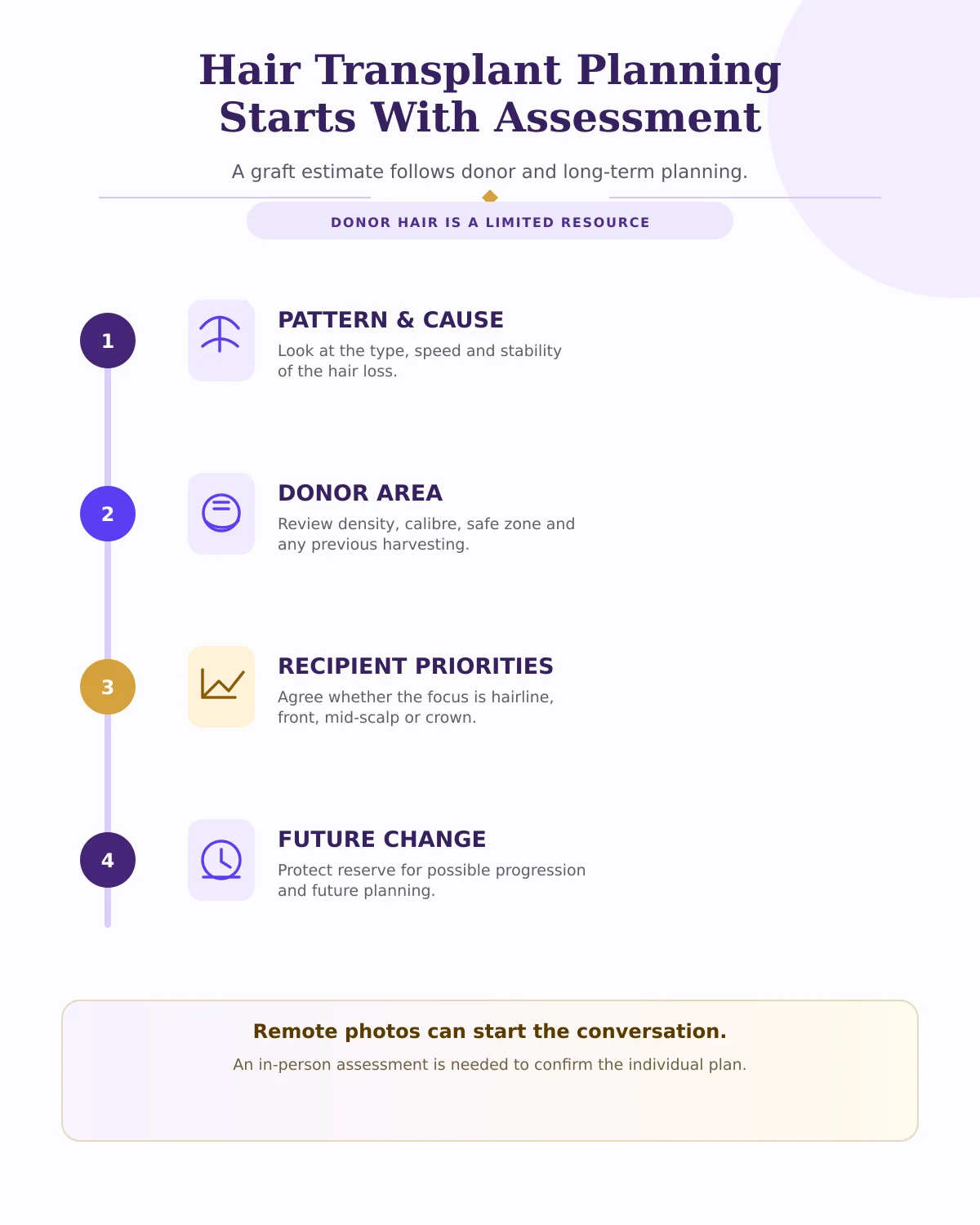
The donor area is a limited resource
The donor area is not an unlimited supply of hair. Its quality and long-term preservation are central to safe planning. Donor density, hair calibre, curl, colour contrast, scalp characteristics, previous harvesting and the boundaries of the likely safe donor area can all affect what is sensible to remove.
The ISHRS FUE clinical guidance explains that donor evaluation helps define limitations, possible contraindications, expected graft availability and potential coverage. It also highlights why a high requested graft count can be unsuitable when the donor area is narrow, hair loss may progress or removal could visibly thin the donor region. Read the donor-area guidance.
A responsible consultation should explain:
- Which area is being considered as the donor area.
- Whether the donor supply appears sufficient for the proposed goal.
- How the plan accounts for future hair loss.
- Whether previous transplants, scars or diffuse thinning affect the donor reserve.
- What the expected trade-off is between density in the recipient area and preservation of the donor area.
- Whether a second session may be discussed in the future rather than promised in advance.
Be cautious with claims that a clinic can provide ‘unlimited grafts,’ guarantee a specific density or complete every case in one session without a meaningful donor-area discussion.
Graft estimates: useful planning tool, not a promise
A graft estimate can help describe the scale of a proposed procedure, but it is not a guarantee of appearance, density or final growth. The number of follicles in each graft varies, and the same graft number can create different visual coverage depending on hair characteristics, the size of the recipient area, the desired hairline and the amount of existing hair being preserved.
A written estimate should clarify:
| Planning point | What to ask |
| Basis of the estimate | How was the proposed graft range assessed? |
| Coverage goal | Which areas are prioritised: hairline, frontal scalp, mid-scalp or crown? |
| Donor preservation | How will the donor area be protected from visible thinning? |
| Existing hair | Could placement affect surrounding native hair or require future planning? |
| Surgical limit | What could reduce or change the planned number on the day? |
| Future loss | How does the design allow for possible progression over time? |
A lower graft estimate is not automatically inadequate, and a higher number is not automatically better. The plan should reflect the individual donor supply, recipient area, hair characteristics and long-term strategy.
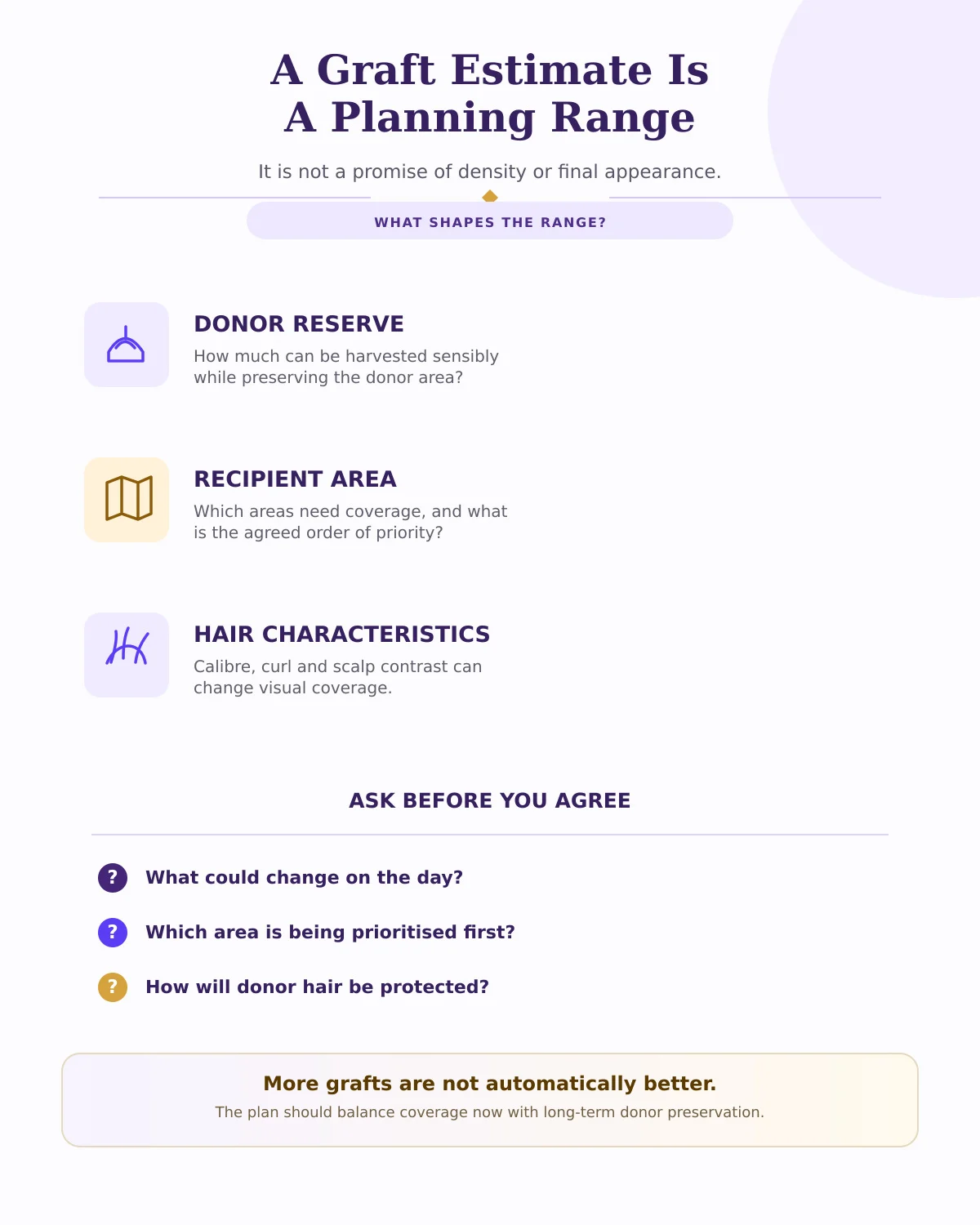
Hairline design: coverage, age and future change
The hairline is not only an aesthetic preference. It affects how donor hair is allocated and how the result may look if hair loss progresses later. A very low or dense hairline can use a large proportion of donor supply that may be needed for other areas in the future.
A plan should discuss:
- The proposed location and shape of the hairline.
- How the hairline relates to the patient’s facial proportions and current pattern of loss.
- How direction, angle and distribution of grafts will be planned.
- Whether the priority is frontal framing, broader coverage or another agreed goal.
- How future thinning could affect the appearance of the design.
- Whether the proposed hairline may be adjusted after an in-person examination.
Patients should not be asked to choose a ‘celebrity hairline’ as though it were a fixed template. A suitable design depends on the individual scalp, donor reserve, hair characteristics and long-term expectations.
FUE, DHI and Sapphire: technique labels are not the whole treatment plan
Technique names can be useful, but they should not replace diagnosis and planning. FUE generally describes a method of extracting follicular units. Other labels may describe a type of implantation instrument, blade material or a clinic’s marketing language.
No technique name proves that a particular plan is appropriate for every patient. The more useful questions are whether the donor area has been assessed, how recipient-site planning will be handled, who performs each stage and whether the proposed method fits the individual case.
For a clearer explanation of common technique labels, compare FUE, DHI and Sapphire FUE from a patient-focused perspective.
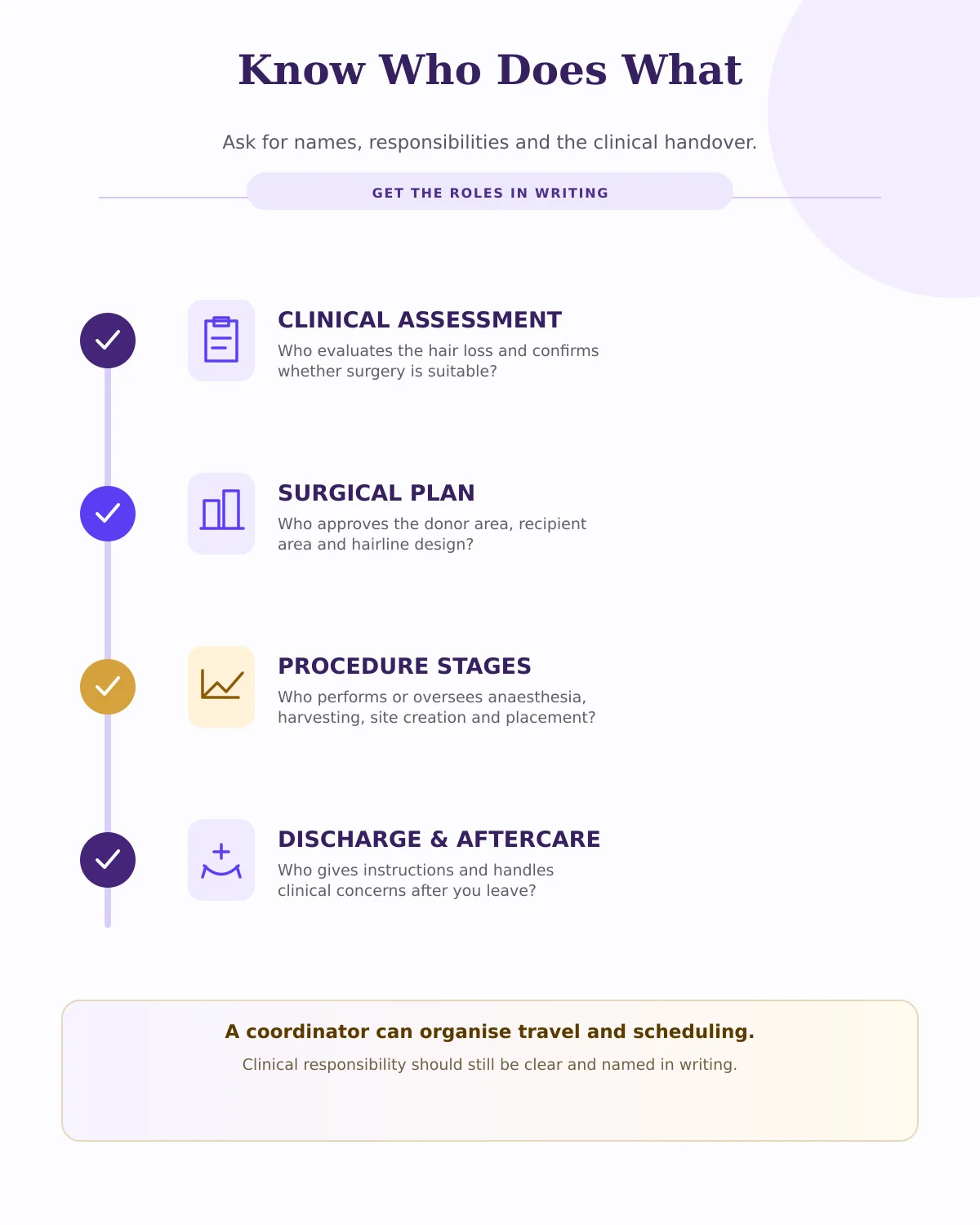
Who performs each stage? Ask for named roles
A clinic may involve more than one person, but the patient should not have to guess who is responsible for the clinical plan. Roles, professional scope and local requirements can vary, so the safest approach is to ask for a clear written explanation of who will assess the patient, who is responsible for the surgical plan and who will carry out or oversee each hands-on stage.
The ISHRS patient question guide specifically encourages patients to ask who will evaluate the hair loss, who will be involved in surgery, what each person’s role is and what education, training and licensure they hold.
| Clinical moment | Question to obtain in writing |
| Assessment | Who will evaluate my hair loss and confirm whether surgery is suitable? |
| Surgical plan | Who approves the donor, recipient-area and hairline design? |
| Anaesthesia | What anaesthesia is planned, who administers it and how is the patient monitored? |
| Donor harvesting | Who performs this stage and who is clinically responsible for it? |
| Recipient-site planning | Who creates or approves the placement plan and graft direction? |
| Graft placement | Who places the grafts, and what supervision applies? |
| Discharge and aftercare | Who gives instructions, answers clinical questions and handles concerns after I leave? |
A consultation coordinator can help with communication, travel or scheduling. However, coordination should not be confused with clinical diagnosis or surgical responsibility. The patient should know the name and role of the clinician responsible for the treatment decision.
For a broader framework, see Venoramed’s doctor and clinic safety checklist.
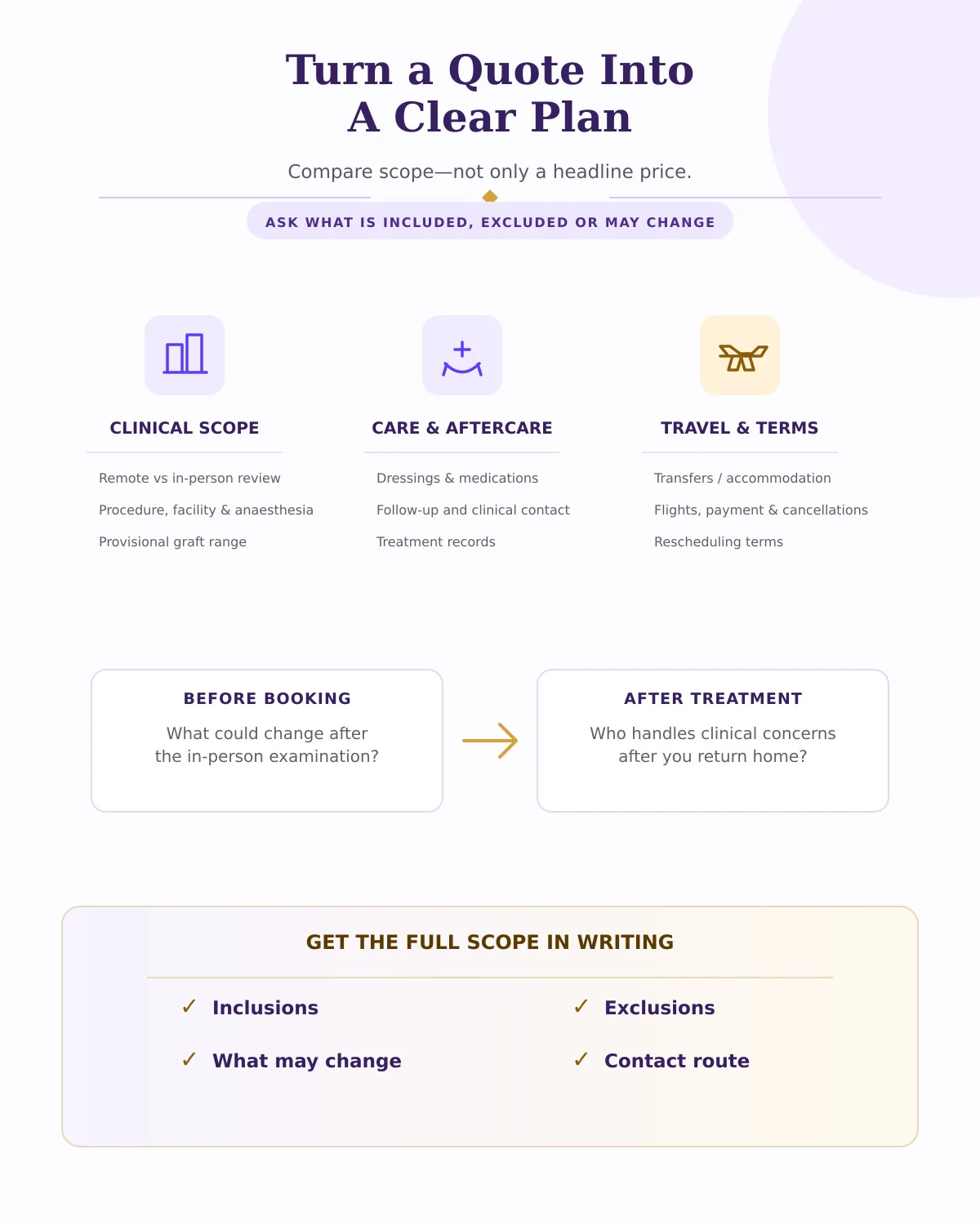
Hair transplant costs in Turkey: compare the scope, not only the headline price
There is no responsible universal price for a hair transplant in Turkey. Cost can change according to the clinical plan, donor assessment, intended coverage, team structure, facility, anaesthesia approach, graft handling, aftercare and non-medical travel arrangements.
Instead of comparing only a headline figure, request an itemised written quotation that states what is included, excluded or subject to change after examination.
A useful quotation should clarify:
- Whether the quote is based on a remote review or an in-person assessment.
- The proposed treatment scope and whether a graft estimate is provisional.
- Consultation, clinical evaluation and procedure fees.
- Facility, anaesthesia and monitoring arrangements.
- Medication, dressings or aftercare products, if included.
- Follow-up appointments and how remote questions are handled.
- Transfers, accommodation or interpreter support, if offered.
- Whether flights are excluded.
- What happens if the in-person assessment changes the plan.
- Payment, cancellation, refund and rescheduling terms.
- Whether further sessions, revision work or unrelated medical care are excluded.
The aim is not to find one ‘correct’ package. It is to understand what is being proposed and whether two quotations describe the same level of clinical care and support. Venoramed’s guide to comparing medical treatment costs and packages can help patients structure that comparison.
Facility, anaesthesia and process questions
Because hair transplantation is surgery, patients should know where the procedure will take place and what process is planned for their safety and comfort. Ask the provider to explain the facility, the anaesthesia plan, relevant pre-procedure checks, patient monitoring, infection-control practices, emergency escalation arrangements and post-procedure contact route.
It is also sensible to disclose relevant allergies, medication use and health history directly to the treating clinical team. Do not rely only on a booking form or marketing representative to interpret medical information.
International patients can also check the current public lists of healthcare providers with international health-tourism authorisation published by the Turkish Ministry of Health. The official directory is available here. A directory entry or certificate should be treated as one verification step – not a substitute for asking about the named team, proposed treatment and aftercare arrangements.
Aftercare, travel and realistic outcomes
Aftercare is part of the treatment, not an optional extra. Instructions for washing, sleeping, activity, medication, follow-up and travel should come from the treating clinical team because they depend on the person’s procedure and medical circumstances.
Before travel, ask for:
- Written post-procedure instructions.
- A contact route for clinical questions after discharge.
- Clear guidance on when to seek urgent medical attention.
- The expected local review or wash appointments, if any.
- Advice about flights, work and activity from the treating clinician.
- A copy of relevant clinical records before leaving Turkey.
- A plan for follow-up after returning home.
Hair transplantation does not stop ongoing hair loss in untreated areas, and the appearance of the scalp can change over time. A responsible provider should discuss uncertainty, the possible need for future planning and the difference between early healing and a settled cosmetic result.
For travel planning around individual recovery, see Venoramed’s guide to how long to stay in Turkey after surgery.
Patient checklist before booking
- Have I received a clear explanation of the suspected cause of my hair loss?
- Is the treatment plan provisional until an in-person examination?
- Has the donor area been assessed for density, stability and future reserve?
- Do I understand that a graft number is an estimate, not a guarantee?
- Which recipient areas are being prioritised, and why?
- How was the proposed hairline planned?
- Who is the named clinician responsible for diagnosis and the surgical plan?
- Who performs each stage of the procedure?
- What anaesthesia and monitoring arrangements are planned?
- Where will the procedure take place?
- What exactly is included and excluded from the quotation?
- What could change after an in-person assessment?
- What records and aftercare instructions will I receive?
- Who handles clinical concerns after I return home?
- What is the plan if future hair loss changes my needs?
Frequently Asked Questions
Does a higher graft number always mean a better result?
No. A graft estimate must be weighed against donor supply, hair characteristics, recipient-area size, coverage priorities and possible future hair loss. Excess harvesting can visibly thin the donor area.
Is a hair transplant suitable for every type of hair loss?
No. Different causes of hair loss need different assessment and management. A qualified clinician should identify the likely cause and explain whether surgical transplantation is appropriate.
Is FUE the same as DHI or Sapphire FUE?
These labels can refer to different parts of the process or to marketing terminology. They do not replace diagnosis, donor planning, team transparency or realistic expectations.
Who should I expect to perform my hair transplant?
The patient should receive a written breakdown of who evaluates the hair loss, approves the plan, performs each stage and provides aftercare. Those roles should never be unclear.
Can I choose my graft number and hairline myself?
Your goals should be part of the discussion, but a clinically appropriate graft range and hairline design depend on the donor area, pattern of loss, hair characteristics and long-term planning.
Can a clinic guarantee the final result?
No responsible provider can guarantee an individual clinical or cosmetic outcome. Healing, donor characteristics, future hair loss and other individual factors can affect the result.
Explore hair-transplant options with Venoramed
Explore the Hair Transplant treatment hub or hair-transplant doctor profiles before requesting consultation or coordination support.
Venoramed is a medical marketplace and coordination platform, not a direct treatment provider. It does not diagnose hair loss, choose a technique or graft number, or guarantee outcomes. Individual clinical assessment is essential before treatment or travel.


Leave a Comment
Share your question or experience. Venoramed reviews comments before publishing.