

Choosing a doctor and clinic in Turkey should involve more than comparing prices, looking at before-and-after photographs or reading social-media comments.
The doctor’s identity, recognised specialty, relevant experience, treatment location, medical assessment process and aftercare arrangements should all be examined separately. A clinic’s website may look professional, but appearance alone does not demonstrate that the proposed treatment is appropriate for a particular patient.
If you’re still researching whether travelling abroad for treatment is the right choice, read our Medical Tourism in Turkey: A Practical Guide for International Patients before using this safety checklist.
This guide explains how to choose a clinic in Turkey using a structured four-layer assessment:
- Verify the doctor.
- Verify the healthcare facility.
- Evaluate the proposed treatment process.
- Confirm aftercare and accountability.
No checklist can guarantee a successful outcome or eliminate every risk. The purpose of these checks is to help international patients distinguish verifiable information from marketing claims and make a more informed decision before booking treatment.
Venoramed is a medical marketplace where users can explore treatment categories and compare available information on specialist doctor profiles in Turkey. It is not a clinic or hospital, and it does not diagnose conditions, prescribe treatment or guarantee clinical outcomes. Medical decisions must be made directly with an appropriately qualified healthcare professional after an individual assessment.
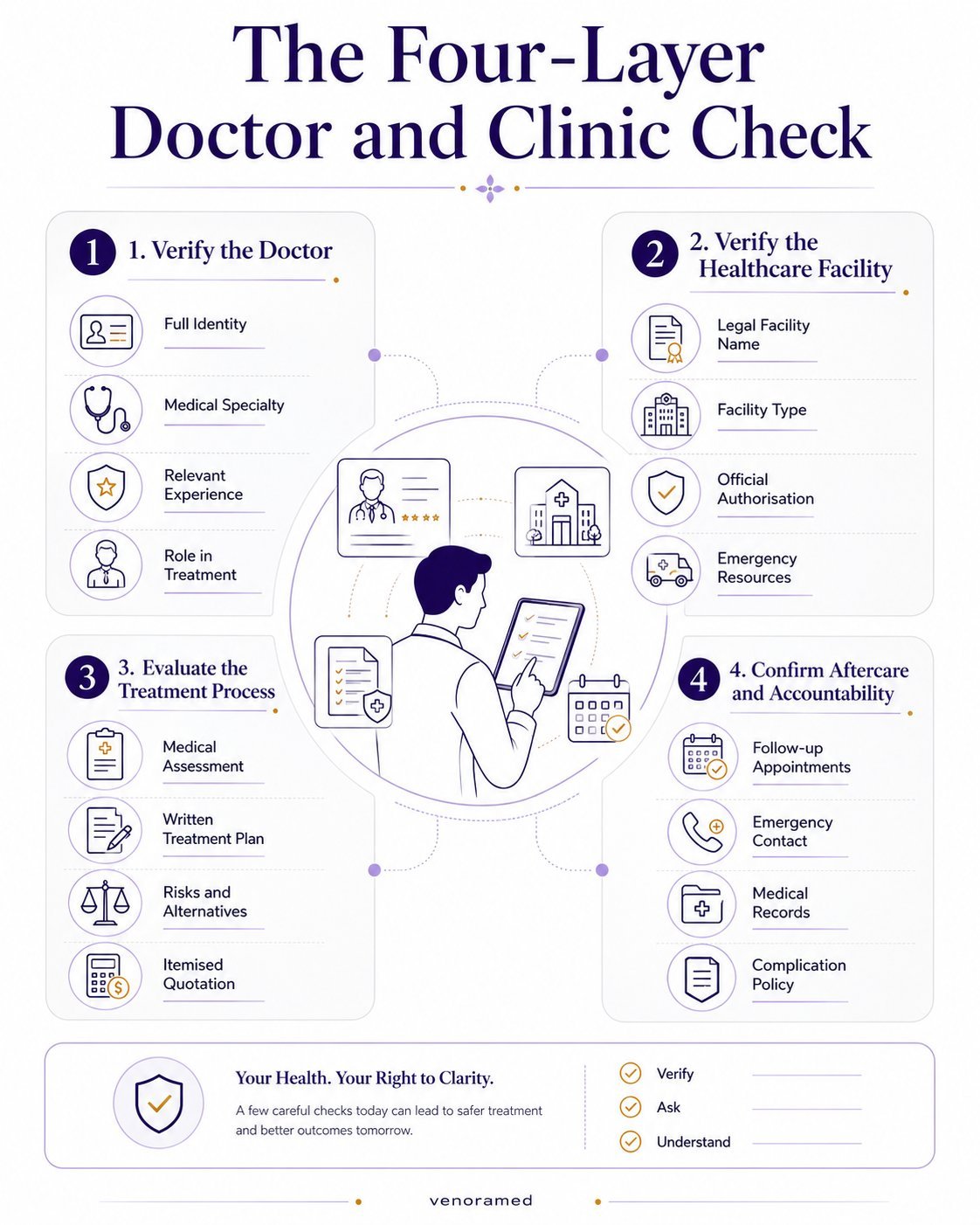
The Four-Layer Doctor and Clinic Check
Before making a payment, patients should examine four separate areas.
Layer 1: The Doctor
Confirm:
- The doctor’s full name
- Exact medical or dental specialty
- Relevant specialist training
- Experience with the proposed procedure
- Personal role in the treatment
- Responsibility for follow-up care
Layer 2: The Healthcare Facility
Confirm:
- The facility’s legal name
- Full address
- Type of healthcare facility
- International health-tourism authorisation where applicable
- Location where treatment will actually take place
- Available clinical and emergency resources
Layer 3: The Treatment Process
Confirm:
- What medical information will be reviewed
- Whether an in-person examination is required
- The proposed treatment and alternatives
- Risks and limitations
- Anaesthesia arrangements
- Written treatment plan
- Itemised quotation
- Informed-consent process
Layer 4: Aftercare and Accountability
Confirm:
- Follow-up appointments
- Emergency contact arrangements
- Management of complications
- Access to medical records
- Care after returning home
- Revision policy where relevant
- Financial responsibility for additional treatment
A provider should not be selected solely because one of these areas appears strong. A well-qualified doctor, for example, may still operate at a facility that has not been clearly identified. An authorised facility may still offer a treatment that is unsuitable for a specific patient.
Start by Identifying Who Is Actually Providing the Treatment
Medical tourism websites often use the words doctor, clinic, hospital, medical centre, facilitator and healthcare platform interchangeably. These organisations do not have the same responsibilities.
Before deciding how to choose a clinic in Turkey, patients should first understand who is involved.
| Party | Primary role | What the patient should confirm |
|---|---|---|
| Doctor | Medical assessment and treatment | Identity, specialty, qualifications and personal role |
| Clinic or private practice | Consultation or treatment location | Authorisation, facilities and scope of services |
| Medical centre | Outpatient healthcare services | Available departments, equipment and emergency procedures |
| Hospital | Surgical, inpatient and specialist care | Operating facilities, anaesthesia, admission and emergency support |
| Health-tourism facilitator | Communication and coordination | Official authorisation and scope of service |
| Medical marketplace | Doctor discovery and profile comparison | Accuracy and limitations of listed information |
| Travel agency | Flights, accommodation and transfers | Travel services only, not clinical decision-making |
Patients should ask:
- Who is giving the medical recommendation?
- Who will personally perform the treatment?
- Who will administer anaesthesia?
- Where will the procedure take place?
- Who will provide follow-up care?
- Who should be contacted if a complication develops?
A salesperson, coordinator or travel representative may explain administrative services, but they should not replace a direct medical discussion with the treating professional.
The NHS advises patients considering surgery abroad to consult the surgeon rather than dealing only with sales staff and to confirm the surgeon’s training, experience, professional memberships and ability to communicate clearly.
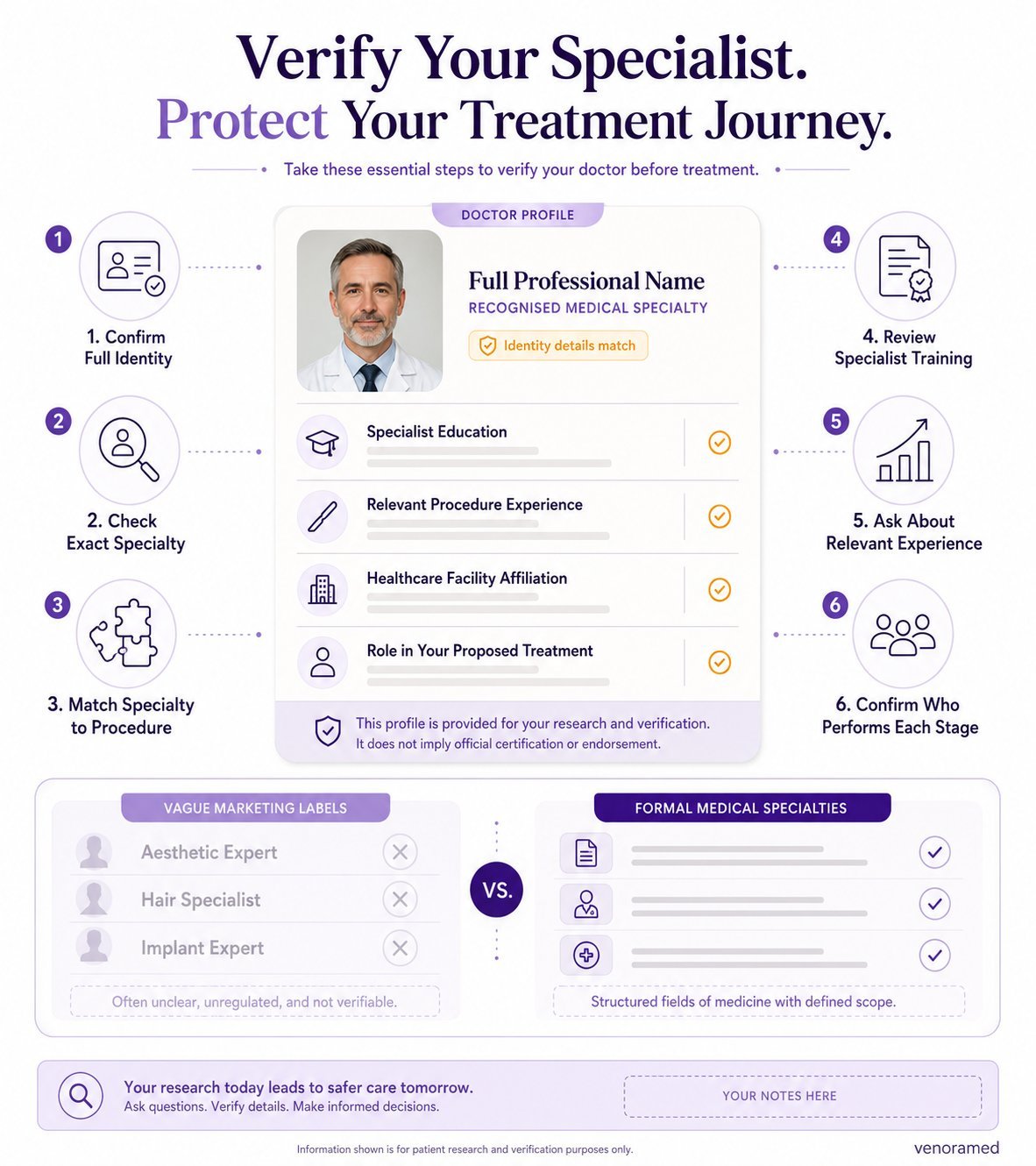
Step 1: Verify the Doctor’s Identity
The first step when trying to verify a doctor in Turkey is confirming the professional’s full identity.
Ask for:
- Full professional name
- Medical or dental title
- Exact specialty
- Current clinic or hospital affiliation
- Name of the facility where treatment will occur
- Professional registration details where available
The same name should appear consistently across:
- The doctor profile
- Medical correspondence
- Treatment plan
- Quotation
- Consent documents
- Facility records
- Discharge documents
Be cautious when a brand or clinic name is prominent but the treating doctor is not identified until after payment.
Confirm Who Will Personally Perform the Procedure
The doctor shown in an advertisement may not necessarily perform every stage of the treatment.
Ask directly:
- Will this doctor perform the whole procedure?
- Will another doctor or technician perform part of it?
- Who will make the final treatment decision?
- Who will be present during the procedure?
- Who will manage post-treatment concerns?
- What happens if the named doctor becomes unavailable?
This is especially important for procedures involving several professionals, such as:
- Hair transplantation
- Dental implant treatment
- Bariatric surgery
- Major plastic surgery
- Cancer surgery
- Procedures requiring general anaesthesia
Administrative staff should not provide vague assurances such as “our team will handle everything” without identifying the professionals responsible for the clinical stages.
Step 2: Confirm the Doctor’s Exact Specialty
A professional title should be specific enough for the patient to understand the doctor’s field of recognised practice.
Descriptions such as these may be too vague on their own:
- Aesthetic doctor
- Cosmetic specialist
- Implant expert
- Hair specialist
- Weight-loss doctor
- Facial expert
The patient should ask for the formal specialty and determine whether it is relevant to the proposed treatment.
Match the Specialty to the Procedure
Different treatments may require different forms of training.
For example:
- A patient considering rhinoplasty should understand whether the case involves cosmetic shape, nasal breathing, reconstruction or revision surgery.
- A patient considering bariatric surgery should identify the surgeon and understand how nutritional, medical and anaesthetic assessment will be managed.
- A patient considering dental implants should confirm who will plan the implant placement, perform the surgery and complete the restorative stage.
- A patient seeking cancer surgery should look for a specialty aligned with the cancer type and affected organ.
- A patient considering body-contouring surgery should confirm the doctor’s relevant surgical training and the facility where the procedure will take place.
A doctor may be highly qualified in one field without being the appropriate professional for every procedure advertised by a clinic.
Ask Procedure-Specific Questions
Instead of asking only, “How many years of experience do you have?”, ask:
- How often do you perform this specific procedure?
- Do you regularly assess patients with circumstances similar to mine?
- What factors might make me unsuitable?
- What alternatives should I consider?
- What complications do you discuss with patients?
- Where do you perform this procedure?
- Who manages complications if they occur?
Twenty years in medicine does not necessarily mean twenty years performing one specific operation.
Step 3: Evaluate Qualifications and Professional Background
A doctor profile may include several types of professional information. Each can be useful, but each must be interpreted correctly.
Medical or Dental Degree
This shows where the professional completed their initial medical or dental education. It does not, by itself, demonstrate specialist training in the proposed procedure.
Specialist Training
Specialist education is more relevant when evaluating whether the doctor’s recognised field matches the patient’s treatment needs.
Fellowship or Additional Training
A fellowship may indicate focused training, but the patient should understand:
- Where it was completed
- How long it lasted
- What it covered
- Whether it involved supervised clinical practice
Academic Title
Academic titles may reflect teaching or research responsibilities. They do not automatically show how frequently a particular procedure is performed.
Professional Membership
Membership may show involvement in a professional organisation, but it should not automatically be interpreted as specialist certification or official approval.
Patients can ask:
- Is this a current membership?
- Is membership based on an examination or application?
- Does the organisation regulate clinical practice?
- Can the membership be independently confirmed?
Certificates
A short course certificate is not equivalent to a recognised medical specialty.
Ask:
- Who issued the certificate?
- What training was required?
- Was there supervised clinical work?
- Does the certificate relate directly to the proposed treatment?
Publications and Conferences
Research, publications and conference activity may provide useful background. They should be considered supporting information rather than proof that a doctor is the right choice for an individual patient.
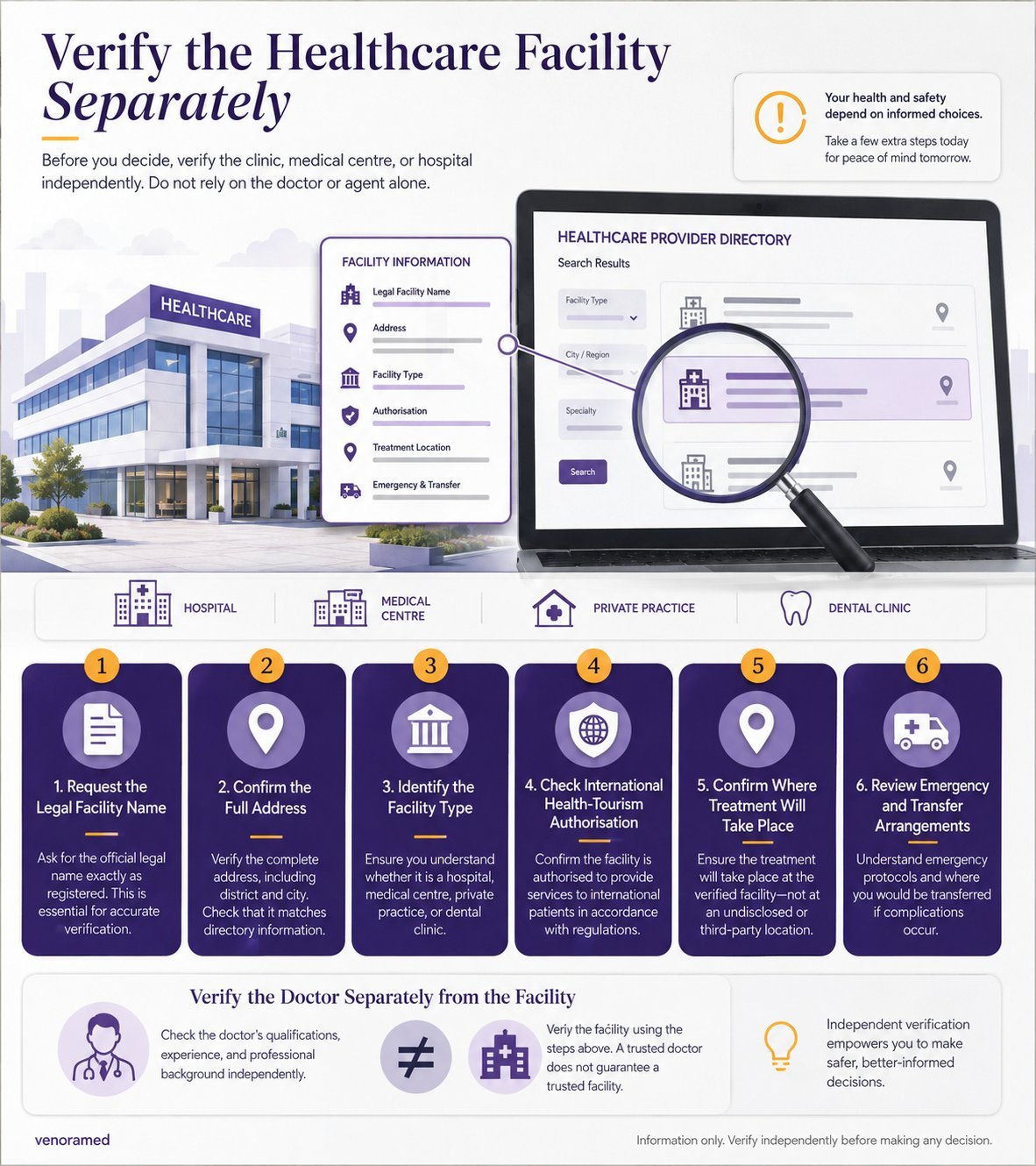
Step 4: Verify the Clinic or Hospital Separately
The doctor and healthcare facility should be checked independently.
A doctor may consult at one clinic but perform surgery at another hospital. A clinic may advertise a treatment that is actually provided elsewhere.
Before paying, request:
- Full legal name of the healthcare facility
- Complete address
- Facility type
- Name of the department where treatment will occur
- Written confirmation that the doctor works or operates there
- Details of admission, discharge and emergency arrangements
Do not rely solely on:
- A shortened brand name
- A social-media location
- A hotel consultation room
- A coordinator’s office
- A generic photograph of a hospital
- The phrase “partner hospital” without a name
Identify the Facility Type
The word clinic may refer to very different settings.
The provider should clearly state whether the location is:
- A hospital
- A medical centre
- A private medical practice
- A dental clinic
- An outpatient treatment facility
- Another authorised healthcare provider
The resources required for a consultation or minor dental procedure are not the same as those required for major surgery under general anaesthesia.
Step 5: Check International Health-Tourism Authorisation
Turkey regulates international health tourism through a formal framework. The current Regulation on International Health Tourism and Tourist Health was published on 9 May 2025.
The Turkish Ministry of Health publishes separate lists of authorised:
- Hospitals
- Medical centres
- Private medical practices
- Other healthcare providers
The Ministry’s Health Tourism Department provides these categories through its official authorised-provider directory.
To check a clinic in Turkey:
- Obtain the facility’s full legal name.
- Identify the type of facility.
- Open the relevant official Ministry list.
- Search for the legal name rather than only the marketing brand.
- Confirm that the address and facility details correspond.
- Ask the provider to explain any difference between the advertised name and the legal entity.
If the facility cannot be found, do not assume that it is unauthorised without further investigation. The name may be written differently, the treatment may take place at another facility or the list may have changed. Ask for clarification and confirm the information through an official source.
Authorisation Is Not a Treatment Guarantee
Authorisation indicates that the facility is operating within the relevant regulatory framework. It does not prove that:
- A particular doctor is the right specialist for the patient
- A proposed procedure is medically appropriate
- The patient will have no complications
- The treatment result will match an advertisement
- Every service advertised online is provided at that location
Authorisation should be one part of the evaluation—not the entire evaluation.
Authorisation and Accreditation Are Not the Same
Patients may see terms such as:
- Licensed
- Authorised
- Accredited
- Certified
- Verified
- Approved
- Award-winning
These words should not be treated as interchangeable.
Authorisation generally relates to permission to operate within a specific legal or regulatory framework.
Accreditation is usually an assessment conducted against the standards of a particular accrediting body.
Certification may refer to a person, process, course, service or management system.
The patient should ask:
- Which organisation issued the status?
- What exactly was assessed?
- Is the status current?
- Can it be independently confirmed?
- Does it apply to the facility, doctor or only one department?
- Is the logo being used with permission?
The CDC recommends examining the qualifications of the healthcare professional and the accreditation of the facility while also arranging access to licensing and outcome information where possible. These checks support decision-making but cannot guarantee an individual outcome.
Step 6: Assess the Facility’s Clinical Capabilities
A patient should evaluate whether the facility has resources appropriate for the proposed treatment.
The questions will vary according to the procedure.
For Procedures Requiring Anaesthesia
Ask:
- What type of anaesthesia is planned?
- Who will administer it?
- Will an anaesthetist assess me before treatment?
- Where will I recover after anaesthesia?
- Will I be monitored overnight if medically necessary?
- What emergency equipment is available?
For Major Surgery
Ask:
- Does the facility have an operating theatre appropriate for the procedure?
- Is inpatient admission available?
- Are blood tests and imaging available?
- Is intensive or higher-level care available if required?
- If not, which hospital will receive the patient?
- How would an emergency transfer be arranged?
- Who is responsible outside normal working hours?
For Dental Treatment
Ask:
- Is appropriate dental imaging available?
- Who plans implant placement?
- Which implant or restorative materials are proposed?
- Will treatment require more than one trip?
- Who manages temporary restorations and complications?
- How will adjustments be handled after returning home?
For Hair Transplantation
Ask:
- Which stages are performed by the doctor?
- Which stages are performed by technicians?
- Who designs the hairline?
- Who administers local anaesthesia?
- How many patients are treated by the team on the same day?
- Who is available if there is bleeding, infection or an adverse reaction?
For Bariatric Surgery
Ask:
- What pre-operative medical and anaesthetic assessment is required?
- How is nutritional suitability evaluated?
- What hospital stay is planned?
- Who provides dietetic follow-up?
- How are dehydration, bleeding or other complications managed?
- What long-term monitoring is required?
A provider should be able to explain why the chosen facility is appropriate for that specific treatment.
Step 7: Review the Medical Assessment Process
A responsible provider should collect relevant health information before making a final treatment recommendation.
Depending on the procedure, this may include:
- Medical history
- Current medication
- Allergies
- Previous operations
- Previous anaesthetic complications
- Smoking and alcohol use
- Chronic health conditions
- Pregnancy status
- Laboratory tests
- Imaging
- Dental scans
- Pathology reports
- Photographs
- Body mass index
- In-person examination
A recommendation based only on a few photographs may be preliminary.
Patients should ask:
- Has a doctor reviewed my information?
- Which information is still missing?
- Is this a preliminary opinion or a final plan?
- What may change after examination?
- Could the doctor decide not to proceed?
- Will additional tests change the quotation?
A trustworthy assessment should allow for uncertainty. The doctor may need to alter, postpone or cancel the treatment if examination or testing shows that the original plan is unsuitable.
Be Cautious When Every Patient Is Accepted
Warning signs include:
- Immediate approval without medical questions
- Identical treatment offered to every patient
- No discussion of health conditions
- No review of medication
- No anaesthetic assessment for major surgery
- Refusal to change a plan after examination
- Pressure to proceed despite new medical concerns
A patient should not feel that the treatment has already become inevitable because travel or accommodation has been booked.
Step 8: Request a Written Treatment Plan
A verbal recommendation or messaging-app conversation is not enough for a major medical decision.
The written plan should identify:
- The patient’s main concern or diagnosis
- Proposed treatment
- Treating doctor
- Treatment facility
- Important stages of care
- Type of anaesthesia
- Expected admission or hospital stay
- Required investigations
- Alternatives
- Important risks
- Limitations
- Expected recovery
- Recommended stay in Turkey
- Follow-up schedule
- Circumstances that could change the plan
A treatment plan should not promise a guaranteed result.
Ask About Alternatives
Patients should be told whether there are reasonable alternatives, such as:
- No treatment
- Delaying treatment
- Non-surgical treatment
- A less extensive procedure
- Treatment in the patient’s home country
- A different medical technique
- Further investigation before deciding
If the provider discusses only one option and frames it as urgent without a clear medical reason, seek further clarification or an independent opinion.
Step 9: Compare the Full Quotation
Knowing how to choose a clinic in Turkey also requires understanding what the quoted price actually covers.
A low headline price may exclude important medical or practical costs.
Request an itemised quotation containing:
| Item | Questions to ask |
|---|---|
| Doctor’s fee | Does it cover consultation and treatment? |
| Facility fee | Which clinic or hospital services are included? |
| Anaesthesia | Are the anaesthetist, medication and recovery area covered? |
| Tests | Which laboratory tests or scans are included? |
| Medical materials | Are implants, crowns, devices or garments included? |
| Medication | Are discharge medicines included? |
| Hospital stay | How many nights are covered? |
| Follow-up | How many appointments are included? |
| Accommodation | Which hotel and room type are provided? |
| Transfers | Which journeys are included? |
| Interpreter | Is medical interpretation included? |
| Companion costs | Are any companion services covered? |
| Additional care | What could create extra charges? |
| Complications | Who pays for further treatment? |
| Cancellation | Which payments are refundable? |
The NHS treatment-abroad checklist advises patients to consider possible extended stays, return journeys, exchange-rate changes and the costs of complications rather than comparing the initial treatment price alone.
Questions About Payment
Before transferring money, ask:
- Who will receive the payment?
- Is the recipient the clinic, hospital, doctor, facilitator or another company?
- Will an invoice or receipt be issued?
- What is the refund policy?
- What happens if the doctor changes?
- What happens if the treatment is cancelled after examination?
- Are deposits transferable?
- Which currency will be used?
- Are card or bank charges included?
The name receiving payment should make sense in relation to the service being purchased.
Step 10: Evaluate Communication and Informed Consent
The patient should be able to understand the proposed treatment without relying on guesses or automatic translation.
Confirm:
- Which languages the doctor speaks
- Whether an interpreter will attend consultations
- Whether the interpreter has experience with medical communication
- Whether consent documents are available in a language the patient understands
- Whether questions can be asked directly
- Whether the patient receives enough time to decide
- Whether risks and alternatives are explained before treatment
Communication should not be limited to sales conversations.
The patient should be able to discuss:
- Personal medical history
- Expectations
- Treatment limitations
- Possible complications
- Pain and recovery
- Aftercare
- Reasons not to proceed
NHS guidance recommends confirming that the surgeon speaks a language the patient understands so the practitioner can explain the procedure and respond to concerns.
Consent Should Occur Before the Procedure
Consent should not be treated as paperwork that the patient signs immediately before anaesthesia without discussion.
Before consenting, the patient should understand:
- What will be done
- Who will do it
- Why it is recommended
- Reasonable alternatives
- Important risks
- Expected recovery
- Possible need for further treatment
- What happens if the result differs from expectations
The patient should also be free to decline treatment after the in-person assessment.
Step 11: Examine Before-and-After Photographs Carefully
Before-and-after images may help patients understand examples of a provider’s work, but they have limitations.
Ask:
- Did the same doctor perform these procedures?
- Were the photographs taken by the clinic?
- Are lighting, angle and facial expression consistent?
- How long after treatment was the “after” image taken?
- Was the image edited?
- Is the case medically similar to mine?
- Was more than one procedure performed?
- Is the patient’s consent for publication documented?
Images selected by a provider usually show chosen examples. They do not show every patient, every complication or every long-term result.
A photograph cannot establish:
- Medical suitability
- Safety
- Final cost
- Healing quality
- Long-term outcome
- Likelihood of revision
- The result another patient will receive
Step 12: Use Reviews as Supporting Information
Reviews can provide clues about communication, organisation and the patient experience. They should not be treated as a clinical evaluation.
Consider:
- Whether reviews appear across more than one platform
- Whether the language is repetitive
- Whether reviews include useful, specific details
- Whether negative reviews receive professional responses
- Whether reviewers describe follow-up care
- Whether the review relates to the same doctor and procedure
- Whether reviews appear to have been incentivised
Be cautious when:
- Every review gives the highest possible rating.
- Reviews are vague and nearly identical.
- Only screenshots are shown.
- The clinic will not identify the original platform.
- A large number of reviews appeared within a short period.
- Negative comments are answered with threats or disclosure of patient information.
Reviews are weaker evidence than a confirmed doctor identity, recognised specialty, named treatment facility and written treatment plan.
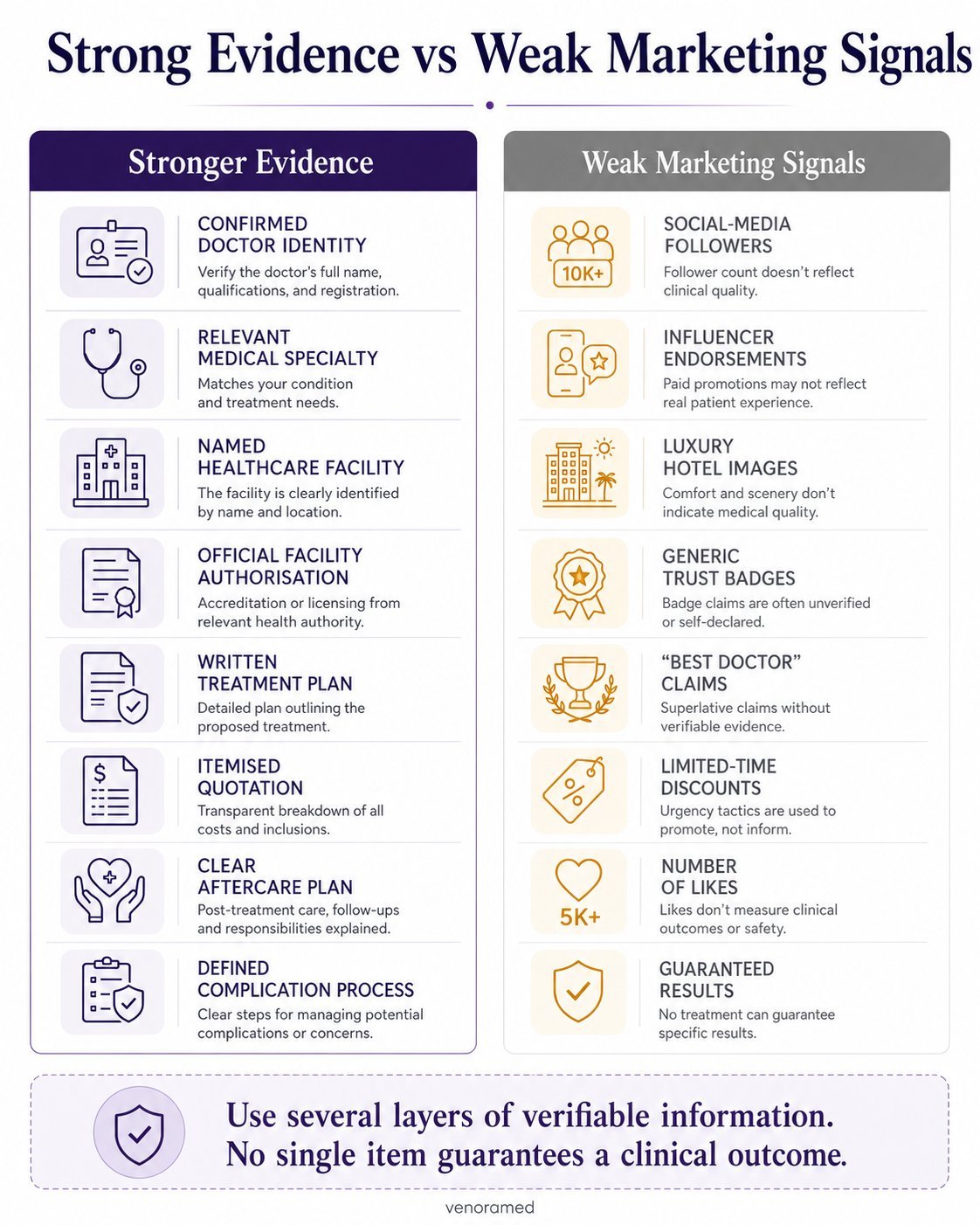
Stronger Evidence and Weaker Marketing Signals
| Stronger evidence | Useful supporting information | Weaker marketing signals |
|---|---|---|
| Confirmed doctor identity | Professional membership | Social-media follower count |
| Relevant recognised specialty | Conference participation | Influencer endorsement |
| Named treatment facility | Before-and-after photographs | Luxury hotel imagery |
| Official facility authorisation | Independent accreditation | Generic “approved” badge |
| Written treatment plan | Published research | “Best doctor” claim |
| Itemised quotation | Patient reviews | Limited-time discount |
| Clear aftercare plan | Online consultation | Number of likes |
| Named complication process | Clinic awards with traceable source | Guaranteed outcome |
| Direct medical consultation | Website design quality | Celebrity photographs |
No single item guarantees quality. The goal is to build several layers of consistent, verifiable information.
Step 13: Confirm Aftercare Before Booking
Aftercare is part of treatment, not an optional extra.
The NHS warns that overseas providers may not offer follow-up care after a patient returns home and advises patients to clarify where follow-up appointments will take place, what happens if complications develop and how additional surgery would be arranged.
Before booking, confirm:
- Number of follow-up visits
- Timing of each visit
- Whether the treating doctor will attend
- Who answers questions outside working hours
- Emergency contact method
- Who removes stitches or dressings
- How wounds or treatment sites will be reviewed
- Whether remote follow-up is available
- What records will be provided
- Whether local follow-up must be arranged
- Who manages medication questions
- What happens if the patient cannot travel back
- What is included in any revision policy
Ask What Happens if There Is a Complication
The provider should explain:
- Which symptoms require urgent attention
- Where the patient should go in Turkey
- Who will assess the problem
- Whether hospital admission may be required
- Who pays for additional care
- Whether insurance may cover the cost
- What support is available after returning home
The CDC advises medical travellers to arrange follow-up care before departure and to know where they will stay immediately after the procedure.
A patient with urgent symptoms should seek appropriate local emergency care rather than waiting for a response through social media or a messaging app.
Red Flags When Choosing a Doctor or Clinic in Turkey
Pause and investigate further when:
- The treating doctor is unnamed.
- The doctor cannot be contacted before payment.
- The exact healthcare facility is not disclosed.
- Treatment is recommended by sales staff.
- No medical history is requested.
- Every patient is described as suitable.
- Results are guaranteed.
- Risks are dismissed.
- The provider pressures the patient to pay immediately.
- The price is available only as a verbal promise.
- No itemised quotation is provided.
- The planned procedure changes without medical explanation.
- Several major procedures are added as a package without sufficient assessment.
- The consent documents are not understandable.
- The facility name on the invoice differs without explanation.
- The named doctor may be changed without the patient’s agreement.
- The patient is told that aftercare will not be necessary.
- Complications are described as impossible.
- The provider refuses to issue medical records.
- The cancellation and refund terms are unclear.
One warning sign does not always prove wrongdoing, but several unresolved warning signs should not be ignored.
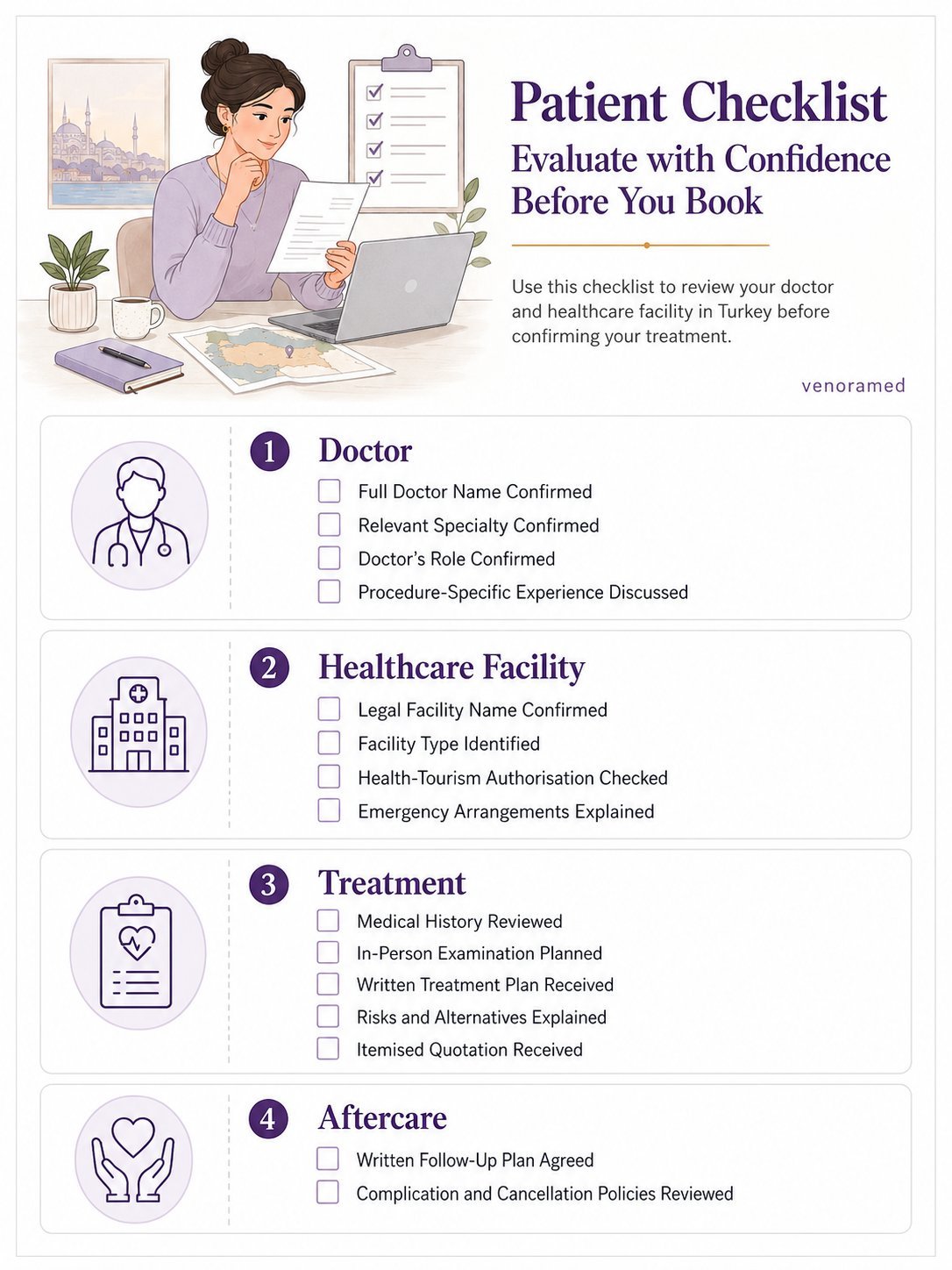
A 15-Point Doctor and Clinic Safety Checklist
Use this checklist before making a final booking.
Doctor
- The doctor’s full name is confirmed.
- The exact specialty is relevant to the treatment.
- The doctor’s personal role is clear.
- Procedure-specific experience has been discussed.
Facility
- The facility’s legal name and address are confirmed.
- The facility type is understood.
- Relevant health-tourism authorisation has been checked.
- Anaesthesia and emergency arrangements are clear.
Treatment
- My medical history has been reviewed.
- An in-person examination is included where necessary.
- I have received a written treatment plan.
- Risks, limitations and alternatives have been explained.
- I have received an itemised quotation.
Aftercare
- A written follow-up plan has been agreed.
- Complication, cancellation and additional-cost policies are clear.
A patient should be able to complete this checklist using written information rather than assumptions.
This checklist focuses on evaluating individual providers. For a broader overview of how medical tourism works, costs, travel planning and patient preparation, see our complete guide to medical tourism in Turkey.
How Venoramed Supports Initial Research
Venoramed allows international users to browse treatment categories and compare available doctor-profile information, including details such as specialty, city, language, experience, education, treatment focus and indicative starting prices.
Patients can use the platform to:
- Select a relevant treatment category.
- Identify doctors whose stated specialty appears relevant.
- Compare available profile information.
- Prepare questions for the doctor.
- Request further information or a consultation.
- Confirm the treatment facility.
- Discuss medical suitability directly with the relevant professional.
A Venoramed profile is a starting point for research. It should not replace:
- Direct medical consultation
- Independent checks
- Facility-authorisation verification
- In-person examination
- Written treatment planning
- Informed consent
- Personal medical advice
Venoramed is not a clinic or hospital and does not guarantee that a doctor, facility or treatment is suitable for an individual patient.
Frequently Asked Questions
How can I verify a doctor in Turkey?
Ask for the doctor’s full name, formal specialty, current healthcare affiliation and role in the proposed treatment. Confirm that the specialty relates to the procedure and request direct medical communication before booking.
How do I check whether a clinic in Turkey is authorised?
Obtain the clinic or hospital’s full legal name and identify the facility type. Search the appropriate official list published by the Turkish Ministry of Health. The Ministry provides separate lists for hospitals, medical centres, private practices and other authorised providers.
Is a private clinic the same as a hospital?
No. A private practice, outpatient clinic, medical centre and hospital may have different permissions, equipment, staffing and emergency capabilities. Ask exactly where the procedure will take place and what resources are available there.
Does accreditation guarantee a safe outcome?
No. Accreditation may provide useful information about a facility’s assessment against particular standards, but it cannot guarantee that treatment will be complication-free or suitable for an individual patient.
Are online reviews reliable?
Reviews can provide supporting information about communication and organisation, but they do not replace verification of specialty, facility, treatment plan and aftercare. Reviews may also be selected, incentivised or difficult to authenticate.
Should I speak directly with the doctor before booking?
For significant or invasive treatment, direct communication with the treating doctor is important. Administrative staff can discuss logistics, but medical recommendations, risks and suitability should be discussed with a qualified healthcare professional.
What documents should I request before paying?
Request the doctor’s name, facility details, preliminary medical assessment, written treatment plan, itemised quotation, cancellation terms, complication policy and planned aftercare arrangements.
Can a clinic provide a final treatment plan from photographs?
Photographs may support a preliminary opinion, but many treatments require examination, imaging, laboratory tests or other investigations. Ask what may change after the in-person assessment.
What happens if the named doctor changes?
The policy should be clarified before payment. Patients should know whether they can refuse a substitute doctor and whether the deposit is refundable if the named professional becomes unavailable.
What should an aftercare plan include?
It should identify follow-up dates, responsible professionals, warning signs, emergency contact details, medication instructions, local care requirements, remote follow-up options and how complications will be handled.
Is the cheapest clinic usually the best option?
Not necessarily. A lower quotation may exclude anaesthesia, hospital fees, tests, materials, medication, follow-up or complication-related care. Compare complete written plans rather than only headline prices.
What is the biggest warning sign?
No single sign applies to every situation, but the combination of an unnamed doctor, unknown treatment facility, no medical assessment and pressure to pay should be treated seriously.
Final Decision Checklist
Before choosing a doctor and clinic in Turkey, make sure you can answer:
- Who will treat me?
- What is their exact specialty?
- Why is this treatment being recommended?
- What alternatives exist?
- Where will the treatment take place?
- Is the facility appropriately authorised?
- Who will provide anaesthesia?
- What emergency resources are available?
- What could change after examination?
- What does the price include?
- What are the main risks and limitations?
- How long should I remain in Turkey?
- Who will provide follow-up care?
- What happens if there is a complication?
- Will I receive complete medical records?
Choosing a provider should be treated as a medical decision first and a purchasing decision second.
A polished website, low price or positive review may attract attention, but stronger decisions are built on confirmed identities, relevant specialties, named facilities, written plans and clear aftercare arrangements.
Careful checks cannot eliminate all risk. They can, however, help international patients ask more useful questions, avoid unclear arrangements and make decisions based on evidence rather than marketing alone.
After choosing a suitable doctor and healthcare facility, the next step is preparing your treatment journey. Our Medical Tourism in Turkey Guide explains what to expect before, during and after travelling.
Medical disclaimer: This article provides general information and does not constitute medical advice, diagnosis or a recommendation to undergo treatment. Individual risks and treatment options must be discussed with an appropriately qualified healthcare professional.
Platform disclaimer: Venoramed is a medical marketplace and is not a clinic or hospital. Information displayed on doctor profiles supports initial research and does not guarantee professional performance, medical suitability, treatment safety or clinical outcomes.



Leave a Comment
Share your question or experience. Venoramed reviews comments before publishing.