

Travelling abroad for medical treatment involves more than choosing a procedure and booking a flight. Patients may need to compare doctors, confirm where the treatment will take place, understand the proposed medical plan, arrange suitable accommodation and prepare for recovery after returning home.
Turkey has developed a substantial international healthcare sector. According to official figures published by USHAŞ and based on data from the Turkish Statistical Institute, 1,398,580 people visited Turkey for healthcare services in 2025. During the first quarter of 2026, a further 302,487 visitors received healthcare services in the country.
These figures demonstrate the scale of medical tourism in Turkey, but they do not mean that every doctor, healthcare facility or treatment package offers the same standards, services or level of suitability for every patient.
The purpose of this guide is not to suggest that travelling to Turkey is the right decision for everyone. Instead, it explains how international patients can research their options, evaluate the information presented by providers and identify the questions that should be answered before they commit to treatment.
Venoramed is a medical marketplace that allows international users to browse treatment categories and explore specialist doctor profiles in Turkey. It is not a clinic or hospital, and it does not diagnose medical conditions, prescribe treatments or guarantee clinical outcomes. Treatment decisions must be made directly with an appropriately qualified healthcare professional following an individual assessment.
Medical Tourism in Turkey at a Glance
Before arranging medical treatment in Turkey, a patient should be able to answer the following questions:
- Who will personally perform the procedure?
- What is the doctor’s exact medical specialty?
- Where will the examination, operation or treatment take place?
- Is the healthcare facility authorised to treat international patients?
- What tests or examinations are required before a final decision?
- What are the risks, limitations and realistic outcomes of the proposed treatment?
- What is included in the written quotation?
- How long should the patient remain in Turkey?
- Who will provide follow-up care after the patient returns home?
- What will happen if a complication requires further treatment?
A low price, a visually attractive website or a large social-media following cannot answer these questions. They should be treated as marketing information rather than evidence of medical suitability.
What Is Medical Tourism?
Medical tourism generally means travelling outside the country in which a person normally lives to receive planned healthcare.
The treatment may involve:
- Medical or surgical consultations
- Dental treatment
- Diagnostic services
- Hair transplantation
- Cosmetic or reconstructive surgery
- Bariatric surgery
- Cancer-related surgery
- Rehabilitation or follow-up care
Medical tourism should be distinguished from receiving emergency treatment while already travelling abroad. In medical tourism, the patient usually makes the decision to travel before the treatment takes place.
Several different parties may be involved in the process:
The Doctor
The doctor evaluates the patient, discusses possible treatment options and may perform or supervise the procedure. Medical recommendations should come from the doctor responsible for the patient’s care.
The Healthcare Facility
The clinic, medical centre or hospital is the location where consultations, tests, surgery or recovery take place. The facility’s authorisation, available equipment, clinical team and emergency resources may be as important as the individual doctor’s profile.
The Medical Marketplace
A medical marketplace helps users discover doctors, explore treatment categories and compare available profile information. A marketplace is not a substitute for a medical consultation and cannot determine whether a particular procedure is safe or appropriate for an individual patient.
The Health-Tourism Facilitator
An authorised health-tourism facilitator may assist with communication, appointments, travel arrangements or coordination between the patient and provider. Facilitators do not replace the treating doctor’s medical judgement.
The Travel Agency
A travel agency may arrange flights, accommodation and transport. It should not diagnose conditions, recommend clinical procedures or make treatment decisions on behalf of a doctor.
Understanding these distinctions helps patients identify who is responsible for each part of their medical journey.
Why Do International Patients Consider Medical Treatment in Turkey?
People consider travelling to Turkey for different reasons. Some are searching for a specific specialist, while others are comparing treatment availability, private healthcare options, waiting periods or potential differences in cost.
Commonly researched treatment categories include:
- Dental implants and restorative dentistry
- Hair transplantation
- Facial plastic surgery and Rhinoplasty
- Body-contouring procedures
- Bariatric surgery
- Oncological surgery
However, the availability of a procedure does not mean that every person is an appropriate candidate.
Suitability may depend on factors such as:
- The patient’s diagnosis
- Age and general health
- Previous surgery or treatment
- Current medication
- Allergies
- Smoking and alcohol use
- Body mass index
- Pregnancy or plans for pregnancy
- Expectations of treatment
- Ability to remain in Turkey during recovery
- Availability of follow-up care at home
An online assessment may help a doctor provide preliminary information, but photographs and messages cannot always replace physical examination, laboratory testing, medical imaging or an in-person consultation.
Is Medical Treatment in Turkey Regulated?
International health tourism in Turkey operates within a regulatory framework.
An updated Regulation on International Health Tourism and Tourist Health was published on 9 May 2025. The regulation addresses the authorisation and responsibilities of healthcare providers and intermediary organisations operating within international health tourism.
The Turkish Ministry of Health also publishes official lists covering authorised:
- Hospitals
- Medical centres
- Private medical practices
- Other healthcare providers
- Health-tourism facilitators
International patients can use these lists to check whether the facility or organisation involved in their treatment appears among providers authorised by the Ministry.
Authorisation is an important starting point, but it should not be interpreted as a guarantee of a particular result. Patients still need to evaluate the treating doctor, the proposed procedure, the facility, their individual risk factors and the arrangements for aftercare.
Is Medical Tourism in Turkey Safe?
There is no responsible one-word answer to this question.
Medical treatment cannot be declared safe or unsafe solely because it takes place in a particular country. The more useful question is:
Is this specific treatment, performed by this healthcare professional in this facility, appropriate for this patient, with a suitable plan for recovery and follow-up care?
All medical and surgical procedures involve some risk. Complications can occur even when a qualified doctor treats a suitable patient in an appropriately equipped facility.
The level of risk may be affected by:
- The patient’s existing medical conditions
- The type and complexity of the procedure
- The doctor’s relevant training and experience
- The facility’s clinical resources
- Infection-prevention practices
- The type of anaesthesia
- The length of surgery
- The patient’s behaviour during recovery
- The timing of the return journey
- Access to urgent and routine follow-up care
The CDC advises medical travellers to consider the treating professional, the healthcare facility and the destination rather than evaluating the procedure in isolation. It also notes that accreditation or certification does not guarantee a good outcome.
Patients should be cautious of providers that:
- Describe a procedure as completely risk-free
- Guarantee a specific cosmetic or clinical result
- Recommend treatment before reviewing relevant medical information
- Refuse to name the operating doctor or healthcare facility
- Pressure the patient to pay immediately
- Avoid discussing complications
- Offer a quotation without explaining what it includes
- Suggest flying home before the treating doctor has assessed recovery
- Promise that every patient is suitable for the same procedure
How to Research a Doctor in Turkey
Choosing a doctor should involve more than reading a profile headline or looking at before-and-after photographs.
Confirm the Doctor’s Exact Specialty
The title “doctor” does not automatically mean that the professional is a specialist in the procedure being advertised.
For example, a patient considering rhinoplasty should understand:
- The doctor’s recognised medical specialty
- Whether the doctor regularly performs rhinoplasty
- Whether the case is cosmetic, functional or reconstructive
- Whether another specialist may need to be involved
- Who will manage breathing, anaesthesia and post-operative concerns
The same principle applies to dental treatment, bariatric surgery, hair transplantation and cancer surgery.
Patients should not assume that years in medical practice are the same as years performing one specific procedure.
Review Education and Professional Background
A profile may include:
- Medical or dental school
- Specialist training
- Fellowship training
- Hospital appointments
- Professional memberships
- Academic publications
- Conference participation
- Additional certificates
These details may help a patient understand the doctor’s professional background, but each has limitations.
Membership in an organisation is not necessarily the same as specialist certification. Conference attendance does not prove surgical experience. An academic publication does not guarantee that the doctor is suitable for a particular patient.
Ask About Relevant Experience
Instead of asking only, “How many years of experience do you have?”, patients can ask more specific questions:
- How frequently do you perform this procedure?
- Do you regularly treat patients with circumstances similar to mine?
- What factors might make me unsuitable?
- What alternative treatments may be available?
- Who performs each stage of the procedure?
- How are complications managed?
- Where are patients transferred if emergency care is required?
The answers should be clear, relevant and consistent with the doctor’s stated specialty.
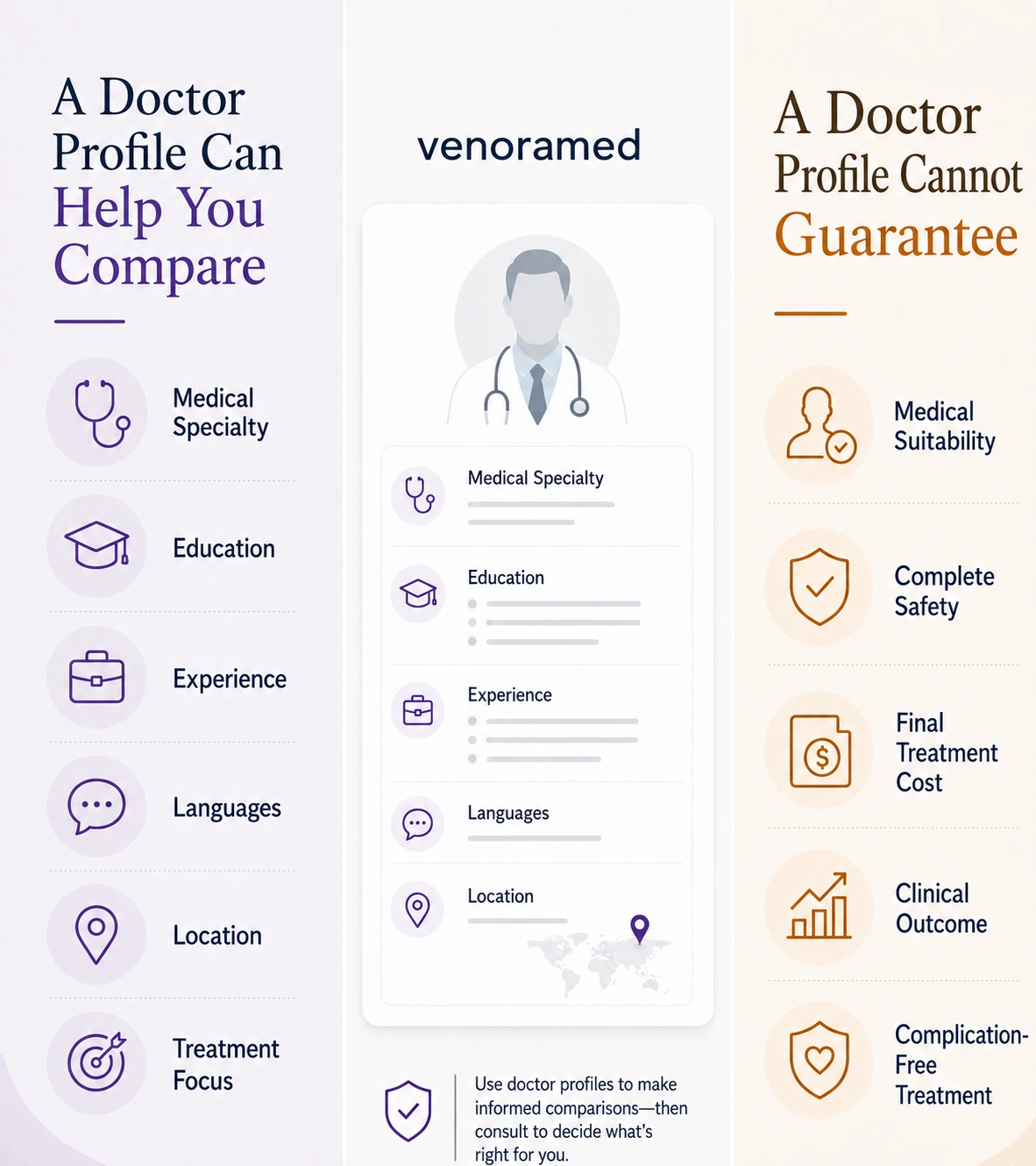
What a Doctor Profile Can and Cannot Tell You
A well-structured doctor profile can support initial research, but it cannot replace an individual consultation.
| Profile information | What it may help you understand | What it does not prove |
|---|---|---|
| Medical specialty | The doctor’s professional field | Suitability for your individual case |
| Years in practice | The length of professional experience | The number of times a specific procedure has been performed |
| Education | Academic and specialist training | A guaranteed level of treatment quality |
| Professional memberships | Participation in professional organisations | Automatic specialist or board certification |
| Treatments listed | The services associated with the doctor’s practice | That every listed treatment is appropriate for you |
| Before-and-after photographs | Examples selected by the provider | That you will receive a similar result |
| Patient reviews | Experiences reported by previous patients | An independent clinical assessment |
| Starting price | A possible entry point for discussion | The final cost of your treatment |
| Languages | Languages reportedly available for communication | That all medical documents or consent forms will be available in that language |
Patients should use profile information to identify questions—not to make a final medical decision.
How to Check the Clinic or Hospital
The doctor and the healthcare facility should be assessed separately.
A doctor may consult in one location but operate in another. Before making a payment, the patient should ask for the full legal name and address of the facility where treatment will occur.
Important questions include:
- Is the facility authorised for international health tourism?
- Is it a clinic, medical centre or hospital?
- Will the procedure take place in an operating theatre?
- What type of anaesthesia will be used?
- Who will provide the anaesthesia?
- Are laboratory tests available?
- Is emergency equipment available?
- Is overnight observation possible when medically necessary?
- What happens if the patient requires a higher level of care?
- Which hospital will receive the patient in an emergency?
- Where will follow-up examinations take place?
For invasive procedures, patients should also understand whether the facility can manage complications such as bleeding, infection, allergic reactions or anaesthetic problems.
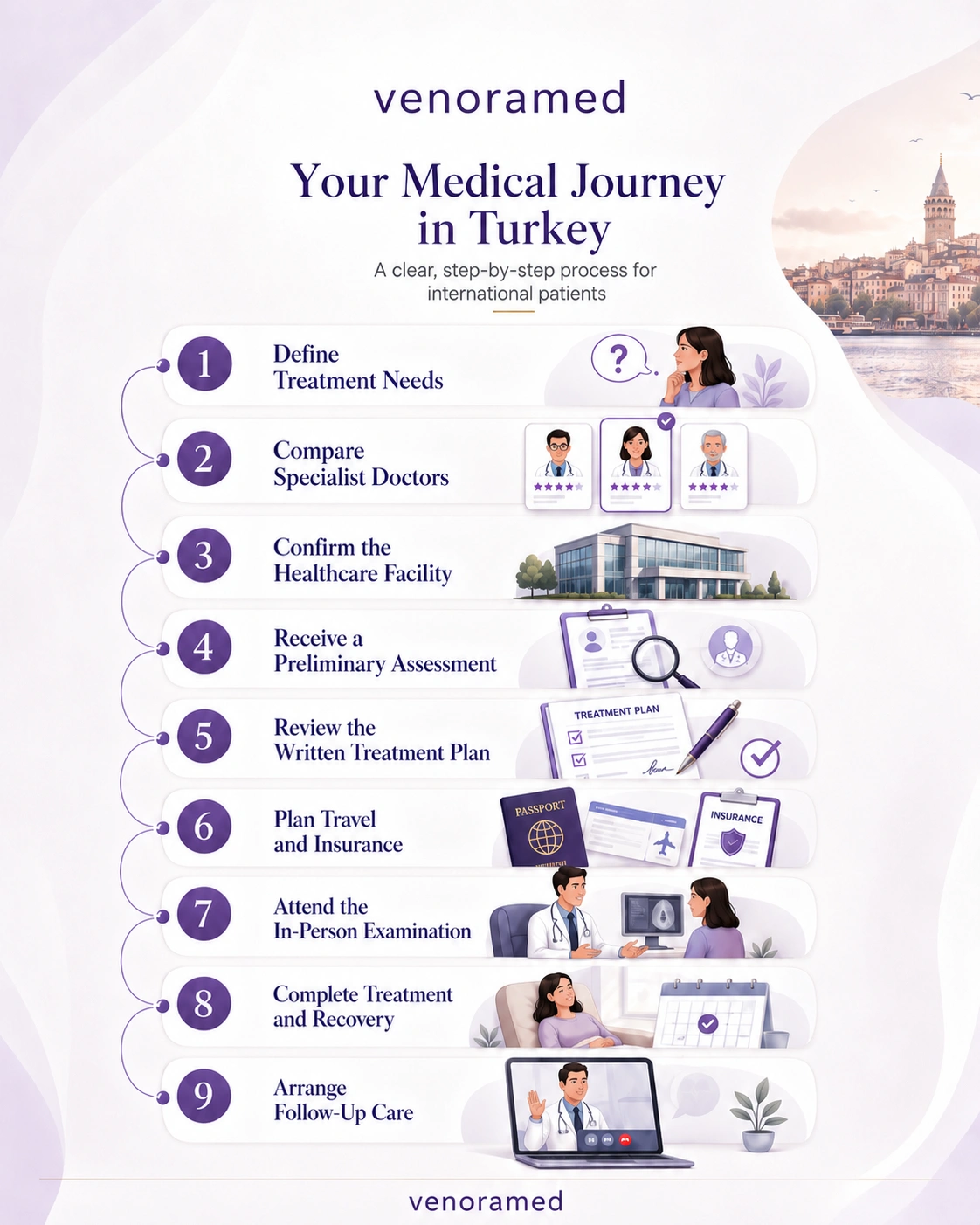
The Medical-Travel Process: Step by Step
A structured process can reduce uncertainty and help the patient compare options more carefully.
Step 1: Define the Medical Question
The process should begin with a clear medical concern or treatment objective—not with a discounted package.
The patient should consider:
- What problem am I trying to address?
- Have I already received a diagnosis?
- Have I discussed the issue with a healthcare professional at home?
- Am I looking for a second opinion?
- Do I understand non-surgical or local alternatives?
- Am I medically and practically able to travel?
For complex conditions, obtaining an opinion from the patient’s usual doctor before travelling may help identify risks and clarify which records are needed.
Step 2: Gather Relevant Medical Information
Depending on the treatment, the doctor may request:
- Medical history
- Current medication list
- Known allergies
- Previous operation reports
- Laboratory results
- Imaging
- Dental X-rays or scans
- Pathology reports
- Photographs
- Information about smoking or alcohol use
- Details of previous complications
- Relevant family medical history
Patients should provide accurate information. Hiding a condition, medication or previous treatment may affect the doctor’s ability to assess risk.
Personal medical documents should only be shared through a communication method the patient considers appropriately secure.
Step 3: Compare Specialist Doctors
Doctor profiles can be used to create an initial shortlist.
Patients may compare:
- Specialty
- Areas of clinical focus
- Education
- Relevant experience
- Languages
- City
- Treatment location
- Consultation options
- Profile information
- Starting prices, where displayed
Price should not be the main filter at this stage. A quotation is only meaningful when the proposed treatment and included services are clear.
Step 4: Confirm the Treating Facility
The patient should obtain the exact name of the clinic, medical centre or hospital before booking.
The facility should then be checked against relevant official Ministry of Health lists where applicable.
The patient should also ask whether the initial consultation, procedure and follow-up visits will take place in the same location.
Step 5: Receive a Preliminary Assessment
A doctor may review documents, images or test results and provide an initial opinion.
Patients should understand that a preliminary online assessment may change after:
- Physical examination
- New laboratory results
- Imaging
- Anaesthetic assessment
- Review of medical history
- Identification of an unexpected health concern
A responsible preliminary assessment should acknowledge uncertainty when a final decision cannot yet be made.
Step 6: Request a Written Treatment Plan
The written plan should state:
- The proposed procedure
- The reason it is being considered
- Important alternatives
- Whether additional procedures are recommended
- Expected treatment stages
- Type of anaesthesia
- Expected hospital stay
- Approximate recovery period
- Required follow-up visits
- Important risks and limitations
- Circumstances that could change the plan
For dental or multi-stage treatment, it should also explain whether more than one visit to Turkey may be required.
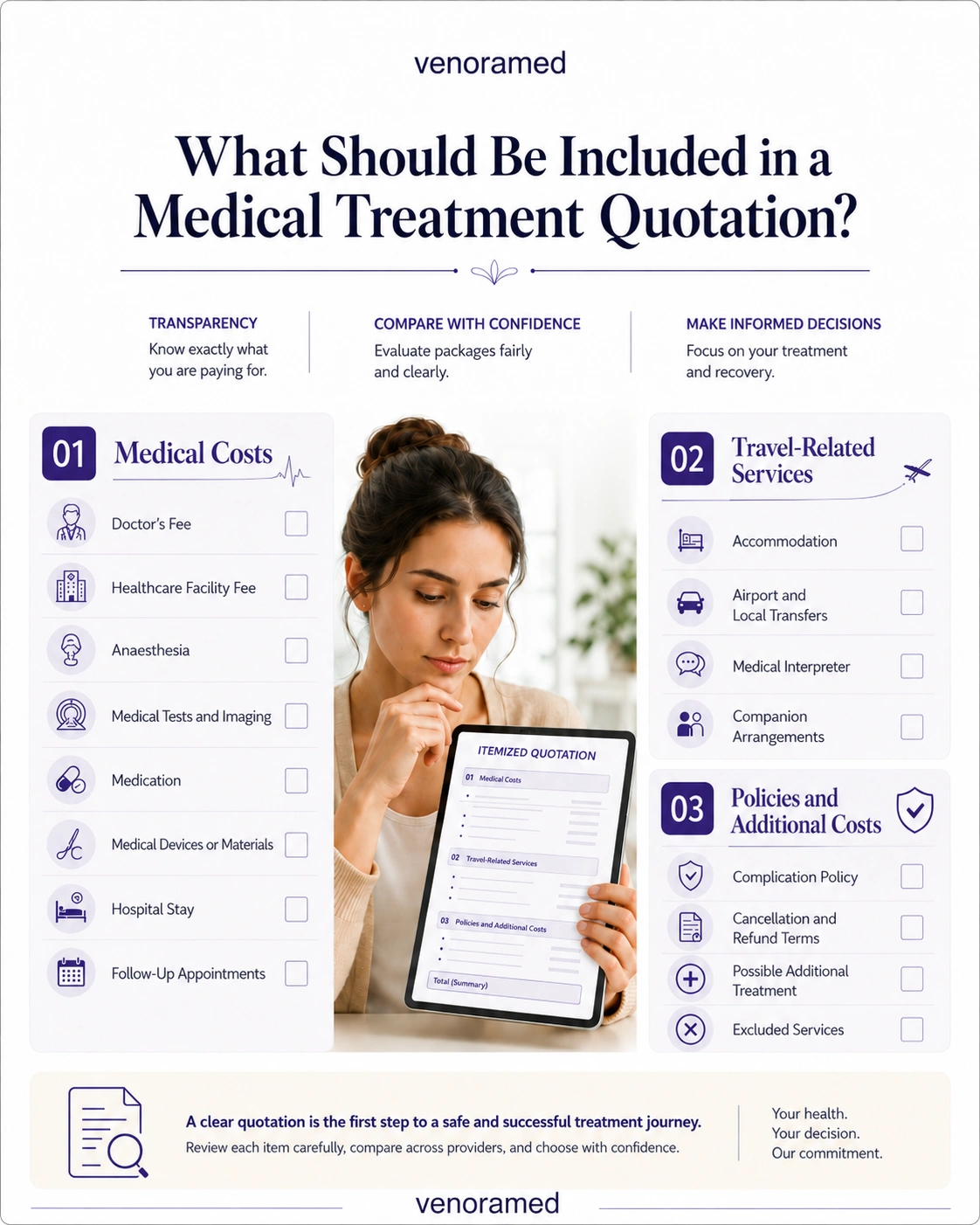
Step 7: Obtain an Itemised Quotation
The quotation should identify what is included and excluded.
Potential items include:
| Cost item | Questions to ask |
|---|---|
| Doctor’s fee | Does this cover the consultation and procedure? |
| Hospital or facility fee | Is the operating theatre or treatment room included? |
| Anaesthesia | Are the anaesthetist and medication included? |
| Medical tests | Which tests are covered? |
| Medical devices or materials | Are implants, crowns, prostheses or other materials included? |
| Medication | Are discharge medicines included? |
| Hospital stay | How many nights are covered? |
| Follow-up appointments | How many appointments are included? |
| Accommodation | What hotel, room type and number of nights? |
| Transfers | Which journeys are included? |
| Interpreter | Is medical interpretation available? |
| Companion expenses | Is anything provided for an accompanying person? |
| Additional treatment | What could create extra charges? |
| Complications | Who pays if further treatment is required? |
| Cancellation | What payments are refundable? |
The patient should also confirm the currency, payment schedule and conditions under which the price may change.
Step 8: Plan Travel, Visa and Insurance
Entry requirements depend on the traveller’s nationality, passport type and circumstances.
Some nationalities can enter Turkey without a visa, some may be eligible for an e-Visa and others must apply through a Turkish diplomatic mission. Requirements should be checked through official Turkish Ministry of Foreign Affairs sources rather than social-media posts or informal travel advice.
The Ministry also states that, as a general entry requirement, a passport should remain valid for at least 60 days beyond the permitted duration of stay under the visa, e-Visa, visa exemption or residence permit.
Patients should consider:
- A flexible return ticket
- Accommodation suitable for recovery
- Access to lifts or step-free rooms
- Distance from the treating facility
- Travelling with a responsible companion
- Transport after discharge
- Storage requirements for medication
- Accessibility needs
- Emergency contact details
Standard holiday insurance may not cover planned treatment abroad. NHS guidance states that most ordinary travel-insurance policies do not cover planned overseas treatment, which means specialist cover may be required.
The policy should be checked for:
- Planned medical treatment
- Complications
- Additional accommodation
- Missed flights
- Medical evacuation
- Emergency hospitalisation
- Treatment after returning home
- Pre-existing medical conditions
Step 9: Attend the In-Person Examination
The final decision should be made only after the treating team has completed the necessary evaluation.
The patient should have an opportunity to:
- Meet the treating doctor
- Ask questions
- Review the final treatment plan
- Discuss risks and alternatives
- Understand the consent documents
- Confirm the quotation
- Decide not to proceed
Consent should not be treated as a formality. The patient should understand what will happen, who will provide treatment and what the realistic limitations are.
General NHS guidance states that a practitioner should explain how a procedure will be performed, whether anaesthesia is required, expected recovery, possible complications and what the patient may reasonably expect afterwards.
Step 10: Complete Treatment and Early Recovery
After treatment, the patient should receive clear instructions covering:
- Medication
- Wound or treatment-site care
- Eating and drinking
- Physical activity
- Showering or bathing
- Compression garments where applicable
- Warning signs
- Emergency contact details
- Follow-up appointments
- Flying and long-distance travel
- Return to work or exercise
Medical travel should not be treated as an ordinary holiday immediately after a procedure. The CDC warns that alcohol, strenuous exercise, swimming, sunbathing and long tours during the post-operative period may delay or interfere with healing.
Step 11: Obtain Medical Clearance Before Travelling Home
Surgery and prolonged travel can both increase the risk of blood clots. Travel soon after an operation may increase that risk further because the patient may remain seated for an extended period while recovering.
There is no single safe flying interval for every procedure. The appropriate timing depends on:
- The type of treatment
- The length and complexity of surgery
- Anaesthesia
- The patient’s health
- Mobility
- Risk of blood clots
- The length of the journey
- The progress of recovery
The CDC advises delaying air travel for approximately 10 to 14 days after major surgery, particularly some operations involving the chest, but the patient must follow the individual advice of the treating medical team.
A return date should not be chosen solely to minimise hotel costs.
Step 12: Arrange Follow-Up Care at Home
Aftercare should be discussed before travelling, not after a problem occurs.
The patient should know:
- When follow-up appointments will take place
- Whether remote follow-up is available
- Who will answer medical questions
- What symptoms require urgent attention
- Whether stitches, dressings or drains require local care
- Who will prescribe additional medication
- Whether a local doctor has agreed to provide follow-up
- What happens if revision or corrective treatment is considered
- Who will pay for additional care
Medical travellers should request copies of their relevant treatment records, ideally in English or another language understood by the healthcare professional providing follow-up at home. The CDC recommends obtaining overseas medical records and sharing them with subsequent healthcare providers to support continuity of care.
Useful records may include:
- Diagnosis
- Operation or procedure report
- Discharge summary
- Test results
- Imaging
- Implant or device details
- Medication list
- Anaesthetic record
- Pathology results
- Follow-up instructions
- Emergency contact information
How Much Does Medical Treatment in Turkey Cost?
There is no single reliable price for “medical treatment in Turkey”.
The final cost may depend on:
- The patient’s diagnosis
- The complexity of the case
- The proposed treatment method
- The doctor’s fee
- The healthcare facility
- Anaesthesia
- Length of surgery
- Hospital admission
- Tests and imaging
- Medical materials or implants
- Medication
- Number of treatment stages
- Length of stay
- Additional follow-up
- Treatment of complications
- Currency movements
Prices shown on profiles or advertisements may represent a starting point rather than a final quotation.
Patients should be particularly cautious when one provider’s price appears much lower than all comparable options. The difference may reflect exclusions rather than savings.
A useful comparison should consider the complete treatment plan, not only the headline price.
What Should a Medical-Tourism Package Include?
The phrase “all-inclusive” does not have one standard medical meaning.
One package may include a hospital stay and anaesthesia, while another may use the same phrase for accommodation and airport transfer only.
Before payment, the patient should request a written list of:
Medical Services
- Consultation
- Procedure
- Anaesthesia
- Hospital or clinic charges
- Laboratory tests
- Imaging
- Implants or materials
- Medication
- Follow-up appointments
Travel-Related Services
- Airport transfer
- Hotel
- Local transport
- Interpreter
- Companion arrangements
Exclusions
- Additional hospital nights
- Blood products
- Intensive care
- Unexpected tests
- Treatment of complications
- Revision surgery
- New flights
- Extended hotel stays
- Local care after returning home
The provider should also explain what happens if the in-person examination shows that the planned treatment is not appropriate.

Red Flags Before Booking Treatment
Patients should pause and investigate further when they encounter any of the following:
Guaranteed Results
No responsible provider can guarantee an exact medical or cosmetic outcome.
No Named Doctor
The patient should know who will assess and treat them.
No Confirmed Facility
The clinic or hospital should be identified before payment.
Pressure to Pay Immediately
A limited-time discount should not replace informed decision-making.
No Medical Questions
A provider that recommends surgery without reviewing basic medical information may not be conducting a meaningful assessment.
Unclear Package Details
“All-inclusive” is insufficient unless each included service is listed.
Treatment Recommended by a Salesperson
Administrative staff may explain services, but medical recommendations should come from an appropriately qualified healthcare professional.
No Discussion of Risks
Every invasive procedure has risks and limitations.
Excessive Combined Procedures
Combining several procedures may increase surgical and recovery demands. The medical justification and individual risk must be discussed with the treating team.
No Aftercare Plan
Patients should know how routine follow-up and complications will be managed before travelling.
Only Social-Media Evidence
Followers, edited videos and selected photographs do not establish specialty, authorisation or suitability.
Questions to Ask Before Booking
Patients may use the following checklist when communicating with a doctor or healthcare provider:
- Who will personally perform my treatment?
- What is the doctor’s exact specialty?
- How often does the doctor perform this procedure?
- Am I likely to require an in-person examination before a final decision?
- What factors could make me unsuitable?
- Are there non-surgical or alternative treatments?
- Where will the procedure take place?
- Is the facility authorised for international health tourism?
- What type of anaesthesia will be used?
- Who will provide the anaesthesia?
- What tests are required?
- What risks are particularly relevant to my case?
- What is included in the quotation?
- What circumstances could increase the price?
- How many nights should I remain in Turkey?
- When can I travel safely?
- How many follow-up appointments are required?
- Who should I contact if I develop symptoms?
- Who pays for treatment of complications?
- Will I receive a copy of my medical records?
- In which language will the consent documents and medical records be provided?
- What is the cancellation and refund policy?
Clear answers do not guarantee an outcome, but unclear or evasive answers provide a reason to delay the decision.
How Venoramed Fits into the Research Process
Venoramed is designed to help users begin their research by exploring treatment categories and viewing specialist doctor profiles in Turkey. Available profile information may include specialty, treatments, city, languages, education, experience and indicative starting prices.
Patients can use this information to:
- Select a relevant treatment category.
- Identify doctors whose stated specialty matches the treatment.
- Compare professional and practical profile details.
- Prepare questions for the doctor.
- Request further information or a consultation.
- Discuss medical suitability directly with the relevant healthcare professional.
Venoramed does not replace the patient’s own checks. A profile should be viewed as the beginning of the decision-making process rather than confirmation that a treatment is suitable, safe or guaranteed to produce a particular outcome.
Frequently Asked Questions
Is medical tourism legal in Turkey?
Yes. International health tourism operates within a regulatory framework in Turkey. Healthcare providers and facilitators working in this field may be required to obtain relevant authorisation from the Ministry of Health. Patients should check the current official lists for the facility or organisation involved.
How can I check whether a hospital or clinic is authorised?
The Turkish Ministry of Health publishes lists of authorised hospitals, medical centres, private practices and other healthcare providers. Ask for the full legal name of the facility and compare it with the appropriate official list.
Do I need a medical visa to receive treatment in Turkey?
Visa requirements vary by nationality and passport type. Some travellers are exempt, some can apply for an e-Visa and others need a visa from a Turkish diplomatic mission. Check the current requirements through official Ministry of Foreign Affairs resources before booking.
Is medical treatment in Turkey cheaper than in Europe or the UK?
It may be less expensive for some procedures, but price differences vary significantly. A valid comparison must include the doctor, facility, treatment method, anaesthesia, materials, tests, hospital stay, aftercare and possible additional costs.
Are treatment results guaranteed?
No. All treatments have limitations and potential risks. Results may vary according to the procedure, the patient’s health, healing, anatomy, adherence to aftercare and other individual factors.
Can a doctor make a final decision from photographs?
Photographs may support a preliminary assessment, but they may not provide enough information for a final diagnosis or treatment decision. Examination, imaging, laboratory tests or other investigations may be necessary.
How long should I stay in Turkey after treatment?
The required stay depends on the procedure and the patient’s recovery. The treating doctor should specify the minimum stay, follow-up appointments and conditions for travel clearance.
Can I travel alone?
This depends on the procedure. A companion may be particularly important after sedation, anaesthesia or major surgery. Ask the treating team whether a responsible adult must accompany you after discharge.
Does ordinary travel insurance cover planned medical treatment?
Often it does not. NHS guidance advises that specialist insurance may be needed because many standard travel policies exclude planned overseas treatment.
What happens if I develop a complication after returning home?
This should be clarified before treatment. Ask who will assess the problem, whether remote contact is available, whether local follow-up has been arranged and who is financially responsible for additional care. Seek urgent local medical attention rather than waiting for an online reply if symptoms may represent an emergency.
Is a doctor profile enough to choose a surgeon or specialist?
No. A profile can help identify potentially relevant doctors, but the patient must still confirm specialty, treatment location, proposed plan, risks, facility authorisation, costs and aftercare arrangements.
Final Checklist
Before committing to medical treatment in Turkey, confirm that you have:
- Identified the treating doctor
- Confirmed the doctor’s relevant specialty
- Received the full name of the healthcare facility
- Checked relevant facility authorisation
- Shared accurate medical information
- Received a preliminary assessment
- Understood that the plan may change after examination
- Requested a written treatment plan
- Received an itemised quotation
- Reviewed risks and alternatives
- Checked visa and passport requirements
- Arranged suitable insurance
- Planned sufficient recovery time
- Confirmed when you may travel
- Arranged follow-up care
- Requested medical records
- Understood the complication and cancellation policies
Medical tourism should be approached as a healthcare decision first and a travel decision second.
Careful research cannot remove every medical risk, but it can help patients avoid unclear arrangements, compare information more responsibly and ask better questions before making a commitment.
Medical disclaimer: This article provides general information and does not constitute medical advice, diagnosis or a recommendation to undergo treatment. Individual risks, treatment options and travel suitability must be discussed with an appropriately qualified healthcare professional.
Platform disclaimer: Venoramed is a medical marketplace and is not a clinic or hospital. Information displayed on doctor profiles is intended to support initial research and does not guarantee medical suitability, provider performance or treatment outcomes.



1 Comment
Share your question or experience. Venoramed reviews comments before publishing.
[…] still researching whether travelling abroad for treatment is the right choice, read our Medical Tourism in Turkey: A Practical Guide for International Patients before using this safety […]