
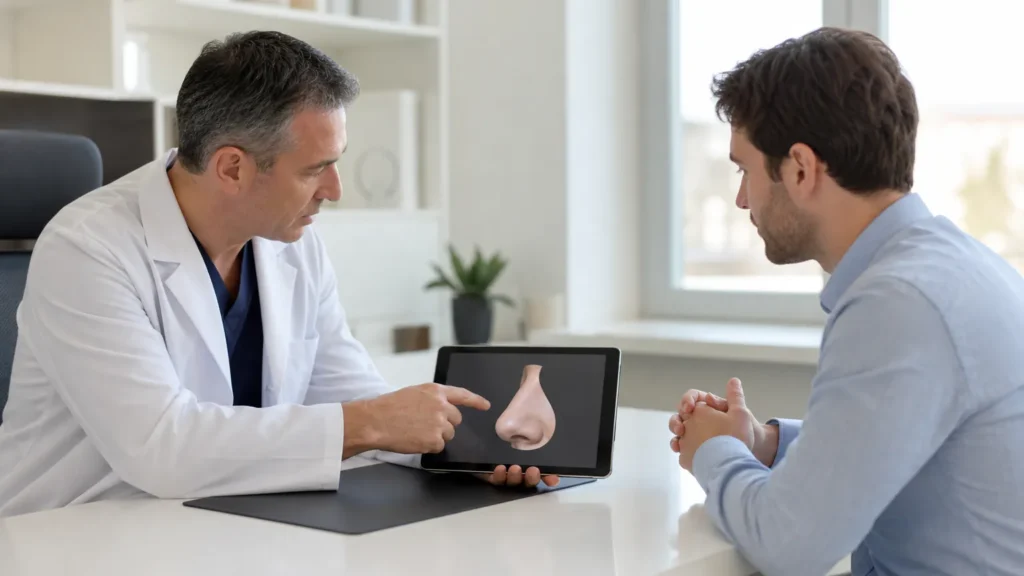
Open vs closed rhinoplasty is one of the first choices patients come across when researching nose reshaping surgery, and it is often presented as a simple trade: a tiny scar in exchange for more control, or no visible scar in exchange for less. The reality is more nuanced, and the right approach depends on what needs to change in your nose.
This guide explains where the incisions go, what the columella scar usually looks like, which kinds of nose suit each approach, and what the research actually shows about swelling and recovery. It also takes apart the “scarless rhinoplasty” claim and gives you questions to put to any surgeon.
Quick answer: Open rhinoplasty adds a small incision across the columella (the skin strip between the nostrils) so the surgeon can lift the skin and see the tip cartilages directly. Closed, or endonasal, rhinoplasty keeps every incision inside the nose. Neither is better for everyone: reviews find similar satisfaction, and the choice depends on what needs changing and the surgeon’s expertise.
Key takeaways
- Both approaches reshape the same bone and cartilage; the difference is how the surgeon reaches them and how much they can see.
- Open rhinoplasty leaves a small columella scar, which most studies describe as hard to notice once healed.
- Closed rhinoplasty avoids an external scar but gives a more limited view, which can make detailed tip work harder.
- Recent reviews find no clear overall difference in satisfaction, swelling or complications, although the evidence quality is moderate.
- “Scarless” means no visible external scar, not no surgery: closed rhinoplasty still involves internal incisions and a full recovery.
What is the difference between open and closed rhinoplasty?
The difference is the incision. In open rhinoplasty the surgeon makes a small cut across the columella, together with incisions inside the nostrils, and lifts the skin to view the nasal framework. In closed rhinoplasty all the incisions stay inside the nose.
The NHS description of nose reshaping sets it out plainly: open rhinoplasty involves a cut across the skin between the nostrils, while closed rhinoplasty uses tiny cuts inside the nostrils, leaving no visible scars, but it “is not always possible or available”. The American Society of Plastic Surgeons (ASPS) describes the same two routes in its rhinoplasty procedure guide, defining the columella as the narrow strip of tissue that separates the nostrils.
What happens next is often similar. With either approach, a surgeon can reduce a dorsal hump (the bump on the bridge), narrow the bones, adjust the septum (the internal wall between the airways) and reshape cartilage. The approach changes access and visibility, not the list of goals.
Is closed rhinoplasty the same as endonasal rhinoplasty?
Yes. “Endonasal” simply means “inside the nose”, and the two terms are used interchangeably. You may also see “scarless rhinoplasty” in marketing, which usually refers to the same closed approach.
Where are the incisions, and what does the columella scar look like?
In open rhinoplasty there is one small external incision across the columella, plus incisions inside the nostrils. In closed rhinoplasty all incisions are hidden inside the nose.
The columella scar is the main reason people hesitate about the open approach, so it is worth looking at the evidence. In a 2020 study of 100 open rhinoplasty patients published in Cureus, comparing two types of stitch for closing that incision, scars were rated unnoticeable in 88% and 86% of the two groups. That is encouraging, but it was a single-centre, retrospective study.
A 2022 systematic review in Archives of Plastic Surgery by Gupta and colleagues notes that the transcolumellar incision can still leave scarring, and that one included study found columellar sensation loss only in the open group. In other words: usually discreet, not invisible, and dependent on healing, skin type and technique.
Which approach suits tip work?
Open rhinoplasty is generally favoured when the nasal tip needs detailed reshaping. The British Association of Plastic, Reconstructive and Aesthetic Surgeons (BAPRAS) explains in its rhinoplasty patient guide that lifting the skin gives the surgeon a better view when making changes to the tip.
The Gupta review reached a similar conclusion: open rhinoplasty offers better exposure of nasal anatomy, which supports precision and complex graft placement, while the limited access of the closed approach makes precise tip work harder. That matters if your main concern is the tip itself, such as a wide or rounded tip, a tip that hangs down when you smile, or asymmetry.
If tip shape is your priority, our guides to tip rhinoplasty, bulbous nose tip rhinoplasty and droopy nose tip surgery explain what can and cannot be achieved and why the approach is often discussed early in consultation.
That said, some experienced surgeons perform limited tip refinements through a closed approach. The question to ask is not “which approach is better?” but “what exactly will you change in my tip, and how will you reach it?”.

Which approach suits a small hump or a mainly straight nose?
A closed approach is often suitable when the main goal is a modest dorsal hump reduction and the tip needs little or no change. The Gupta review notes that several studies suggest closed techniques are reasonable for primary cases (first-time surgery) without significant deviation or implant problems.
Typical situations where a surgeon may discuss a closed approach include:
- a small or moderate bump on the bridge with a tip you are happy with;
- minor narrowing of the nasal bones;
- limited septal work alongside a cosmetic change;
- a patient for whom avoiding any external scar is a strong priority, and whose anatomy allows it.
Breathing issues add another layer. If you also have a blocked side or a deviated septum, our guide to functional versus cosmetic rhinoplasty explains how breathing and appearance goals are combined in one plan.
If you are weighing up an approach for your own nose, a surgeon can usually tell you which they would use after reviewing your photographs.
Is open rhinoplasty better for revision surgery?
Open rhinoplasty is frequently chosen for revision surgery, though not in every case. Revisions often involve scar tissue, missing or weakened cartilage and the need for grafts, and the Gupta review links the open approach with better exposure for complex graft placement.
BAPRAS also warns that too much surgery can weaken the structural scaffolding of the nose. A second operation therefore usually needs rebuilding as well as reducing, which is where a clear view helps. A small, isolated irregularity, by contrast, may sometimes be corrected through a closed approach.
Revision is a specialist area in its own right. Our guide to revision rhinoplasty in Turkey covers timing, grafts and what to bring to a consultation.
Does closed rhinoplasty mean less swelling and a faster recovery?
Possibly, but the evidence is weaker than marketing suggests. BAPRAS states that open surgery causes greater swelling and a longer recovery, and that closed operations usually take about two weeks to settle. Pooled research, however, has not found a clear overall difference.
A 2025 systematic review and meta-analysis by Abi Zeid Daou and colleagues, published in Plastic and Reconstructive Surgery Global Open, pooled 12 studies and 1,067 patients. It found no significant difference between open and closed rhinoplasty in swelling, bruising, satisfaction or complication rates. The authors rated the studies as moderate quality, and the swelling and bruising comparisons rested on only two studies each.
The Gupta review found one study showing less early swelling and bruising with the closed approach, alongside others that showed no clear difference. The fair summary is that some patients may settle a little faster after a closed approach, but you should not choose an approach on recovery speed alone.
What does recovery look like with either approach?
The broad timeline is similar. According to the NHS, the operation usually takes 1.5 to 3 hours under general anaesthetic, a splint is taped over the nose for about seven days, you may need up to two weeks off work, and swelling can take up to six months to settle fully.
Cleveland Clinic adds that about 90% of swelling has gone by three months, but that minimal swelling can remain for up to a year. BAPRAS adds that after tip surgery around 60% of the change is visible at three weeks, with the rest evolving over several months or even a year. For a detailed timeline, see our guide to rhinoplasty recovery week by week.
Which approach gives the surgeon better visibility?
Open rhinoplasty gives better visibility. With the skin lifted, the surgeon can see both sides of the tip cartilages together, check symmetry directly and place and stitch grafts under direct vision.
Closed rhinoplasty works through the nostrils with what the Gupta review calls limited surgical access and visibility. Experienced surgeons can achieve good results this way, but they see less of the framework at once. Cleveland Clinic’s overview reflects the common framing: open rhinoplasty is described as a procedure for major reshaping, and closed rhinoplasty for more minor reshaping. That framing is a generalisation, but it captures why surgeons choose differently for different noses.
Is “scarless rhinoplasty” a myth?
Partly. “Scarless” accurately means there is no visible external scar, because the incisions are inside the nose. It does not mean there is no cutting, no internal healing or no recovery.
Some common myths, and what the evidence says:
| Myth | What the evidence says |
|---|---|
| Closed rhinoplasty is non-invasive. | It is full surgery under anaesthetic, with internal incisions and the same bone and cartilage work. |
| Closed always means less swelling. | A 2025 meta-analysis found no significant pooled difference, although some individual studies favour closed. |
| The open scar is always visible. | In a study of 100 open cases, scars were rated unnoticeable in most patients, though not all. |
| Open gives better results. | Reviews found high satisfaction with both and no overall advantage for either. |
| Any nose can be done closed. | The NHS notes that closed rhinoplasty “is not always possible or available”. |
The honest message is that “scarless” is a description of incision placement, not a promise about results or recovery.

Open vs closed rhinoplasty: side-by-side comparison
The table below summarises the main differences, drawing on the NHS, BAPRAS and the systematic reviews cited above.
| Factor | Open rhinoplasty | Closed (endonasal) rhinoplasty |
|---|---|---|
| Incisions | Small cut across the columella plus incisions inside the nostrils | All incisions inside the nose |
| External scar | Small columella scar, usually discreet once healed | No visible external scar |
| Surgeon’s view | Direct view of the tip cartilages and framework | More limited access and visibility |
| Often discussed for | Detailed tip work, complex grafting, many revisions | Modest hump reduction, limited changes, minimal tip work |
| Swelling | Traditionally described as greater; pooled studies show no clear difference | Sometimes settles faster; evidence mixed |
| Recovery basics | Splint for about a week, up to two weeks off work | Splint for about a week, up to two weeks off work |
| Satisfaction | High in reviews | High in reviews |
How does the approach affect cost?
The approach itself is rarely the main cost driver; the complexity of the work is. A closed rhinoplasty with complex septal work can cost more than a simple open rhinoplasty, and vice versa.
On Venoramed, rhinoplasty doctor profiles in Istanbul currently display starting prices from EUR 2,400 to EUR 4,000, with one profile displaying USD 2,500 (November 2026). These are starting figures, not final quotes; a final price follows an individual assessment. Our page on Turkey rhinoplasty package prices explains what is usually included, and our guide to rhinoplasty abroad compares the wider costs of travelling for surgery.

Questions to ask your surgeon about open or closed rhinoplasty
Bring these to your consultation and ask for answers specific to your nose.
- Which approach would you use for my nose, and why?
- What exactly will you change in the tip, the bridge and the septum?
- Would you consider the other approach for me, and what would I gain or lose?
- Where will the incisions be, and what does your typical columella scar look like at one year?
- How many open and closed rhinoplasties do you perform each year?
- Will you need to use cartilage grafts, and where would they come from?
- What swelling should I expect at one week, three months and one year?
- If I have breathing problems, how will you assess and address them?
- What is your approach if a revision is ever needed?
To get the most from a remote consultation, our guide to preparing medical records for an online consultation explains which photographs and documents to send.

Frequently asked questions
Is open or closed rhinoplasty better?
Neither open nor closed rhinoplasty is better for everyone. A 2022 systematic review and a 2025 meta-analysis both found high patient satisfaction with each approach and no clear overall advantage. Open rhinoplasty gives a better view for detailed tip work and grafting, while closed rhinoplasty avoids an external scar. The right choice depends on your anatomy, your goals and your surgeon’s expertise.
Does open rhinoplasty leave a noticeable scar?
Open rhinoplasty leaves a small scar across the columella, the strip of skin between the nostrils. In a 2020 study of 100 open rhinoplasty patients, scars were rated unnoticeable in 86% to 88% of cases. Healing varies between people, so a small number may still find the scar visible. Ask your surgeon to show you healed results at one year.
Is closed rhinoplasty really scarless?
Closed rhinoplasty is “scarless” only in the sense that there is no visible external scar, because all incisions are made inside the nose. It is still surgery under anaesthetic, with internal incisions, healing and swelling. The NHS also notes that the closed approach is not always possible, so suitability depends on what needs to change.
Is recovery faster after closed rhinoplasty?
Recovery may be slightly faster for some people after closed rhinoplasty, and BAPRAS describes greater swelling after open surgery. However, a 2025 meta-analysis of 1,067 patients found no significant pooled difference in swelling or bruising. With either approach, expect a splint for about a week, up to two weeks off work and residual swelling for months.
Can tip rhinoplasty be done with a closed approach?
Some limited tip refinements can be done through a closed approach by experienced surgeons. However, open rhinoplasty gives a direct view of the tip cartilages, and a 2022 systematic review noted that limited access in closed surgery makes precise tip work harder. Detailed tip reshaping, grafting or correction of asymmetry is more often planned through an open approach.
Which approach is used for revision rhinoplasty?
Revision rhinoplasty is frequently performed through an open approach, because second operations often involve scar tissue and cartilage grafts, which benefit from a clear view. A small, isolated problem can sometimes be corrected through a closed approach. The decision depends on what went wrong the first time and what the surgeon needs to rebuild.
Does the approach change the price of rhinoplasty?
The approach alone rarely decides the price; the complexity of the work matters more. Septal correction, grafting and revision usually add more than the choice of incision. Rhinoplasty doctor profiles on Venoramed currently display starting prices from EUR 2,400 to EUR 4,000 in Istanbul, with final quotes given after an individual assessment.
Next steps
The most useful next step is to let a surgeon see your nose. Share clear photographs and describe what bothers you, then ask which approach they would use and why, before you think about dates or travel.
Browse surgeon profiles or ask us to arrange a free consultation.
This article is general educational information, not medical advice. Venoramed is a medical marketplace and coordination platform; it does not provide treatment, diagnose conditions or guarantee outcomes. Suitability, risks and recovery must be assessed individually by a qualified, treating clinician.




Leave a Comment
Share your question or experience. Venoramed reviews comments before publishing.