
Introduction
FUE, DHI and Sapphire FUE are often presented as three competing hair-transplant ‘methods.’ That framing can make a decision sound simpler than it really is.
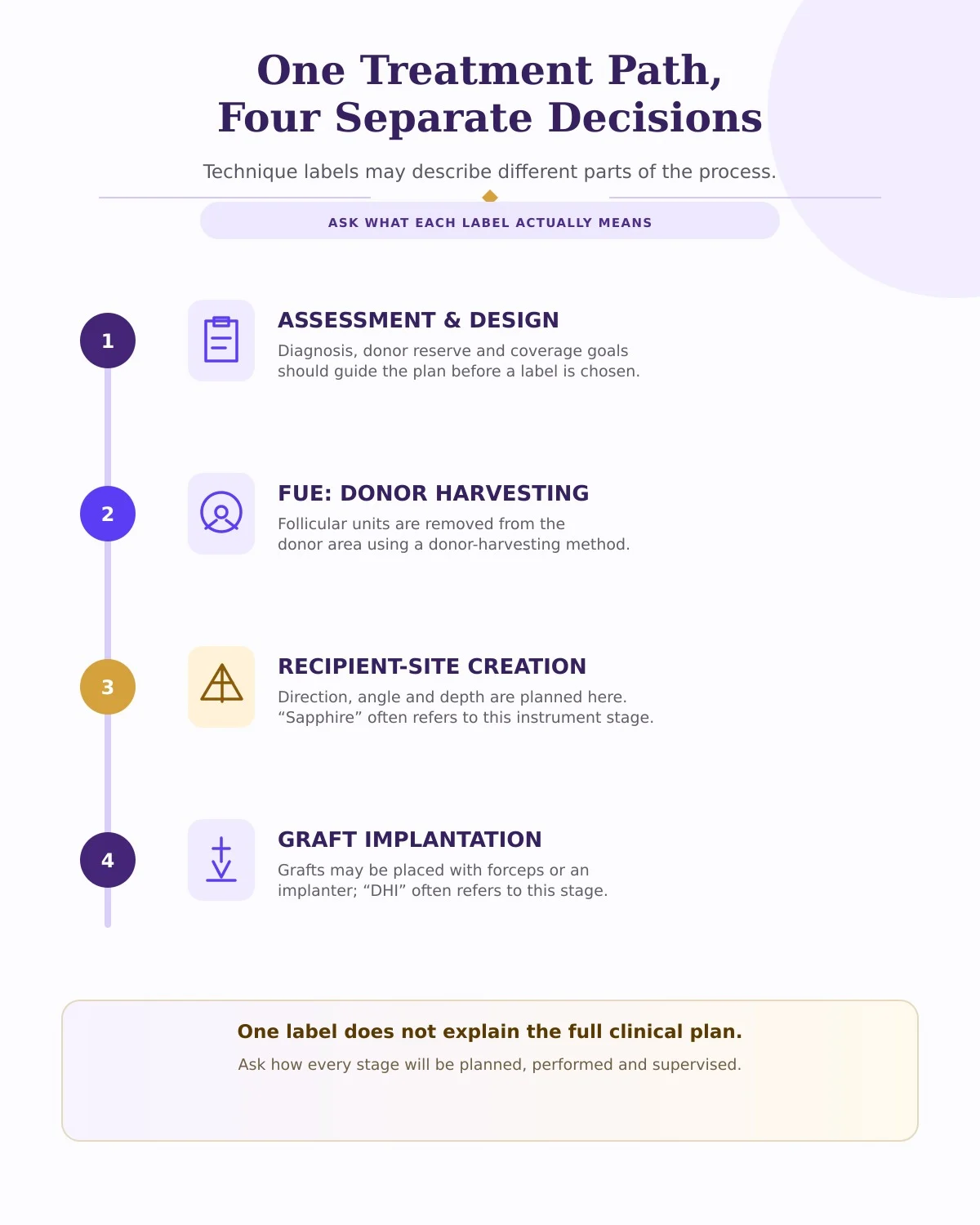
In practice, these labels may describe different stages of the same treatment pathway:
- How follicular grafts are taken from the donor area.
- How recipient sites are created in the thinning area.
- How grafts are inserted.
- Which instrument is used during one of those stages.
- How a clinic markets its workflow.
That means ‘FUE vs DHI vs Sapphire FUE’ is not always a direct like-for-like comparison. A patient may have FUE donor harvesting and then have grafts placed with an implanter. Another patient may have FUE harvesting, recipient sites created with a sapphire blade and grafts placed into those sites with forceps. The final plan should explain each stage clearly instead of relying on one headline label.
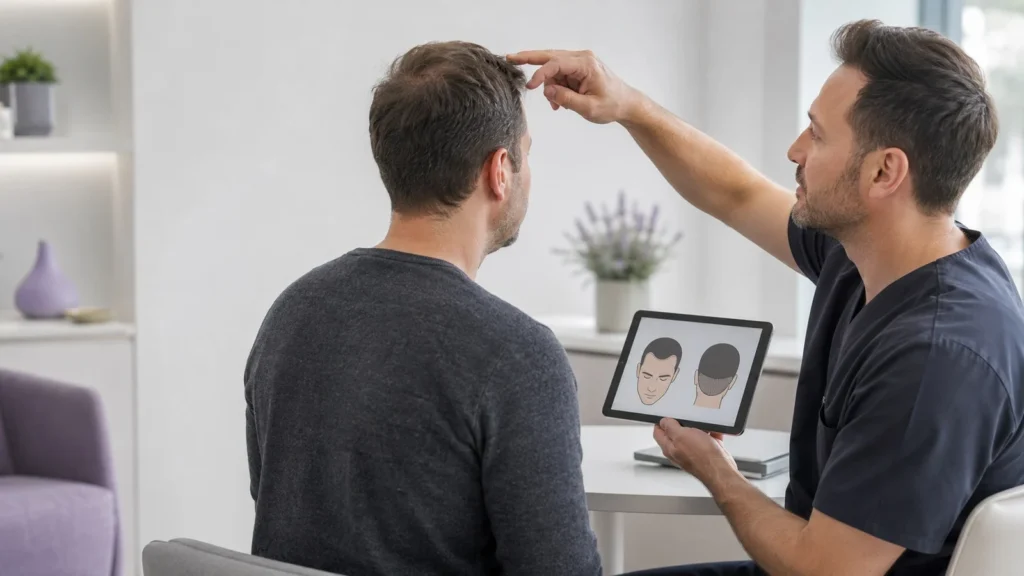
A hair transplant remains surgery. It requires diagnosis, donor-area assessment, realistic coverage planning, appropriate clinical responsibility and aftercare. The International Society of Hair Restoration Surgery (ISHRS) notes that FUE involves many small skin incisions and should not be described as a scarless or risk-free procedure.
Venoramed is a medical marketplace and coordination platform. It does not diagnose hair loss, choose a technique, recommend a graft number or guarantee a treatment outcome. A final plan should be made by an appropriately qualified clinician after individual assessment.
For wider context on donor supply, graft estimates, team roles and quotations, read Venoramed’s guide to hair transplant in Turkey.
Start by separating the treatment stages
A useful comparison starts with three separate questions:
| Treatment stage | What it means | Labels commonly used in marketing |
| Donor harvesting | Removing follicular units from the donor area | FUE |
| Recipient-site creation | Planning and making the small sites where grafts will go | Sapphire FUE, pre-made sites, stick-and-place |
| Graft implantation | Putting grafts into recipient sites | Forceps placement, implanters, DHI |
One label cannot answer every question about the procedure. For example, FUE tells you mainly about donor harvesting. It does not automatically tell you who creates recipient sites, how grafts are placed, whether an implanter is used, how much shaving is needed or whether the donor area is appropriate for the requested coverage.
The ISHRS terminology guide uses the term follicular unit excision because the process involves both making an incision around the follicular unit and removing it. This is why FUE is best understood first as a donor-harvesting method.
What does FUE mean?
FUE stands for Follicular Unit Excision. During this donor-harvesting approach, individual naturally occurring follicular units are removed from the donor area, often at the back and sides of the scalp, using small circular instruments.
A follicular graft is not always equal to one hair. One graft can contain more than one follicle, and visual coverage depends on several factors beyond graft count: donor density, hair calibre, curl, colour contrast, the size of the recipient area and the distribution plan.
FUE can be part of many different treatment workflows. After grafts are removed, the team may create recipient sites in advance and place grafts with forceps, use implanters for placement or use another clinically appropriate method. Therefore, a provider saying ‘we use FUE’ should be the start of the discussion, not the full answer.
The ISHRS clinical guidance for FUE emphasises donor assessment, candidate selection and avoiding overharvesting. A high graft number is not automatically a better plan if it could visibly thin the donor area or leave too little reserve for future change.
Questions to ask include:
- Is FUE the donor-harvesting method proposed for me?
- Which areas are considered safe donor zones in my case?
- How will donor density and possible future hair loss affect the plan?
- Who will perform or clinically oversee the donor-harvesting stage?
- What could change after an in-person scalp examination?
What does DHI usually describe?
DHI is commonly used to mean Direct Hair Implantation. In many clinic descriptions, it refers to an implantation approach using an implanter device, sometimes called an implanter pen.
The important distinction is that DHI usually describes how grafts are placed, not how they are harvested. Grafts may still be harvested using FUE before they are loaded into an implanter.
According to the ISHRS patient guidance, implanters can be dull or sharp:
- A dull implanter places a graft into a recipient site that has already been made.
- A sharp implanter can create a skin incision and place a graft as part of a ‘stick-and-place’ workflow.
This is why DHI should not be treated as automatically separate from FUE. A proposal called ‘DHI’ should explain the entire workflow: donor harvesting, recipient-site planning, graft loading, placement, shaving requirements and the roles of the people involved.
DHI also does not prove that a particular patient will need fewer grafts, have a better density result, recover faster or avoid all shaving. Those outcomes depend on the person’s donor characteristics, the extent of hair loss, recipient-area planning, graft handling, team skill and aftercare.
What does Sapphire FUE usually describe?
‘Sapphire FUE’ is commonly used to describe a workflow in which FUE donor harvesting is combined with recipient sites made using a sapphire-bladed instrument rather than a conventional steel blade.
This label usually points to one part of the recipient-site stage. It does not, on its own, explain:
- How follicular units are harvested.
- Who creates the recipient sites.
- How grafts are inserted.
- Whether forceps or implanters are used.
- Whether the patient needs partial or broader shaving.
- How the clinic protects existing native hair.
- Whether the donor supply is sufficient for the requested goal.
The ISHRS includes ‘Sapphire FUE’ among the growing number of marketing labels that it does not recognise as standard surgical terminology. That does not mean a sapphire instrument cannot be part of a treatment plan; it means the name alone should not replace a clear explanation of the clinical plan.
A better question is: ‘What exactly will the sapphire instrument be used for in my procedure, and why is that approach appropriate for my scalp, existing hair and coverage goal?’
FUE, DHI and Sapphire FUE: practical comparison
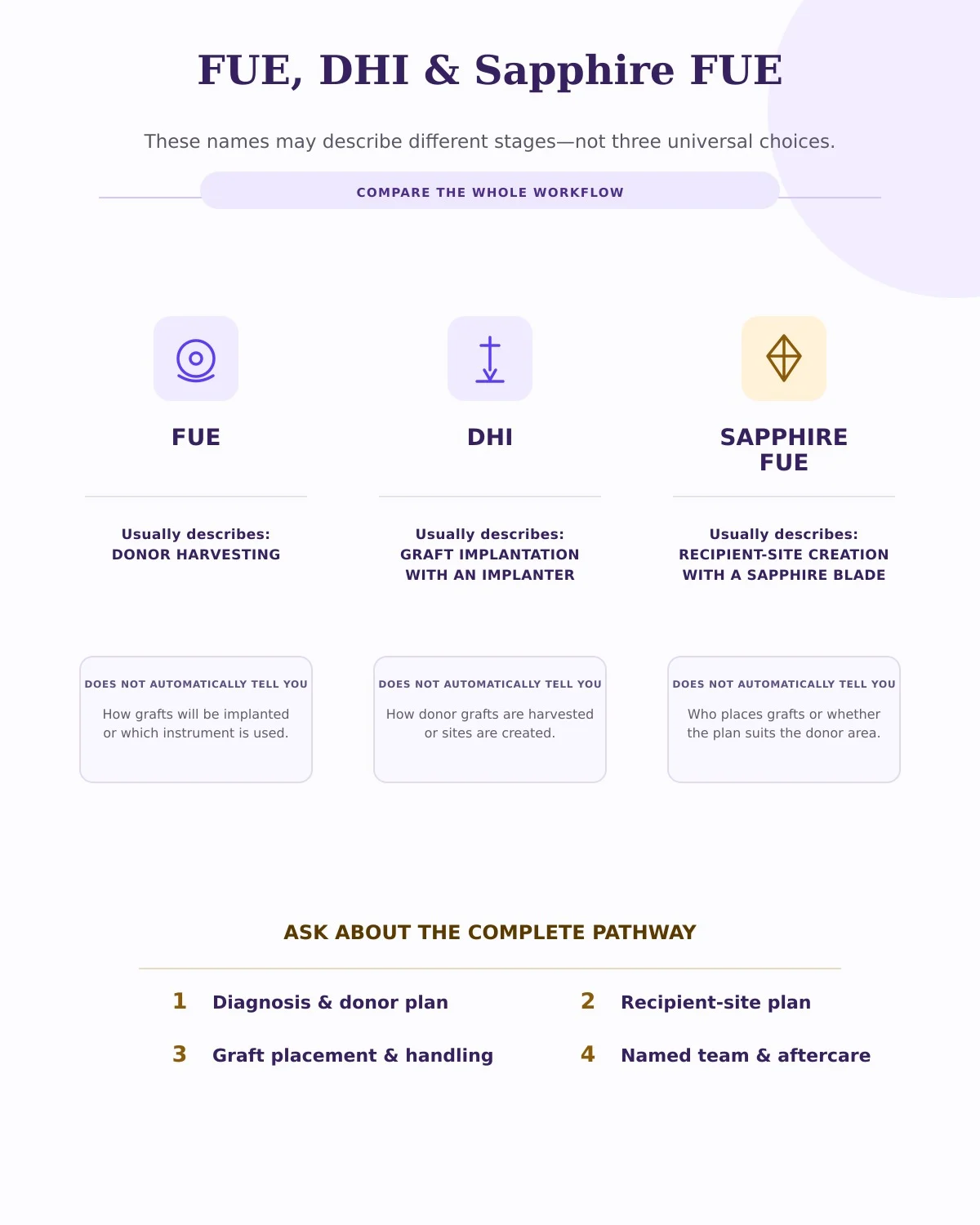
| Label | Usually describes | Does not automatically tell you | Questions to ask |
| FUE | Individual donor-hair harvesting | How grafts will be implanted, who creates recipient sites or whether a sapphire blade is used | How will donor harvesting be planned and who performs it? |
| DHI | Graft implantation with an implanter, sometimes a sharp implanter workflow | Whether donor grafts are harvested with FUE, the exact recipient-site plan or whether shaving is avoided | Does DHI mean a sharp or dull implanter, and who uses it? |
| Sapphire FUE | Use of a sapphire-bladed instrument during recipient-site creation in an FUE workflow | Graft quality, donor suitability, placement method, team roles or a guaranteed result | Which step uses the sapphire blade, and who designs direction, angle and depth? |
The comparison should not end with the instrument. A patient needs to understand the full chain of decisions: diagnosis, donor assessment, hairline design, recipient-area priorities, graft handling, clinical oversight and aftercare.
Shaving, graft handling and procedure duration
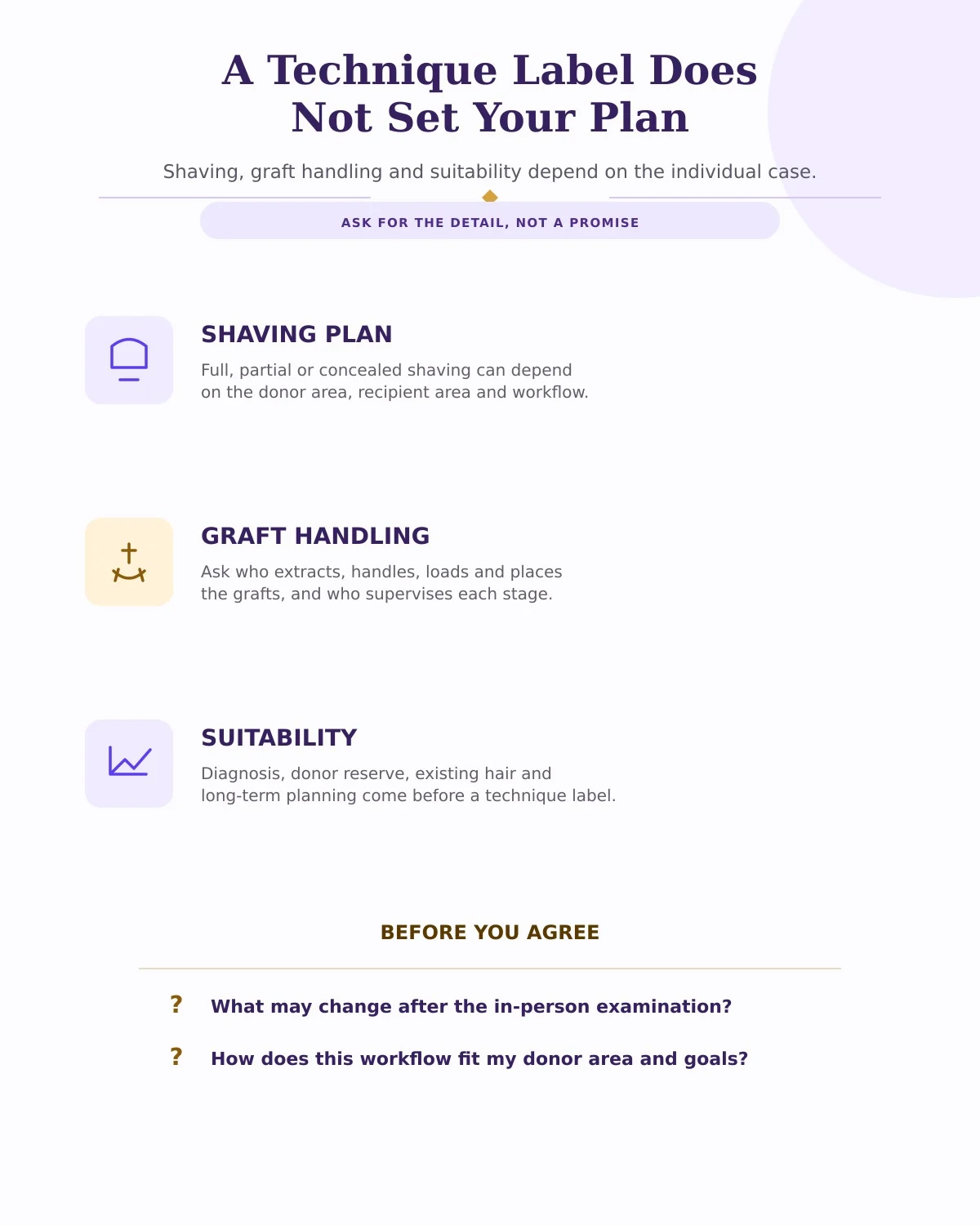
Shaving is a planning issue, not a promise
Some providers use ‘unshaven,’ ‘no-shave’ or ‘partially shaved’ language in connection with DHI or FUE. The actual shaving plan can vary according to the donor area, recipient area, degree of thinning, hair characteristics, number of planned grafts and the team’s workflow.
A patient should ask:
- Which donor and recipient areas, if any, will be shaved?
- Is the plan fully unshaven, partially shaved or simply designed to conceal a shaved area?
- Could the shaving plan change after the in-person examination?
- Does a less visible shaving plan affect procedure time, cost, donor planning or the number of grafts that can be handled safely?
The most appropriate plan is not automatically the one with the least visible shaving. It is the one the clinician can explain in relation to safe donor harvesting, recipient-site visibility and the patient’s clinical needs.
Graft handling matters more than the label suggests
Grafts are delicate biological tissue. Their handling involves extraction, sorting, hydration or storage according to the clinical protocol, loading where an implanter is used and placement into the recipient area.
A patient does not need to choose a technical workflow alone. They should, however, know who is responsible for graft handling and how the proposed process fits the case.
Useful questions include:
- Will grafts be placed with forceps, implanters or a combination?
- Who handles, loads and places the grafts?
- Who is responsible for protecting graft quality throughout the procedure?
- How is the direction, angle and distribution of grafts planned?
- How will existing native hair be considered in the recipient area?
A longer or shorter procedure is not a quality score
Procedure duration can depend on the number of grafts, donor characteristics, the area being treated, the placement method, the degree of precision required and the structure of the clinical team.
A short procedure is not automatically better, and a long procedure is not automatically more thorough. What matters is whether the plan is clinically appropriate, whether the patient is monitored properly and whether the team can explain what will happen at each stage.
Which approach is suitable for a patient?
There is no universal ‘best’ choice between FUE, DHI and Sapphire FUE. The appropriate plan depends on the person, not on which label sounds newer or more premium.
A qualified clinician may consider:
- The suspected cause, pattern and stability of hair loss.
- The density, calibre, curl and quality of donor hair.
- Previous transplant surgery, scars or diffuse donor thinning.
- The size of the recipient area and the priority between hairline, frontal scalp, mid-scalp and crown.
- Existing native hair that needs protection.
- Hairline design and the likelihood of future hair loss.
- Medical history, medications, allergies and scalp condition.
- Whether the patient’s goals are realistic relative to donor reserve.
The FUE guidelines published by ISHRS highlight the importance of evaluating both donor and recipient areas, including hair density, scars, scalp conditions, hair direction, colour, calibre and curl. These factors can affect whether a proposed plan is suitable and how much visible coverage is realistic.
Technique names should therefore come after diagnosis and planning, not before them.
Team roles: know who performs each stage
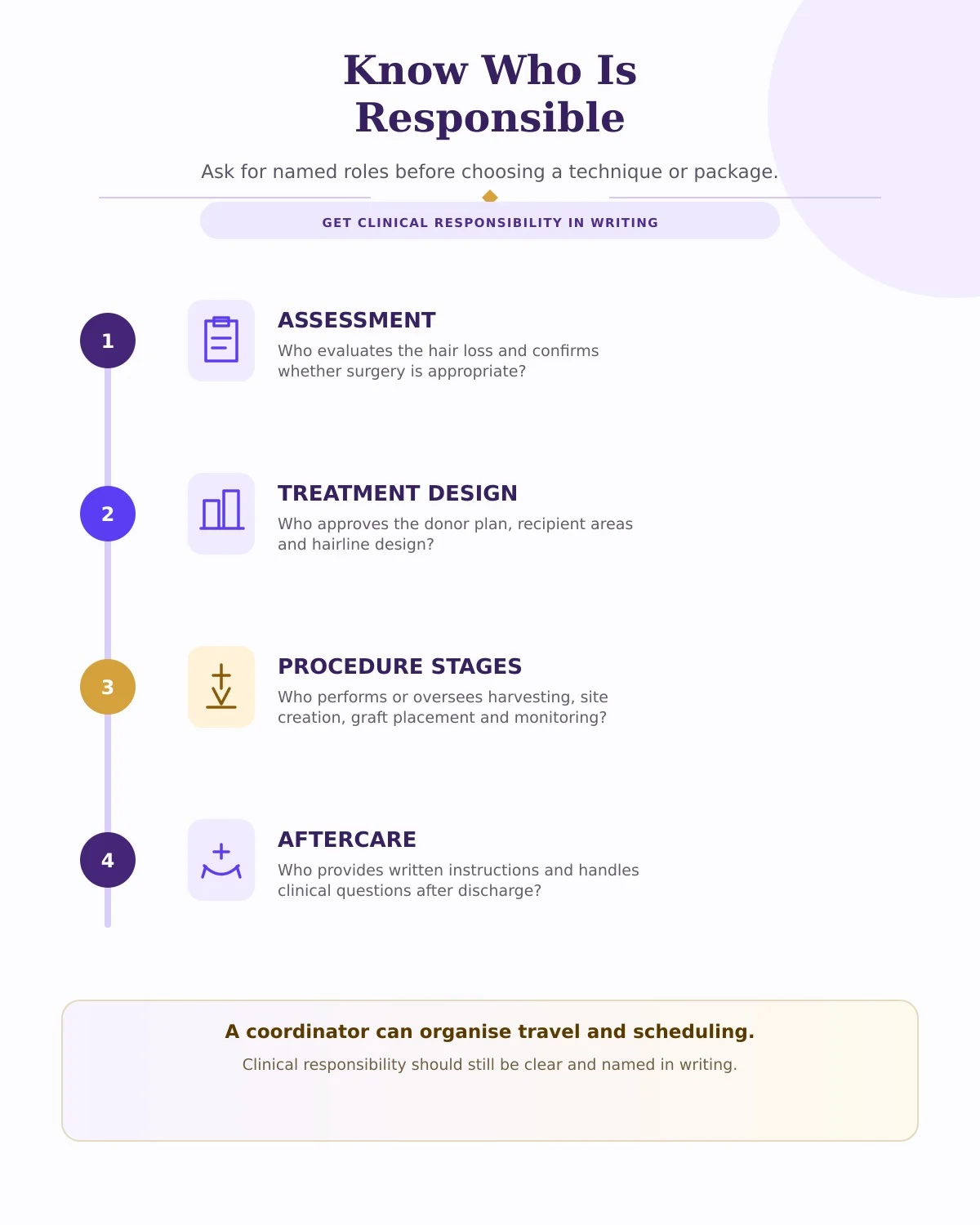
Whether a clinic describes a procedure as FUE, DHI or Sapphire FUE, the patient should receive a clear written explanation of clinical responsibility.
Ask for the names and roles of the people involved in:
| Clinical stage | What to clarify |
| Assessment | Who evaluates the hair loss and confirms whether surgery is appropriate? |
| Treatment design | Who approves the donor plan, recipient areas and hairline? |
| Anaesthesia and monitoring | What is planned, who administers it and how is the patient monitored? |
| Donor harvesting | Who performs this stage and who has clinical responsibility? |
| Recipient-site creation | Who decides the direction, angle and depth of placement sites? |
| Graft placement | Who places grafts and what supervision applies? |
| Aftercare | Who provides written instructions and handles clinical concerns after discharge? |
The ISHRS patient question guide encourages patients to ask who will evaluate the hair loss, who will be involved in surgery and what each person’s training, licensure and role will be.
A coordinator can be valuable for translation, travel and scheduling. But coordination is not the same as diagnosis or surgical responsibility. Local professional roles and regulations can vary, so written clarity is essential.
Recovery expectations should not come from a marketing label
FUE, DHI and Sapphire FUE may involve different workflow details, but none of their names creates a universal recovery timetable. Instructions for washing, sleeping, activity, sun exposure, medication, travel and when to seek help should come from the treating clinical team.
Do not infer that a procedure is risk-free, scar-free or suitable for early travel simply because it is described as ‘DHI,’ ‘Sapphire’ or ‘minimally invasive.’ Ask for written aftercare instructions and a clear contact route before booking flights.
Questions to ask before choosing a label or package
- What is the suspected cause of my hair loss, and what still needs in-person assessment?
- Is FUE being used for donor harvesting in my case?
- Does ‘DHI’ describe an implanter, immediate implantation or another clinic-specific workflow?
- Does ‘Sapphire FUE’ describe recipient-site creation only, and which exact step uses the sapphire instrument?
- Who will assess my donor area and decide the safe graft range?
- How will the plan account for future hair loss?
- Which areas are prioritised, and why?
- How much shaving is likely, and could this change after examination?
- Who performs donor harvesting, recipient-site creation and graft placement?
- What anaesthesia and monitoring arrangements are planned?
- How will grafts be handled and protected during the procedure?
- What is included in the written quotation and aftercare plan?
- What records and instructions will I receive before returning home?
Frequently Asked Questions
Is DHI better than FUE?
Not as a universal rule. FUE usually describes donor harvesting, while DHI commonly describes an implantation approach. The right plan depends on diagnosis, donor supply, recipient-area goals, hair characteristics, clinical workflow and the qualifications of the treating team.
Is Sapphire FUE a separate hair-transplant method?
Usually, it describes the use of a sapphire-bladed instrument during recipient-site creation within an FUE workflow. It does not automatically describe every stage of treatment or prove that one result will be better for every patient.
Does DHI mean that I will not need shaving?
No. Shaving requirements depend on the individual plan, donor area, recipient area, amount of hair loss and clinic workflow. Ask for the expected shaving plan in writing.
Does FUE leave scars?
FUE does not create a linear strip scar, but it still involves small circular donor-site excisions. Any visible scarring and healing experience can vary by individual and by how the procedure is performed.
Can a clinic promise a specific density or result?
No responsible provider can guarantee an individual cosmetic or clinical outcome. Donor supply, scalp characteristics, graft quality, healing and future hair loss can all affect the result.
What matters most when comparing two proposals?
Compare the diagnosis, donor assessment, intended coverage, hairline planning, named clinical roles, graft-handling workflow, aftercare plan, written quotation and records provided—not only the technique label.
Explore hair-transplant options with Venoramed
Explore Hair Transplant treatment information and review Venoramed’s doctor and clinic safety checklist before requesting consultation or coordination support.
Venoramed does not provide direct treatment, diagnose hair loss, choose a surgical technique or guarantee an outcome. Any treatment and travel decision should follow an individual assessment by an appropriately qualified clinician.


Leave a Comment
Share your question or experience. Venoramed reviews comments before publishing.