

Medical treatment costs in Turkey cannot be reduced to one reliable price list.
A figure displayed on a doctor profile, clinic website or social-media advertisement may represent only a starting point. It may not include the healthcare facility, anaesthesia, diagnostic tests, medical materials, medication, follow-up appointments, accommodation, transfers or the cost of managing an unexpected complication.
For an international patient, the more useful question is not simply, “How much does treatment cost in Turkey?” It is: “What exact treatment is being proposed, what is included in the quotation, what could change after examination and what will the complete medical journey cost?”
Turkey has a large international healthcare sector. According to official health tourism data from USHAŞ, 1,398,580 people travelled to Türkiye for healthcare services in 2025, with a further 302,487 visitors recorded during the first quarter of 2026. The scale of the sector creates a wide range of providers, treatment models and package structures, but it does not create one standard price for each procedure.
Patients who are still learning how treatment abroad works should begin with Venoramed’s practical guide to medical tourism in Turkey. This article focuses specifically on understanding medical treatment costs in Turkey and comparing written quotations without relying on incomplete headline prices.
Venoramed is a medical marketplace that helps users explore treatment categories and compare available specialist doctor profiles. It is not a clinic or hospital and does not determine final treatment prices. A final quotation must come from the relevant healthcare provider after reviewing the patient’s individual circumstances.
Why There Is No Single Price for Medical Treatment in Turkey
Two patients requesting a procedure with the same general name may receive different treatment plans.
For example, “dental implants” could mean:
- One straightforward implant
- Several implants
- Extractions followed by implants
- Bone grafting
- Sinus lifting
- Temporary teeth
- Full-arch rehabilitation
- Treatment requiring more than one visit
“Rhinoplasty” could refer to:
- Primary cosmetic rhinoplasty
- Functional nasal surgery
- Revision rhinoplasty
- Reconstructive surgery
- A combined functional and cosmetic procedure
Similarly, bariatric surgery, body contouring, hair transplantation and cancer surgery all require individual assessment.
The final cost may therefore depend on:
- The patient’s diagnosis or treatment objective
- Medical history
- Complexity of the procedure
- Doctor’s proposed technique
- Healthcare facility
- Anaesthesia
- Length of surgery
- Hospital admission
- Laboratory testing
- Medical imaging
- Implants, prostheses or other materials
- Medication
- Number of treatment stages
- Follow-up requirements
- Length of stay in Turkey
- Need for an accompanying person
- Additional treatment identified after examination
A general procedure name is not detailed enough to support a meaningful price comparison.
Starting Price vs Final Quotation
Understanding the difference between a starting price and a final quotation is essential when comparing medical treatment costs in Turkey.
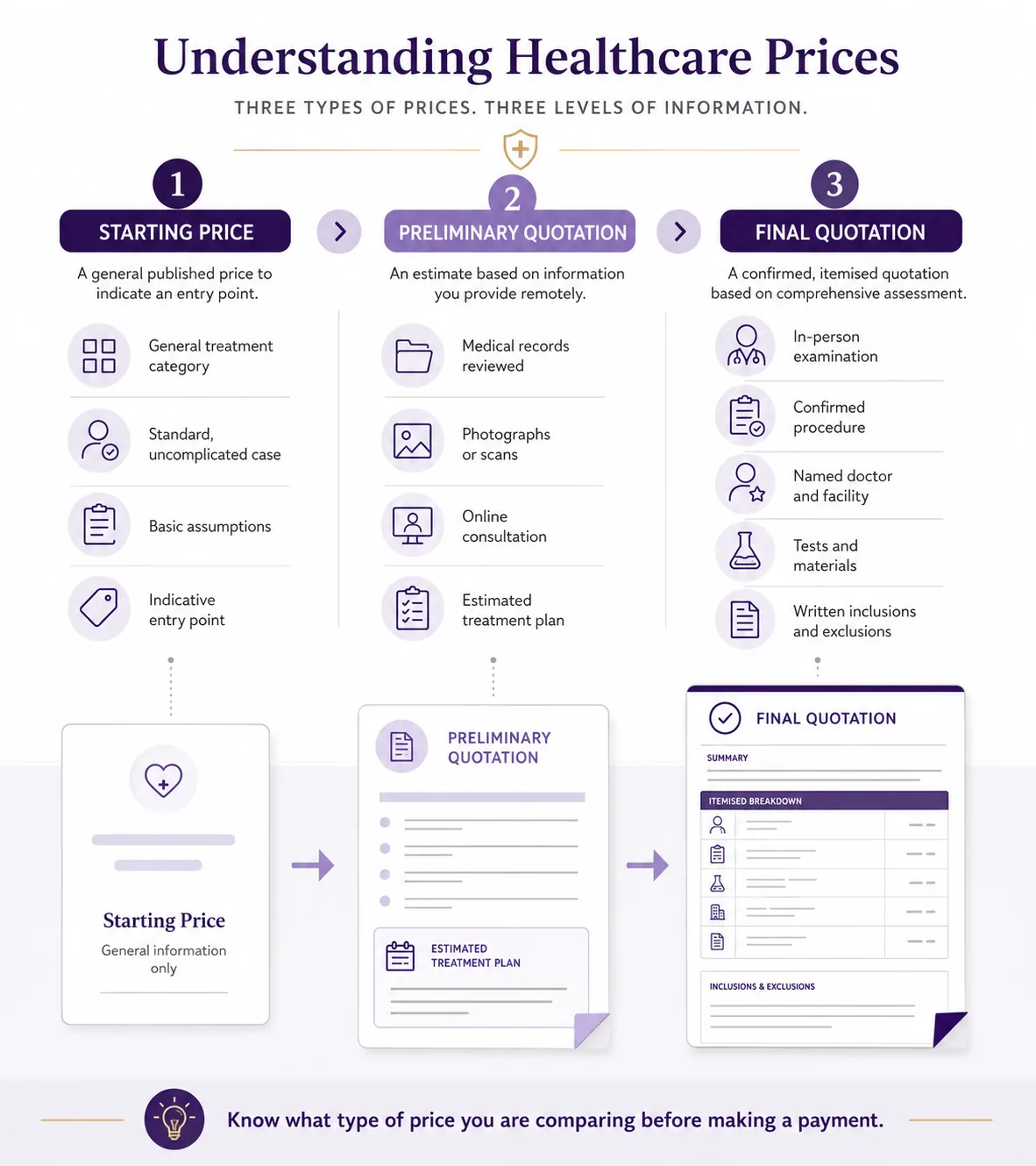
What Is a Starting Price?
A starting price is an indicative figure showing the lowest or typical entry point for a service under certain assumptions.
It may assume:
- A straightforward case
- A standard treatment method
- No additional tests
- No complex medical history
- No hospital admission beyond the standard package
- Standard medical materials
- No additional procedures
- A particular number of grafts, implants or treatment areas
A starting price can help a patient decide whether further research is worthwhile. It should not be treated as a binding final cost.
What Is a Preliminary Quotation?
A preliminary quotation may be issued after the provider reviews medical records, photographs, dental scans, imaging, laboratory reports, previous operation reports, medication history or information supplied through an online consultation.
This quotation is more specific than an advertised starting price, but it may still change after an in-person examination or new diagnostic information.
What Is a Final Quotation?
A final quotation should reflect the treatment plan confirmed after the provider has enough information to make a responsible decision.
It should identify:
- The exact procedure
- Treating doctor
- Healthcare facility
- Type of anaesthesia
- Medical services included
- Materials included
- Follow-up services
- Non-medical services
- Exclusions
- Payment schedule
- Circumstances that could change the price
For many procedures, the most reliable final decision can only be made after examination, testing or imaging.
Patients should therefore ask whether a figure is an advertised starting price, estimate, preliminary quotation, fixed quotation, price range, package price or deposit request. These terms should not be assumed to mean the same thing.
A Five-Part Model for Calculating the Real Cost
A useful way to compare medical treatment packages is to separate the total cost into five parts.

1. Core Medical Costs
These are the costs directly related to assessment and treatment. They may include:
- Doctor’s consultation
- Surgeon or treating professional’s fee
- Assistant fees
- Anaesthetist
- Operating theatre or treatment room
- Hospital or clinic charge
- Nursing care
- Laboratory tests
- Imaging
- Medication administered during treatment
- Medical materials
- Implants or prostheses
- Pathology
- Hospital admission
- Follow-up appointments
2. Treatment-Specific Materials and Services
Some treatments involve products or stages that significantly affect the quotation.
- Implant system and prosthetic components in dentistry
- Crowns, veneers or bridge materials
- Number of grafts in hair transplantation
- Compression garments after body-contouring surgery
- Surgical implants
- Pathology and molecular testing in cancer treatment
- Nutritional and dietetic follow-up after bariatric surgery
- Additional imaging or laboratory monitoring
The quotation should identify important brands, specifications or quantities where these affect treatment quality, compatibility or price.
3. Travel and Recovery Costs
The medical invoice is only part of the total expense. Patients may also need to budget for:
- Flights
- Visa costs where applicable
- Accommodation
- Airport transfer
- Transport to follow-up appointments
- Meals
- Interpreter
- Companion’s travel
- Companion’s accommodation
- Additional hotel nights
- Changeable return flights
- Airport assistance
- Medication after discharge
- Local follow-up after returning home
NHS treatment-abroad checklist advises patients to include fluctuating exchange rates, possible extensions of the stay and potential return trips when calculating the cost of overseas treatment.
The required recovery period should be based on medical advice, not the number of hotel nights included in a package. Venoramed’s guide to how long to stay in Turkey after surgery explains the factors that may affect follow-up and travel timing.
4. Conditional Costs
Conditional costs are not always required, but they may become necessary depending on the patient’s examination or recovery.
- Additional blood tests
- Further imaging
- Cardiology or anaesthesia consultation
- Extra hospital nights
- Treatment-plan changes
- Additional medication
- Blood products
- Intensive care
- Extended accommodation
- Flight changes
- Additional follow-up appointments
- A second trip for multi-stage treatment
- Local treatment after returning home
These costs should not be hidden. The provider should explain which circumstances could activate them.
5. Financial Contingency
A patient should not plan a medical trip using only the exact amount shown in the initial quotation. A practical budget should include a contingency for currency movements, bank charges, card fees, extended recovery, additional transport, missed or changed flights, companion expenses, emergency assessment, unplanned accommodation and follow-up treatment.
This does not mean that complications are expected. It means the patient is financially prepared if the original schedule changes.
What Should an Itemised Medical Quotation Include?
A quotation is easier to compare when every important item is listed separately.

| Quotation item | What the patient should confirm |
| Treating doctor | Full name and personal role in the procedure |
| Proposed treatment | Exact procedure rather than a general package name |
| Healthcare facility | Legal name and address |
| Doctor’s fee | Consultations, treatment and follow-up included |
| Facility fee | Operating room, treatment room, recovery area or admission |
| Anaesthesia | Anaesthetist, anaesthetic medication and monitoring |
| Tests and imaging | Which investigations are included |
| Medical materials | Brand, type or quantity where relevant |
| Medication | Medication during treatment and after discharge |
| Hospital stay | Number and type of included nights |
| Follow-up | Number, timing and format of appointments |
| Interpreter | Whether medical interpretation is included |
| Accommodation | Hotel name, room type and number of nights |
| Transfers | Exact journeys included |
| Companion services | What is included for an accompanying person |
| Additional costs | Circumstances that may increase the price |
| Complication policy | What additional treatment is covered or excluded |
| Revision policy | Conditions, time limits and exclusions |
| Cancellation policy | Deposit and refund rules |
| Currency | Currency used for the invoice and payment |
| Payment recipient | Clinic, hospital, doctor, facilitator or another entity |
The same items should be compared across every provider. A quotation containing fewer lines is not necessarily cheaper. It may simply contain fewer included services.
How to Compare Two Quotations Fairly
Patients often compare quotations that are not based on the same treatment assumptions. Before deciding which offer is less expensive, normalise the information.
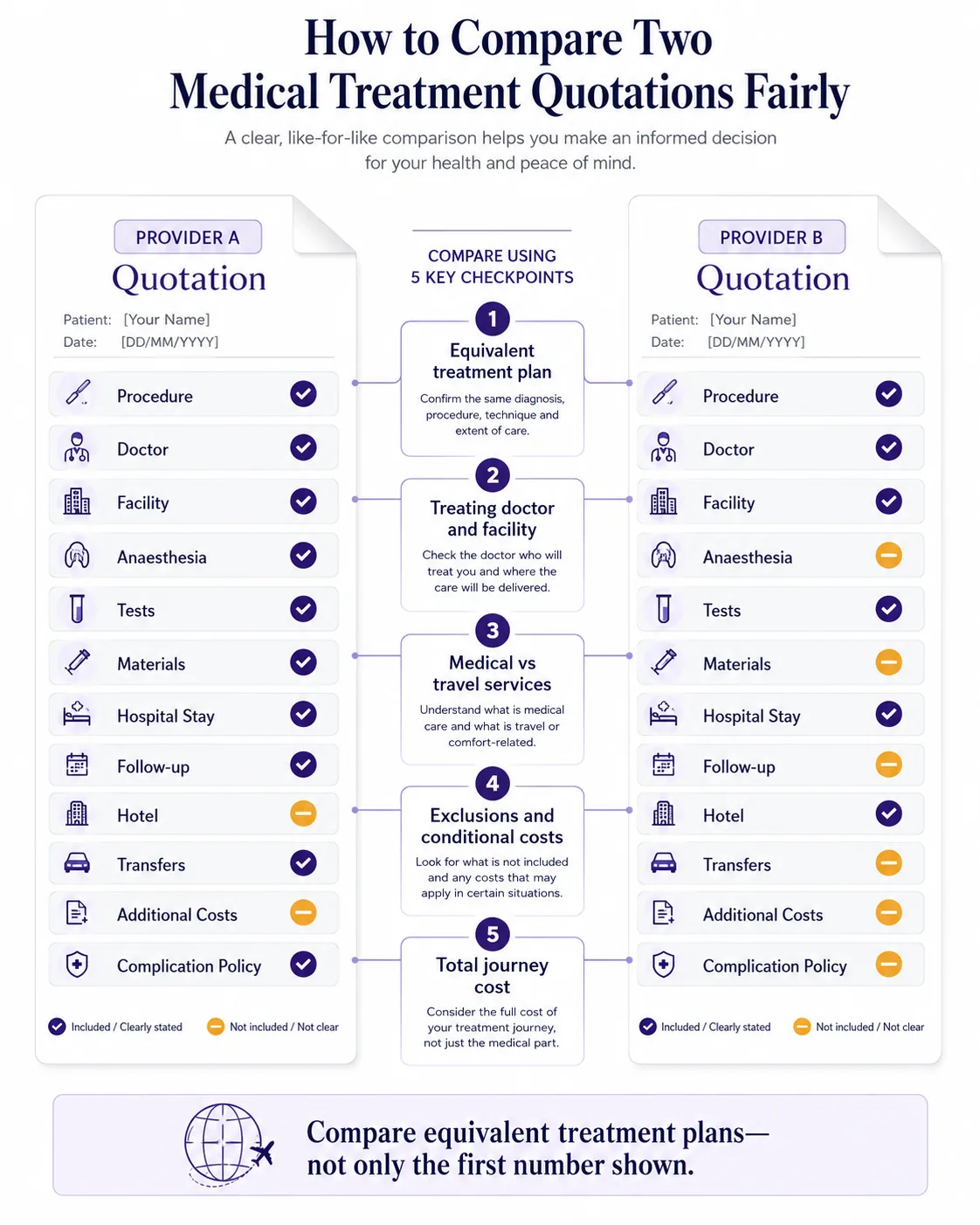
Step 1: Confirm That the Proposed Treatment Is the Same
Check whether both providers are recommending the same procedure, number of treatment areas, number of implants or grafts, medical materials, type of anaesthesia, hospital stay and number of treatment stages. A cheaper quotation may be for a different or less extensive procedure.
Step 2: Confirm Who Will Perform the Treatment
Compare the treating doctor, medical specialty, role of assistants or technicians, anaesthetist, follow-up provider and facility where treatment will occur. The provider and facility should be evaluated separately. Venoramed’s patient safety checklist for choosing a doctor and clinic in Turkey explains how to check identities, specialties, facilities and aftercare arrangements.
Step 3: Separate Medical and Travel Services
Create two sections. Medical services may include consultation, procedure, anaesthesia, hospital, tests, materials, medication and follow-up. Travel and support services may include hotel, transfers, interpreter, companion services and travel assistance. This makes it easier to see whether a package is medically comprehensive or mainly travel-focused.
Step 4: Add Excluded Costs
For every quotation, identify what is not included, what may be charged later, what must be paid directly to the hospital, which materials are upgrades, which tests may be added and what happens if the treatment changes.
Step 5: Calculate the Complete Journey
A useful comparison is: confirmed medical costs + travel and accommodation + recovery expenses + possible additional services + financial contingency = estimated total cost of the medical journey. This total is more meaningful than the first number displayed in an advertisement.
Why Medical Quotations May Differ
A higher or lower quotation does not automatically indicate better or worse care. Differences may result from different treatment plans, doctor fees, facilities, anaesthesia methods, material brands, hospital-stay requirements, follow-up arrangements, support services, package exclusions, currency assumptions or case complexity.
The patient should ask the provider to explain the difference rather than drawing conclusions from price alone.
Treatment-Specific Examples
This article does not provide procedure price lists because such lists can become outdated and cannot account for individual treatment needs. The following examples show why quotations vary between treatment categories.
Dental Treatments
When comparing dental treatment options in Turkey, the quotation may depend on the number of teeth being treated, extractions, implants, implant brand, bone grafting, sinus lifting, temporary restorations, crown or veneer material, laboratory work, number of visits and anaesthesia. A quotation for “full-mouth treatment” should identify each stage and material rather than using only a package name.
Hair Transplantation
A hair-transplant quotation may be affected by the treatment area, donor-area condition, estimated graft count, extraction and implantation methods, doctor and technician roles, procedure duration, medication, first washing, follow-up, accommodation and transfers. A high graft number should not automatically be interpreted as better value.
Facial Refinement and Rhinoplasty
The cost of facial procedures and rhinoplasty may vary according to primary or revision surgery, cosmetic or functional objectives, need for cartilage grafts, previous surgery, length of surgery, hospital, anaesthesia, overnight admission, combined procedures and follow-up requirements.
Body Contouring
A body-contouring quotation may depend on the number of body areas, tissue distribution, liposuction alone or skin removal, muscle repair, combined procedures, length of surgery, admission, compression garments, mobility and aftercare. A package combining several procedures should be assessed medically, not selected only because the combined price appears attractive.
Bariatric Surgery
A bariatric-surgery package may include surgical consultation, anaesthetic assessment, blood tests, imaging, endoscopy where required, hospital admission, surgeon, anaesthetist, medication, dietetic consultation, post-operative diet plan, vitamins, follow-up tests and long-term monitoring. The operation is only one part of bariatric care.
Oncologic Surgery
The cost of oncologic surgery may depend on cancer type, stage, pathology review, imaging, specialist consultation, multidisciplinary assessment, surgical complexity, reconstruction, hospital stay, intensive care, post-operative pathology, additional oncology treatment and follow-up planning. Cancer-related quotations should not be compared before confirming that the diagnosis, staging and proposed treatment are equivalent.
What Does “All-Inclusive” Mean?
“All-inclusive” is a marketing description, not a universal medical standard. One provider may use the phrase for surgery, hospital, anaesthesia, tests, medication, hotel, transfers, interpreter and follow-up. Another may use the same phrase while excluding pre-operative testing, additional hospital nights, medical materials, medication after discharge, companion costs, complication treatment, revision surgery, extended accommodation or return visits.
Patients should ask for the phrase “all-inclusive” to be replaced by a written list. A complete package should state included medical services, included travel-related services, excluded services, possible additional charges, conditions that may change the package, responsibility for complications, and cancellation and refund terms.
Common Hidden or Overlooked Costs
The following costs are often missed when patients focus only on the main procedure price.

Additional Diagnostic Tests
The online assessment may not identify every test required before treatment.
Additional Hospital Nights
Recovery may require longer observation than originally planned.
Upgraded Medical Materials
A basic price may apply to one material, while another brand or specification costs more.
Companion Expenses
A companion’s flight, room, food and transport may not be included.
Extended Accommodation
The patient may need to remain in Turkey longer for follow-up or recovery.
Flight Changes
A fixed return ticket may become expensive if the doctor advises delaying travel.
Local Follow-Up
The patient may need wound care, dental adjustments, blood tests, imaging or specialist review after returning home.
Repeat Visits
Dental rehabilitation, reconstructive treatment and some staged procedures may require another trip.
Currency and Payment Charges
The final amount paid may be affected by exchange-rate changes, international transfer fees, card-provider charges, conversion fees or payment in a different currency from the quotation. NHS treatment-abroad checklist specifically advises patients to account for exchange-rate movements, extended stays and possible return journeys when evaluating overseas treatment costs.
Deposits, Payments and Currency
Before sending a deposit, the patient should know:
- Who is receiving the payment?
- What service does the deposit reserve?
- Is the deposit refundable?
- Can the date be changed?
- Can the deposit be transferred to another doctor?
- What happens if the doctor becomes unavailable?
- What happens if the patient is medically unsuitable?
- What happens if the treatment plan changes?
- When is the remaining balance due?
- Which currency is used?
- Will an invoice or receipt be provided?
- Are bank and card fees included?
The recipient’s name should make sense in relation to the service. If payment is going to a company different from the clinic, hospital or doctor, the patient should ask for a written explanation of that company’s role.
Cancellation and Refund Policies
A refund policy should be reviewed before travel. It should explain what happens if the patient cancels, the provider cancels, the named doctor changes, the healthcare facility changes, travel is disrupted, the patient is found medically unsuitable, tests reveal that another procedure is required, the patient decides not to proceed after the in-person consultation, the procedure must be postponed or only part of the package is used.
Patients should not assume that a deposit is refundable because the treatment did not occur. Refund rights may depend on the contract, payment recipient, timing, reason for cancellation and applicable law. Any unclear term should be clarified in writing before payment.
Complications and Revision Costs
Every medical procedure carries some possibility of complications or an unsatisfactory outcome. Financial questions should be discussed before treatment:
- Which complications can the provider manage?
- Where will additional care take place?
- Are additional hospital costs included?
- Who pays for medication or testing?
- What if the patient has returned home?
- Does the provider cover a return procedure?
- Is accommodation covered?
- Is revision surgery included?
- What conditions exclude revision?
- Is the original doctor required to approve it?
- Is there a time limit?
- Are facility and anaesthesia fees included in a revision policy?
CDC medical tourism guidance warns that follow-up care after complications can be expensive, prolonged and potentially excluded from the patient’s health-insurance coverage. It recommends planning for possible out-of-pocket costs before travelling.
A “free revision” statement may still exclude hospital fees, anaesthesia, tests, medication, travel, accommodation, lost income and treatment at home. The complete policy matters more than the word “free”.
Insurance and Medical-Tourism Costs
Standard holiday insurance should not automatically be assumed to cover planned medical treatment. NHS guidance on medical treatment abroad states that most ordinary travel-insurance policies do not cover planned treatment abroad and that specialist cover may be required.
Patients should ask an insurer whether the policy covers the planned treatment, cancellation because of medical concerns, complications, additional hospital treatment, extended accommodation, new flights, medical evacuation, care after returning home, pre-existing conditions and a companion’s extended stay. The answer should be obtained in writing where possible.
Insurance coverage does not replace a clear complication policy from the healthcare provider.
Authorisation and Price Are Separate Issues
A competitive price does not demonstrate that a facility is appropriately authorised. Turkey’s current international health-tourism framework is based on the Regulation on International Health Tourism and Tourist Health published on 9 May 2025. The Ministry of Health also maintains separate authorised-provider lists for hospitals, medical centres, private practices and other healthcare providers.
Patients should confirm the full legal name of the treating facility, facility type, address, whether treatment will occur there, and relevant international health-tourism authorisation. A facility’s authorisation does not guarantee a treatment result, but price comparison should not replace regulatory checks.
Red Flags When Comparing Treatment Prices
Pause before paying when:
- The price is available before any medical information is reviewed.
- The provider will not identify the treating doctor.
- The treatment facility is not named.
- The quotation contains only one total number.
- The phrase “all-inclusive” is not defined.
- The provider refuses to identify exclusions.
- The patient is pressured to pay immediately.
- A discount expires within hours.
- The treatment plan changes repeatedly without medical explanation.
- Additional procedures are added as sales upgrades.
- The payment recipient is unclear.
- No invoice is provided.
- The complication policy is verbal only.
- The refund policy is unavailable.
- The provider guarantees a result.
- The price is dramatically lower but no one can explain why.
A low price is not automatically a warning sign. An unexplained price is.
Questions to Ask Before Accepting a Quotation
1. Is this a starting price, estimate or final quotation?
2. Which doctor reviewed my case?
3. What exact treatment is included?
4. What could change after examination?
5. Where will treatment take place?
6. Is the facility authorised for international health tourism?
7. Is the doctor’s fee included?
8. Is anaesthesia included?
9. Are tests and imaging included?
10. Which medical materials are included?
11. Are medication and follow-up included?
12. How many hospital nights are included?
13. How many hotel nights are included?
14. Which transfers are included?
15. Is an interpreter included?
16. What services are excluded?
17. What circumstances create additional charges?
18. What happens if I am not medically suitable?
19. What is the deposit policy?
20. What is the cancellation policy?
21. What is the complication policy?
22. What is the revision policy?
23. Which currency will I pay in?
24. Who receives the payment?
25. Will I receive an invoice and receipt?
How Venoramed Supports Cost Comparison
Venoramed allows users to explore specialist doctor profiles and treatment categories in Turkey. Profile information may help patients initially compare specialty, treatment focus, city, languages, education, experience, available services and indicative starting prices where displayed.
A starting price displayed on a profile should be treated as a reference point for further discussion, not as a final medical quotation.
Patients can use the platform to:
1. Identify doctors associated with the relevant treatment.
2. Review available professional information.
3. Compare profile details.
4. Request an individual assessment.
5. Ask for a written treatment plan.
6. Obtain an itemised quotation.
7. Confirm the healthcare facility.
8. Compare complete costs before making a decision.
Venoramed does not set the provider’s final price, diagnose the patient or guarantee that a quoted treatment will remain unchanged after examination.
Frequently Asked Questions
Are medical treatment costs in Turkey fixed?
No. Final costs depend on the patient, procedure, doctor, facility, anaesthesia, tests, materials, recovery requirements and included services.
Why does a doctor profile show a starting price?
A starting price may indicate the approximate entry point for a straightforward or standard case. The final quotation requires individual assessment.
Is the cheapest quotation the best option?
Not necessarily. It may exclude important medical services, materials, hospital fees, follow-up or complication care. Compare the complete plan.
What should be included in a treatment package?
The package should define medical services, facility charges, anaesthesia, tests, materials, medication, follow-up, accommodation, transfers, interpretation and all exclusions.
Can the price change after I arrive in Turkey?
It may change if examination, testing or imaging reveals that the original plan is incomplete or unsuitable. The provider should explain possible changes before travel.
Should I pay the full amount before travelling?
Payment structures vary. Before paying, review the deposit, refund, cancellation and treatment-change policies and confirm who receives the money.
Does “all-inclusive” include treatment of complications?
Not automatically. The provider must define whether complications, additional hospital care, medication, revision treatment, travel and accommodation are included.
Does travel insurance cover planned treatment?
Many ordinary travel policies do not cover planned medical treatment abroad. Specialist insurance may be required.
Should I compare prices in the same currency?
Yes. Convert all quotations using the same exchange-rate assumption and include transfer or card fees.
Do treatment packages include flights?
Some may, but many do not. Every travel-related service should be confirmed in writing.
What happens if I need to stay longer?
Clarify responsibility for additional accommodation, transport, medication, follow-up and flight changes before booking.
Can Venoramed provide my final treatment price?
Venoramed can support initial doctor and treatment research, but the final quotation must come from the relevant provider after individual assessment.
Final Cost-Comparison Checklist
Before selecting a quotation, confirm that:
- The proposed treatments are comparable.
- The treating doctors are identified.
- The healthcare facilities are identified.
- The quotations use the same currency.
- Medical services are itemised.
- Medical materials are identified.
- Anaesthesia is included or excluded clearly.
- Tests and imaging are identified.
- Hospital nights are confirmed.
- Follow-up appointments are confirmed.
- Travel and accommodation are separated.
- Excluded services are listed.
- Additional-charge conditions are explained.
- Complication policies are written.
- Revision policies are written.
- Cancellation and refund conditions are understood.
- Payment recipients are identified.
- Insurance coverage has been checked.
- Recovery and return-travel costs are included.
- A financial contingency has been planned.
Medical treatment costs in Turkey should be compared through the complete treatment plan—not through the lowest number displayed online.
A transparent quotation allows patients to understand what they are buying, which costs are conditional and what responsibilities remain after treatment. It cannot remove medical risk, but it can reduce financial uncertainty and help patients make a more informed decision.
Medical Disclaimer
This article provides general information and does not constitute medical advice, diagnosis, financial advice, legal advice or a recommendation to undergo treatment. Treatment suitability and clinical decisions must be discussed with an appropriately qualified healthcare professional.
Platform Disclaimer
Venoramed is a medical marketplace and is not a clinic, hospital, insurer or financial provider. Profile prices may be indicative and do not represent a final quotation or guarantee that a particular treatment is suitable.



2 Comments
Share your question or experience. Venoramed reviews comments before publishing.
[…] Venoramed guide to comparing medical treatment costs and packages explains why a starting price is not a final medical quotation. For rhinoplasty, costs may vary […]
[…] Venoramed’s medical treatment cost and package guide to compare written quotations beyond the advertised starting […]