

Tummy Tuck in Turkey Candidacy Recovery Risks and Travel
Patient information on assessment, recovery planning, risks, travel and questions to ask before booking
A tummy tuck in Turkey can mean very different treatment journeys. One person may be concerned about loose abdominal skin after weight change or pregnancy. Another may be asking about abdominal contour, a scar from a previous operation, or whether muscle separation needs evaluation. The procedure label does not establish whether surgery is appropriate, which variation is being proposed, what recovery will involve, or when travel may be safe.
This guide explains the questions an international patient can use to compare a tummy-tuck proposal more carefully: candidacy, procedure boundaries, scars, anaesthesia and facility arrangements, recovery, clot-risk planning, travel, quotations and aftercare. For a wider treatment overview, see Venoramed’s Body Contouring treatment information.
For broader preparation before arranging treatment abroad, read the Medical Tourism in Turkey guide.
Venoramed is a medical marketplace and coordination platform. It does not diagnose a condition, select a surgical technique, issue individual aftercare instructions, determine fitness to fly or guarantee a result. Those decisions should follow an individual assessment by the appropriately qualified treating clinician.
Tummy tuck is the common name for abdominoplasty. Depending on the individual plan, it may involve removal of excess skin and may involve work on the abdominal wall. It is not a universal response to body dissatisfaction, it is not a substitute for weight management, and it cannot promise a specific shape. The American Society of Plastic Surgeons overview describes abdominoplasty as a procedure that can address excess skin and fat and, in many cases, weakened or separated muscles. That description still does not tell a patient what is suitable in their own case.
- Loose skin or a lower abdominal overhang may be part of the concern, but an assessment is needed to decide what can realistically be addressed.
- Localised fat, skin quality, scars, hernias, posture and abdominal-wall changes are different clinical questions and may not have the same solution.
- A tummy tuck does not remove all stretch marks, correct every contour irregularity or prevent future changes related to weight fluctuation, pregnancy or ageing.
- A responsible consultation should also allow for the possibility that surgery is not appropriate now, that a different plan is relevant, or that more information is needed before any decision.
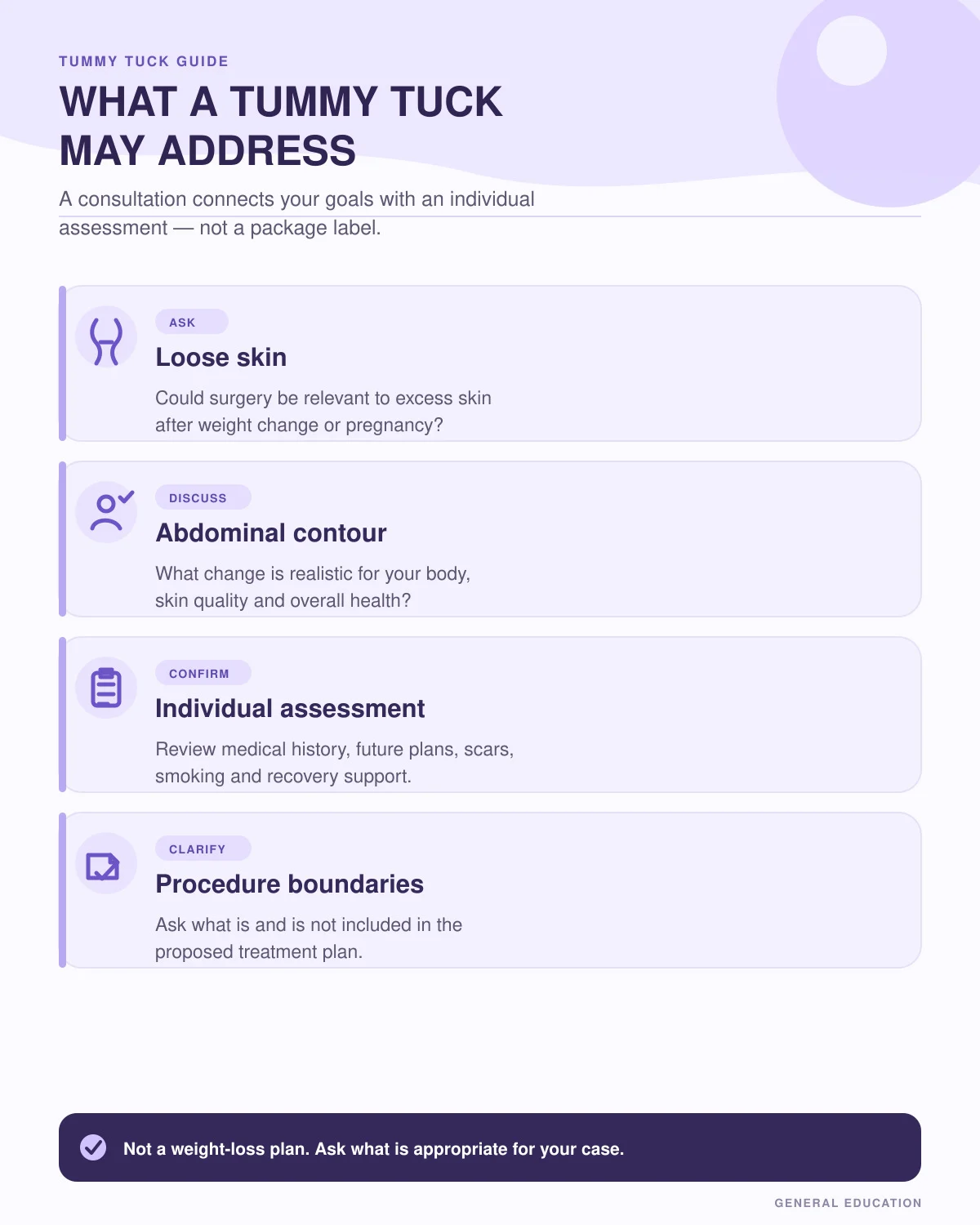
Candidacy is not determined by a single photograph, a body-mass number, a package label or an advertised starting price. A meaningful assessment should consider the patient’s goals, general health, medications, nicotine use, previous operations, allergies, pregnancy plans, support at home, work demands and travel arrangements. The ASPS consultation guidance likewise describes evaluation of health and risk factors, discussion of options and likely outcomes, and a review of risks and possible complications.
Remote photographs and medical records can help begin a conversation. They do not necessarily confirm tissue quality, scar position, muscle separation, safety for anaesthesia or the final scope of surgery. Ask what still needs an in-person examination and whether any medical information could change the plan.
A provider may use terms such as mini tummy tuck, full tummy tuck, extended tummy tuck, fleur-de-lis abdominoplasty, panniculectomy or lipoabdominoplasty. These labels can indicate different incision patterns, areas treated, scar placement, work on the abdominal wall, the relationship to liposuction, or whether excess skin extends beyond the central abdomen. They are not interchangeable package tiers.
Ask the named surgeon to explain the exact proposed procedure in plain language: where the incision may be placed, whether the umbilicus is likely to be involved, whether abdominal-wall work is planned, what role liposuction has if any, and which changes cannot responsibly be promised. A written plan should distinguish what is confirmed, what is provisional and what depends on examination.
Some patients ask about diastasis recti, commonly described as separation of the rectus muscles. Whether abdominal-wall repair is relevant, how it would be assessed and how it changes recovery are individual clinical questions. It should not be assumed from a flat-looking photograph, from pregnancy history alone or from a sales conversation.
Ask whether the concern has been assessed by the treating clinician, whether another condition needs to be ruled out, and how any planned repair would affect movement, lifting, pain control and follow-up. Do not treat online exercise advice or a generic post-pregnancy package as a replacement for this assessment.
An incision creates a scar. Its final appearance can be affected by the procedure variation, individual healing, skin characteristics, wound care, tension, infection, nicotine exposure and other factors. Sensation changes, swelling, tightness and asymmetry concerns can also be relevant during healing. A good consultation should describe the likely scar location and the uncertainty around scar maturation rather than suggesting that a scar will be invisible.
The NHS tummy-tuck guidance notes that there will be a scar, and that recovery takes time. Do not use another patient’s before-and-after photograph as a forecast of your own healing or result. Ask how comparable the case is, what the photo does not show and when an individual result can be meaningfully assessed.
A patient should be able to identify the clinician responsible for the surgical plan, the legal name and location of the facility, the anaesthesia arrangements, the team’s roles during the procedure and the named route for aftercare. Coordination can be helpful for language, transport and scheduling, but it is not the same as clinical responsibility.
Use Venoramed’s doctor and clinic safety checklist to structure the conversation. Ask who assesses fitness for surgery, who administers anaesthesia, how monitoring is arranged, where any overnight observation takes place if relevant, and how a complication is escalated. A price quote should never be the only evidence that these arrangements exist.
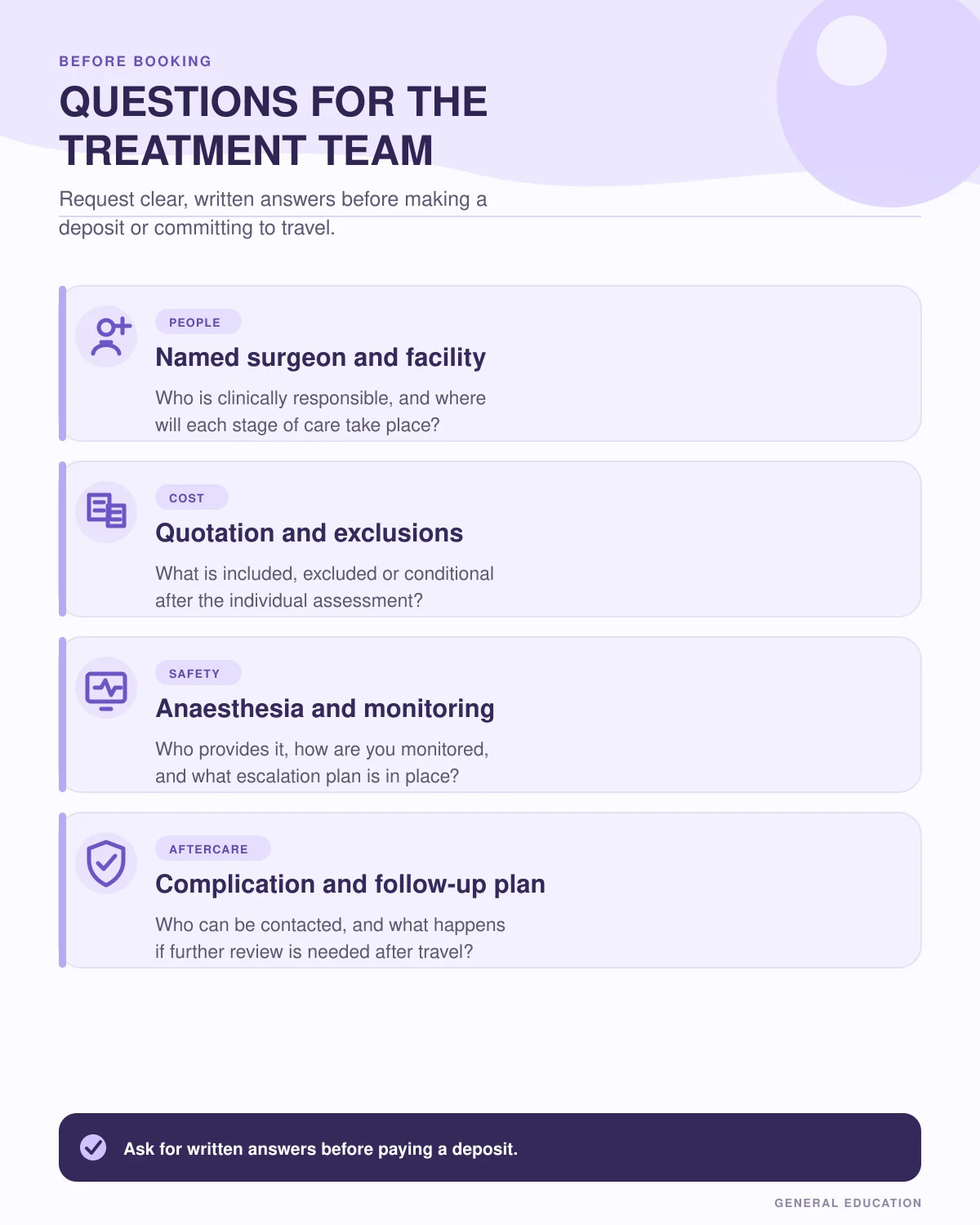
Recovery is a clinical plan, not a universal calendar. The operation, whether abdominal-wall work is performed, the incision pattern, medical history, healing, pain-control plan, work demands and any complications can all change what is appropriate. The NHS gives broad recovery references for tummy-tuck surgery, but written instructions from the treating team should take priority for washing, dressings, compression garments, sleeping, lifting, driving, work, exercise and travel.
| General stage | What may need planning | What must be individual |
| Discharge and early recovery | Rest, prescribed medicines, mobility, support at home and the first clinical review. | Dressings, showering, garments, sleep position, drains if used and when to contact the team. |
| Early follow-up | Review of the incision, comfort, swelling, mobility and travel readiness. | Exact review date, activity limits, wound-care method and work or driving clearance. |
| Return to routine | A staged return to household tasks, work and movement may be discussed. | Lifting, exercise, childcare, physical work and any specific restriction. |
| Longer-term healing | Scar maturation, swelling and contour can continue to change over time. | Timing of outcome assessment, scar care, persistent symptoms and future planning. |
The most useful question is not “What can everyone do on day X?” Instead ask: “What can I do now, what should I avoid, and what symptoms mean I should contact the clinic?” This keeps recovery planning tied to the actual procedure and the clinician responsible for it.
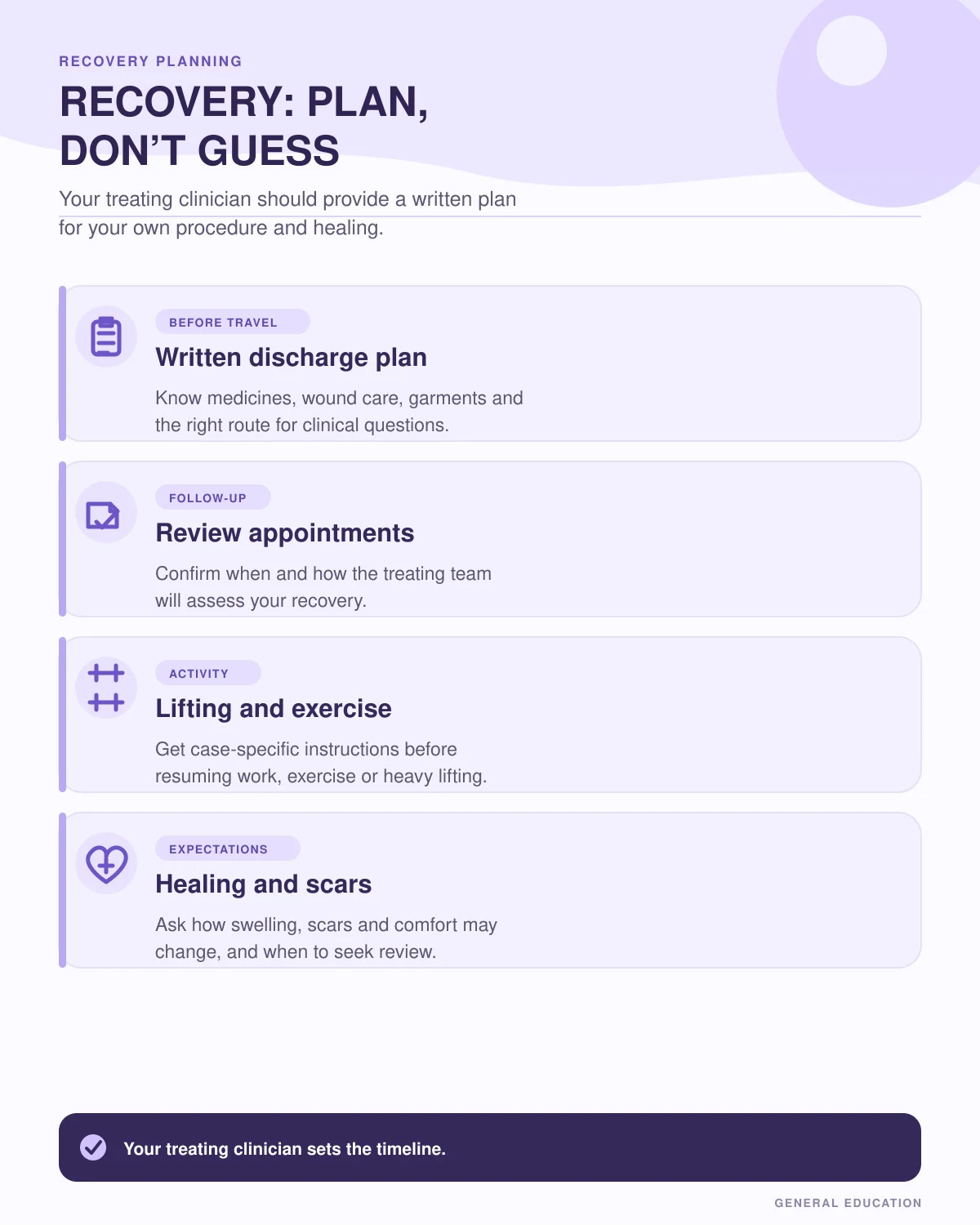
Major surgery and long-distance travel can each increase blood-clot risk. The CDC medical tourism guidance advises that flying after surgery can increase the risk of blood clots and notes that the travel interval should be discussed with the treating clinician. The NHS guidance on cosmetic surgery abroad gives broad travel references, but these are not a personal clearance letter and should not override the operating team’s plan.
Do not make a non-changeable flight or hotel itinerary the deciding factor. Before travel, obtain written answers about the required in-person review, expected stay, medication, mobility advice, records to carry, the clinical contact route after you return home and what would require a longer stay. Venoramed’s guide on how long to stay in Turkey after surgery can help frame these questions, but your own travel timing needs individual clinical approval.
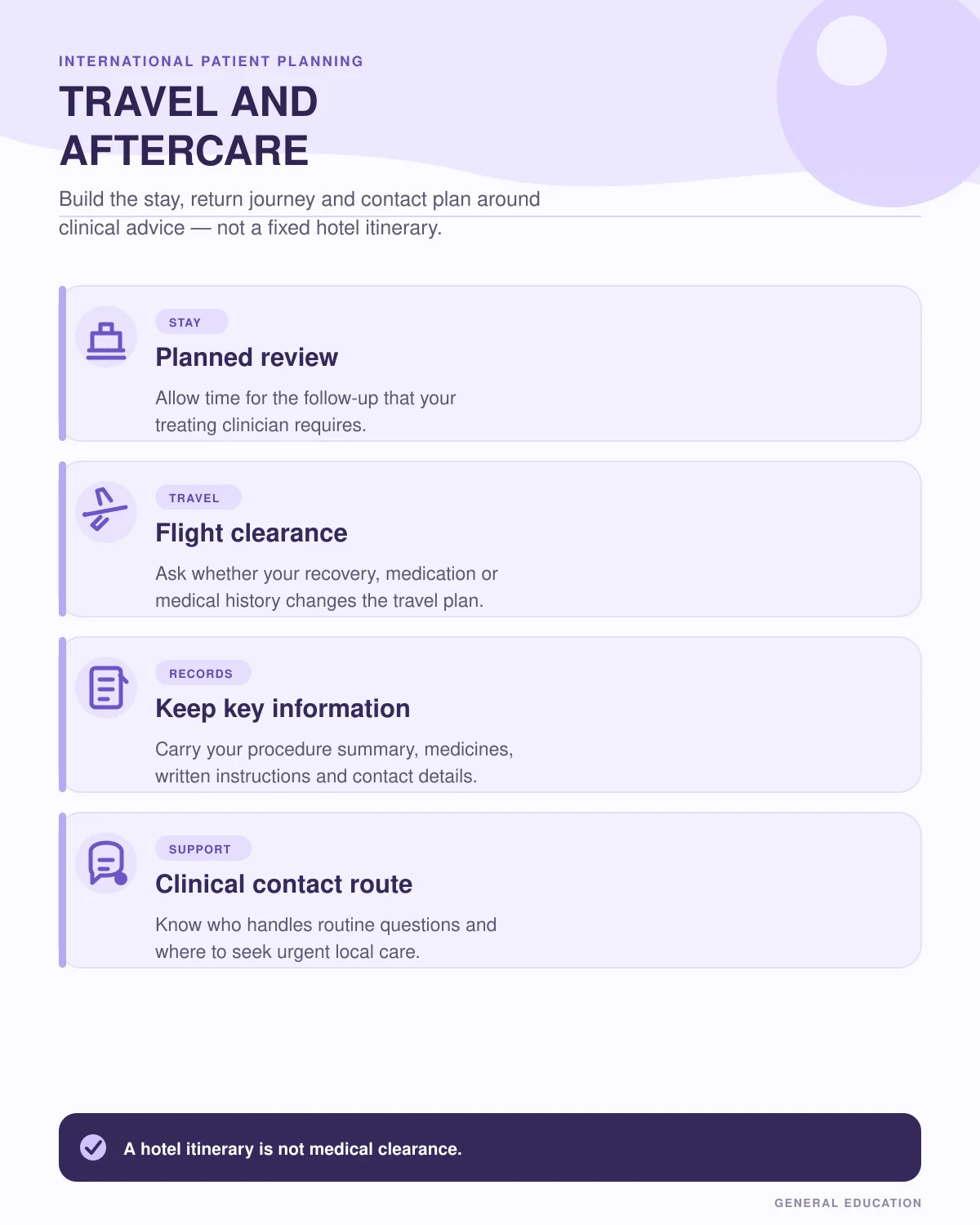
No surgery is risk-free. The ASPS tummy-tuck safety page lists potential risks including anaesthesia risks, bleeding, deep vein thrombosis, fluid accumulation, infection, changes in sensation, poor wound healing, unfavourable scarring and possible revisional surgery. The relevance and likelihood of each risk depend on the individual and the treatment plan.
Before booking, ask how the team distinguishes expected post-operative symptoms from a concern that requires review, how the patient contacts the responsible clinical team outside normal hours, and how care is arranged if the patient has already travelled home. For broader contingency planning, read Venoramed’s guide to complications after treatment abroad.
Severe or rapidly worsening symptoms should not wait for a coordinator or a website chat reply. Seek urgent local care for emergency symptoms such as severe breathing difficulty, chest pain, fainting, uncontrolled bleeding or a severe allergic reaction. For any non-emergency concern, use the written clinical route provided by the treating team.
Some proposals combine abdominoplasty with other operations. A combined plan can affect operative time, anaesthesia exposure, blood-loss considerations, recovery demands, travel planning, childcare and the ability to monitor healing. It should be justified by the patient’s health assessment and the treating team’s clinical judgement, not by a package discount or the desire to complete several changes in one trip.
Ask what benefit is expected from combining procedures, why a staged approach may or may not be safer, and what circumstances would make the clinician postpone or change the plan. A patient considering more than one procedure should also understand the questions around combined and staged recovery rather than assuming that one trip is automatically the right choice.
For patients considering more than one procedure, explore the practical questions around combined and staged mommy makeover procedures.
A starting price does not establish the final cost of a tummy tuck. The quotation can be affected by the proposed variation, facility, anaesthesia, tests, garments, hospital stay, medications, follow-up, translation, transfer, accommodation, changes after examination and the plan for unexpected needs. Ask for a written itemised quotation and identify what remains conditional.
Compare quotes using the same clinical scope rather than asking which package is cheapest. Venoramed’s guide to medical treatment costs in Turkey explains why a headline price is not a complete comparison. A written quotation should also state whether revisions, extra nights, emergency care or travel changes are included, excluded or subject to further assessment.
- What concern is being assessed, and what may not be addressed by the proposed procedure?
- What information still requires an in-person examination before the plan can be confirmed?
- Which tummy-tuck variation is proposed, where may the scar be, and is abdominal-wall work planned?
- Who is the named surgeon, where will treatment take place and who has clinical responsibility at each stage?
- What are the anaesthesia, monitoring and emergency arrangements?
- What written instructions will I receive for medicines, wound care, garments, movement and follow-up?
- How long should I plan to stay, and who gives travel clearance after review?
- Which costs are included, excluded or conditional after assessment?
- What is the aftercare route after I return home, and what symptoms need urgent local care?
Is a tummy tuck a weight-loss operation?
No. A tummy tuck is not a substitute for weight management. It may address excess skin and abdominal contour in selected cases, but whether it is appropriate and what it can realistically achieve require an individual assessment.
Can a tummy tuck remove all stretch marks?
No. Some stretch marks may be removed only if they are within the skin that is excised. Others may remain. Ask the treating clinician to explain what can and cannot be expected in your own case.
How long is tummy-tuck recovery?
Recovery is individual. Broad references can help you plan time away from work and travel, but the treating clinician must provide the actual plan for your procedure, healing and follow-up.
When can I fly after a tummy tuck?
Do not choose the date from a package itinerary alone. The operating team should confirm the required follow-up, travel timing, medication and any individual factors that affect clearance.
Can I combine a tummy tuck with another procedure?
Possibly, but only after an individual safety assessment. A combined operation can change operative time, recovery and travel planning, and it is not automatically safer or more convenient for every patient.
Can a provider guarantee a tummy-tuck result?
No responsible provider can guarantee an individual cosmetic or clinical outcome. Anatomy, procedure scope, healing, scars, complications and future body changes can affect the result.
Explore Body Contouring treatment information and compare available body-contouring doctor profiles before requesting consultation or coordination support.
Venoramed does not provide direct treatment, diagnose medical conditions, choose a surgical plan, issue individual recovery instructions or guarantee a result. Any treatment, recovery and travel decision should follow an assessment by an appropriately qualified clinician.


Leave a Comment
Share your question or experience. Venoramed reviews comments before publishing.