

Droopy nose tip surgery is a form of rhinoplasty (nose reshaping surgery) that lifts and supports a nasal tip which points downwards, either all the time or only when you smile. For many people the droop is small on paper but very noticeable in photographs, especially in profile, where the tip seems to hang towards the upper lip.
This guide explains why a nose tip droops, what a surgeon actually does to lift it, where “tip stitches” fit in, why threads and fillers have real limits, and what recovery, risks and costs look like for patients travelling from the UK and Europe to Istanbul.
Quick answer: Droopy nose tip surgery lifts a downward-pointing tip by rebuilding the support under it, usually with tip sutures (stitches), a cartilage strut or a septal extension graft, and sometimes by releasing the depressor septi muscle that pulls the tip down when you smile. It is a rhinoplasty under general anaesthetic, the splint usually stays on for about a week, and the final shape takes many months to settle.
Key takeaways
- A droopy tip (tip ptosis) usually comes from weakened tip support, ageing changes, an overactive depressor septi muscle or a previous rhinoplasty that lost support.
- Lasting correction is structural: sutures, struts, grafts and repositioning of the cartilage, not just removing tissue.
- A tip that drops only when you smile needs a dynamic assessment, ideally with smiling photographs and video.
- Threads, fillers and muscle-relaxing injections can change the look temporarily, but they do not rebuild support and carry their own risks.
- Plan for about one week in a splint, two weeks before most social or office life, and many months before the tip looks final.
What is a droopy nose tip?
A droopy nose tip is a tip that sits or points lower than the person would like, so the angle between the nose and the upper lip (the nasolabial angle) looks closed rather than open. Surgeons call this tip ptosis, and when the tip looks as though it is plunging towards the lip, some describe it as a “plunging tip”.
The British Association of Aesthetic Plastic Surgeons (BAAPS) rhinoplasty guide lists changing the shape of the tip and changing the angle between the nose and the upper lip among the things rhinoplasty can do, and notes that adjusting the septum and tip cartilage can reduce the length of the nose.
There are two broad patterns, and telling them apart is the first job of any consultation:
- Static droop: the tip is low at rest, because its support has weakened or the tip was always under-rotated.
- Dynamic droop: the tip looks acceptable at rest but drops, and the upper lip shortens, when you smile or talk.
If your main concern is a rounded or wide tip rather than a low one, our guide to bulbous nose tip rhinoplasty covers that separate problem.

Why does the nose tip droop?
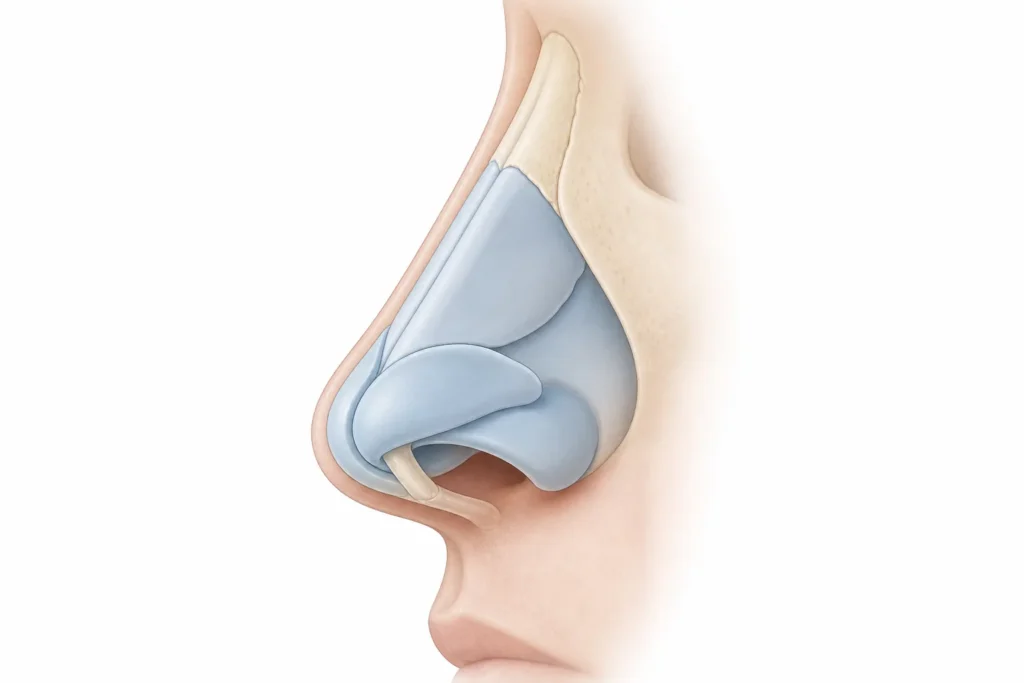
The nose tip droops when the structures holding it up are weaker than the forces pulling it down. Those structures are the lower lateral cartilages (the paired, curved cartilages that shape the tip), their attachments to the septum (the central wall of the nose) and the ligaments and soft tissue around them.
Ageing
Age is one of the most common causes. A 2026 review of rhinoplasty in the ageing nose (Aesthetic Surgery Journal) describes tip ptosis, a “pseudohump” on the bridge and nasal valve collapse as the main age-related changes, driven by reduced skin elasticity, soft-tissue thinning and weakening of the ligaments that suspend the cartilages. This is why an older patient’s droop often comes with breathing complaints too.
Weak or naturally low tip support
Some younger people simply have soft, thin or long tip cartilages, or a short septum that gives the tip little to rest on. The tip looks low from the late teens and never changed. Here the aim is to give the tip a stronger base, not to “pull” the skin up.
Previous rhinoplasty
A tip can also drop months or years after an earlier nose job, if support was weakened during surgery or not rebuilt. A review of the depressor septi nasi muscle in Facial Plastic Surgery warns that once patients use their facial expressions again after rhinoplasty, untouched muscle forces can rotate the tip downwards over the long term. Correcting a droop after previous surgery is a revision, which is usually more complex than a first operation.
Injury and septal problems
Trauma or a damaged septum can remove the central support of the tip and may also block breathing. If you have both a droop and a blocked nose, read our explainer on functional versus cosmetic rhinoplasty before your consultation, because the plan should address both.
Why does my nose tip droop when I smile?
A nose tip that drops when you smile is usually caused by the depressor septi nasi muscle, a small muscle under the upper lip that pulls the base of the nose downwards. The same Facial Plastic Surgery review explains that this muscle moves the tip down and shortens the upper lip during smiling, and that overactivity can make the angle between nose and lip look sharper.
A systematic review in Plastic and Reconstructive Surgery, covering 175 cadaver specimens and 821 treated patients, found that anatomical descriptions vary but the muscle inserts on the medial crura (the inner legs of the tip cartilages). Disrupting that connection is the basis of surgical treatment, although the review found no single technique proven superior.
Releasing the muscle alone may not be enough. In a UK study of 40 endonasal rhinoplasty patients (Plastic and Reconstructive Surgery Global Open, 2021), the nasolabial angle changed by a mean of 3.66 degrees on smiling after muscle release alone, compared with 2.27 degrees when release was combined with a columellar strut graft. The authors concluded that the strut’s added stability reduced tip droop on smiling.
In practical terms: if your tip drops on smiling, send your surgeon a short smiling video and side-profile photographs, at rest and mid-smile. A static photograph alone can hide the problem you most want fixed.
How does nose tip lift surgery work?
Nose tip lift surgery works by repositioning the tip cartilages and fixing them to a stronger support, so the tip sits higher (more rotation) and further from the face where needed (more projection). It is performed under general anaesthetic as an open or closed rhinoplasty; the NHS guide to nose reshaping says the procedure usually takes 1.5 to 3 hours.
In a closed approach the incisions are inside the nostrils. In an open approach the surgeon adds a small cut across the columella (the strip of skin between the nostrils), which gives a direct view of the cartilage and is often chosen when grafts are needed. Surgeons describe this work as part of tip rhinoplasty; a droop is one specific reason for it.
The 2026 ageing-nose review concludes that septal extension grafts, columellar struts and tongue-in-groove positioning can restore tip rotation and projection, and that surgery should prioritise strong cartilage reinforcement rather than simple removal of tissue.
If you would like a surgeon to look at your own tip, the next step is a photo-based review with a rhinoplasty specialist.
Tip stitches, struts and grafts: which technique does what?
Each tip-support technique solves a slightly different problem, and operations often combine several. Here is a plain-English map of the terms in a surgical plan.
| Technique | What it is | What it mainly does | Typical use |
|---|---|---|---|
| Tip sutures (“tip stitches”) | Permanent or long-lasting internal stitches that reshape and bind the tip cartilages | Adjust rotation, projection and tip shape | Mild droop with reasonable cartilage strength |
| Columellar strut graft | A small strip of cartilage placed between the inner legs of the tip cartilages | Adds a “tent pole” under the tip for stability | Weak tip support; dynamic droop combined with muscle release |
| Septal extension graft | Cartilage fixed to the front edge of the septum, extending it towards the tip | Gives strong, controlled support and position | Moderate to marked droop, ageing nose, revision cases |
| Tongue-in-groove | The tip cartilages are stitched onto the front of the septum | Fixes the tip to the septum to control rotation and projection | Droop with a long or strong caudal septum |
| Depressor septi release | Dividing or repositioning the muscle under the upper lip | Reduces downward pull on smiling | Tip that drops on animation |
A review of nasal tip suture techniques in the American Journal of Rhinology & Allergy describes more than a dozen named sutures, including tip rotation sutures, suspension sutures and the tongue-in-groove technique, and reports that tip sutures can increase projection, narrow the tip, add stability and provide rotation, either alone or together.
Grafts need cartilage. The BAAPS guide notes that cartilage can come from the septum or from other sites such as the ear or rib. Ask where yours would come from, because a second donor site adds a scar and its own recovery.
Can a nose tip stitch or thread lift fix a droopy tip without surgery?
Threads, fillers and muscle-relaxing injections can lift the look of a tip for a while, but they do not rebuild cartilage support, so they are not a permanent fix for a structurally drooping tip. The BAAPS guide states that there is no surgical alternative to rhinoplasty and that fillers can be used only as a temporary cosmetic treatment.
- Fillers (non-surgical rhinoplasty): a 2024 systematic review of 9,657 patients in Aesthetic Plastic Surgery found most complications were mild, but 0.27% of patients had a serious arterial occlusion, with outcomes that can include blindness, skin necrosis and stroke.
- Threads: absorbable polydioxanone (PDO) threads are used to lift the tip, but a Korean case series of thread-only nose procedures reported abscesses, open wounds and skin necrosis in some patients, and advised against threads in noses that already contain implants.
- Muscle-relaxing injections: a 2024 review of neuromodulators for nasal appearance notes that injecting the depressor septi can reduce tip droop, but the studies mainly report patient-rated outcomes and better comparison studies are still needed.
Note the wording: a “nose tip stitch” in surgery means an internal suture placed during rhinoplasty, not a thread inserted under the skin. If an offer sounds like the second, ask what material is used, how long it lasts and what happens if it becomes infected.
| Option | Rebuilds support? | How long it lasts | Main caution |
|---|---|---|---|
| Rhinoplasty with tip support | Yes | Intended to be long term; the nose still changes with age | Surgical risks, recovery time, swelling for months |
| Filler | No | Temporary | Rare but serious vascular complications |
| PDO threads | No | Temporary; threads absorb | Infection and thread exposure reported |
| Muscle-relaxing injection | No | Temporary | Helps only the smiling component; limited evidence |
Am I a good candidate for a nose job to shorten the tip?
You may be a reasonable candidate if your nose has finished growing, you are in good general health, you do not smoke or can stop, and you want a defined, realistic change rather than a different face. Only an examination by the treating surgeon can confirm suitability.
The BAAPS guide stresses that there are limits to how much a nose can be altered, that the result depends on the size of your nose, your skin and your age, and that stopping smoking at least six weeks before surgery helps reduce the risk of complications. Skin quality matters as much as cartilage: it is one of the factors BAAPS names as shaping the final result.
Be cautious about over-lifting. A tip rotated too far upwards can show too much nostril from the front. A good plan names a target, for example “slightly more open angle at rest, less drop on smiling”, rather than an exact degree. Our page on facial refinement and rhinoplasty in Istanbul shows the surgeons you can compare.
What is recovery like after nasal tip surgery?
Recovery after nasal tip surgery follows the general rhinoplasty pattern: a splint for about a week, visible bruising and swelling for two to three weeks, then a long, slow refinement of the tip. The NHS says the splint is usually held on for 7 days, you may need up to 2 weeks off work, strenuous exercise is usually possible after 4 to 6 weeks, and swelling can take up to 6 months to go.
The tip is usually the last area to look refined, so do not judge a lift at three weeks. BAAPS notes that the nose may feel stiff and numb once swelling settles and that the final result may not be achieved for 12 to 18 months.
For travellers, the practical question is how long to stay in Istanbul; see how long to stay in Turkey after surgery for a planning checklist.

What are the risks of droopy nose tip surgery?
Droopy nose tip surgery carries the general risks of rhinoplasty, plus some that are specific to tip work. The NHS lists occasional permanent breathing difficulty, damage to the septum, altered sense of smell and nosebleeds, alongside general surgical risks such as bleeding, blood clots, infection and anaesthetic reactions.
Risks to discuss specifically for a tip lift include:
- Return of droop if support is not strong enough for your skin and muscle pull.
- Over-rotation, giving an upturned look or too much visible nostril.
- Asymmetry and stiffness of the tip; BAAPS notes that stiffness may be permanent and that grafts can rarely work their way through the skin months or years later.
- Changes in how the lip and tip move after muscle release, to be discussed with your own smiling photographs.
- Donor-site effects if ear or rib cartilage is used.
Ask in advance what aftercare covers once you are home. Our guide to handling complications after treatment abroad sets out the questions worth agreeing before you fly.
How much does droopy nose tip surgery cost?
In the UK, the NHS puts the cost of private nose reshaping at £4,000 to £7,000, plus consultations, any further surgery and follow-up care. Our UK nose job cost guide explains what usually sits inside and outside a quote.
In Istanbul, the rhinoplasty doctor profiles on Venoramed currently display starting prices from EUR 2,400 to EUR 4,000, and one profile displays USD 2,500 (November 2026). These are starting figures, not final quotes: grafts, revision work or combined breathing surgery can change the plan. See the Turkey rhinoplasty package price guide for what packages typically include.
Compare like with like: a quote for tip sutures alone is not the same operation as one with a septal extension graft and rib cartilage.

Questions to ask before booking a nose tip lift
- Is my droop static, dynamic or both, and how did you assess it?
- Which support techniques do you plan: sutures, strut, septal extension graft, tongue-in-groove, muscle release?
- Where will any graft cartilage come from, and what does that add to recovery?
- Open or closed approach, and why for my nose?
- Will you address breathing at the same time if my septum or valves need it?
- How many tip-support rhinoplasties do you perform, and can I see long-term results, including smiling views?
- What is included in the price, and what would a revision cost?
- Who will I contact after I fly home, and how are follow-up reviews done?
For a fuller framework, read how to choose a doctor and clinic in Turkey.
Frequently asked questions
What is droopy nose tip surgery called?
Droopy nose tip surgery is a type of rhinoplasty, often described as tip rhinoplasty, tip-plasty or correction of tip ptosis. When the droop happens mainly on smiling, the plan may include depressor septi release. When the earlier result of a nose job has dropped, it is called revision rhinoplasty. The name matters less than the plan, so ask which structures will be changed and how the tip will be supported.
Can a droopy nose tip be fixed without breaking the nose?
Often, yes. A droopy tip is a cartilage and soft-tissue problem, so lifting it usually involves the tip cartilages and septum rather than the nasal bones. The bones are only adjusted if the bridge also needs narrowing or straightening. Avoiding bone work can mean less bruising around the eyes, but you will still have swelling, a splint and a recovery period, and the tip will take months to settle.
How long does a nose tip lift last?
A surgical nose tip lift that rebuilds support with sutures, struts or grafts is intended to be long term, unlike fillers, threads or muscle-relaxing injections, which are temporary. Even so, the nose keeps changing with age, sun exposure and weight, and tip support can weaken again over many years. Strong structural support is generally chosen precisely because simple tissue removal is less durable in a drooping tip.
Is a nose tip stitch the same as a thread lift?
No. In surgery, a nose tip stitch is an internal suture placed on the cartilage during a rhinoplasty to reshape or rotate the tip. A thread lift uses absorbable threads inserted under the skin, usually without opening the nose. Threads do not rebuild support and reported complications include infection and thread exposure, so the two should not be compared as equal options.
Will lifting my nose tip change my smile?
It can, especially if the depressor septi muscle is released or repositioned. Because that muscle shortens the upper lip when you smile, changing it can alter how the lip and tip move together. Ask your surgeon to explain the expected effect on your smile using your own smiling photographs.
How soon can I fly home after nose tip surgery?
Your surgeon decides, based on how you are healing. Most international patients plan to stay in Istanbul at least until the external splint is removed and the nose has been checked, which the NHS says is usually about seven days after nose reshaping. Book flexible flights in case your review moves, and ask what support is available if a problem appears after you are home.
Can a droopy tip after a previous nose job be corrected?
Often it can, but it becomes a revision rhinoplasty, which is more complex than a first operation because of scar tissue and because the cartilage normally used for grafts may already have been taken. Surgeons usually want the earlier result to settle fully before re-operating. Bring your operation notes and photographs from before and after the first surgery to the consultation.
Next steps
Start with clear photographs: front, both profiles, base view and a smiling profile. Compare surgeons who explain how they will support your tip, not just how it will look, and read our overview of rhinoplasty in Turkey for travel and planning. When you are ready, you can browse doctor profiles or ask for a free review.
This article is general educational information, not medical advice. Venoramed is a medical marketplace and coordination platform; it does not provide treatment, diagnose conditions or guarantee outcomes. Suitability, risks and recovery must be assessed individually by a qualified, treating clinician.



Leave a Comment
Share your question or experience. Venoramed reviews comments before publishing.