
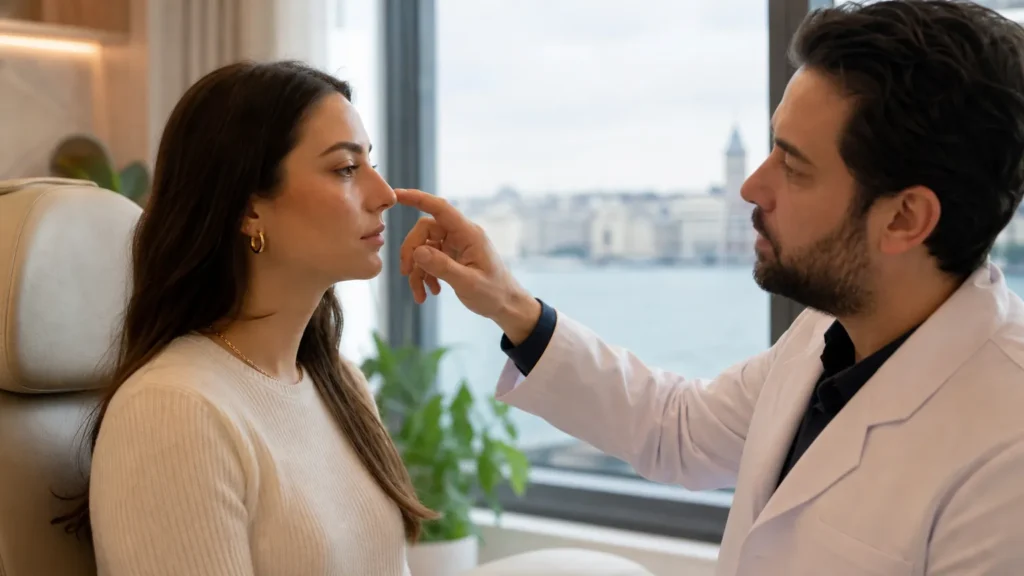
Bulbous nose rhinoplasty is surgery to refine a nasal tip that looks wide, round or “ball-like” compared with the rest of the nose. It is one of the most common reasons people look into rhinoplasty (nose reshaping surgery), and it is also one of the most misunderstood, because the tip is shaped by skin and soft tissue as much as by cartilage.
This guide explains what makes a tip bulbous, how surgeons refine it, why thick skin changes what is realistic, what fillers can and cannot do, and what recovery, cost and choosing a surgeon look like if you are considering treatment in Istanbul from the UK or Europe.
Quick answer: A bulbous nose tip is usually caused by wide or strongly curved tip cartilages, thick skin, extra soft tissue, or a mix of these. Bulbous tip rhinoplasty narrows and supports the cartilage with reshaping, sutures and sometimes grafts. Thin and medium skin often shows more definition; thick skin usually limits how sharp the tip can become, and tip swelling can take many months to settle.
Key takeaways
- A bulbous tip has more than one possible cause: cartilage shape, skin thickness and soft-tissue bulk. The right plan depends on which ones apply to you.
- Surgery refines the tip mainly by reshaping and suturing the tip cartilages, with grafts used for support where needed.
- Thick skin can hide cartilage changes, so the realistic goal is often “more refined”, not “pinched” or “sharp”.
- Fillers add volume. They cannot make a tip smaller, and the nasal tip is a higher-risk area for injections.
- Most bruising fades within weeks, but the tip is usually the last part of the nose to settle, often over months up to a year.
What causes a bulbous nose tip?
A bulbous nose tip is caused by the shape of the tip cartilages, the thickness of the skin over them, the amount of soft tissue in between, or a combination of all three. Two people can have tips that look equally round for completely different reasons, which is why a careful examination matters more than a photo.
Cartilage shape and width
The tip is supported by the lower lateral cartilages (the paired, curved cartilages that form the tip and nostril rims). When these are wide, strongly convex or set far apart at the domes, the tip looks broad and boxy. Surgical reviews describe tip planning by noting areas of cartilage “excess, deficiency, malposition and asymmetry”, because each calls for a different technique, as set out in a Plastic and Reconstructive Surgery Global Open review of nasal tip shaping.
Thick skin and soft-tissue fat
The skin-soft tissue envelope (the skin, fat and fibrous layer covering the cartilage) can be thick, oily and heavy, especially at the tip. A 2025 study in Aesthetic Surgery Journal Open Forum on the bulbous nasal tip describes a bulbous tip as an abnormally broad tip with unclear tip-defining points, and links it in its patient group to a thick skin and soft-tissue envelope with abundant tissue under the skin.
| Main cause | What it looks like | What surgery can usually change |
|---|---|---|
| Wide or convex tip cartilage | Broad, boxy or round tip with visible cartilage shape under thinner skin | Often responds well to cartilage reshaping and sutures |
| Thick, oily skin | Soft, heavy tip with little definition; cartilage outline not visible | Improvement is possible, but definition is limited by the skin itself |
| Extra soft tissue between the cartilages | Fullness or “padding” at the tip | Some surgeons remove a limited amount of tissue in selected cases |
| Weak tip support | Tip looks wide and drooping, sometimes worse when smiling | Support grafts can strengthen and shape the tip |
How is a bulbous tip corrected with surgery?
A bulbous tip is usually corrected by reshaping the tip cartilages, holding them in a narrower position with sutures, and adding support with cartilage grafts where the framework is weak. This is often called tip refinement or tipplasty (surgery limited to the nasal tip), and it can be done on its own or as part of a full rhinoplasty.
The British Association of Aesthetic Plastic Surgeons (BAAPS) explains that to change the tip, the cartilage under the tip needs to be partly removed or reshaped. If you want a deeper look at tip-only surgery, our guide to tip rhinoplasty and what it can achieve covers it in detail.
Cartilage reshaping (cephalic trim)
A cephalic trim removes a strip from the upper edge of the lower lateral cartilages to reduce their bulk. The Global Open review notes that surgeons preserve a rim strip at least 6 mm wide, so the tip keeps its support. Removing too much cartilage can weaken the tip, which is why modern techniques lean towards reshaping rather than aggressive removal.
Suture techniques
Sutures are the main tool for narrowing a wide tip. According to the same tip-shaping review, transdomal sutures (stitches across each dome) narrow the tip and correct curvature, and interdomal sutures (stitches between the two domes) bring the tip-defining points closer together.
Grafts for support and shape
Grafts are pieces of cartilage, usually from the septum (the wall between the nostrils), used to strengthen or shape the tip. A septal extension graft controls tip projection, rotation and shape, while tip grafts such as cap grafts can smooth or define the tip. Grafts matter most when the cartilage is weak or the skin is thick and needs a firmer framework to drape over.

Open or closed rhinoplasty for a bulbous tip?
An open approach is often used for significant tip work because it gives a direct view of the cartilage, but closed rhinoplasty can suit some smaller tip changes. The choice depends on how much the tip needs to change and on the surgeon’s own technique; the Global Open review calls a systematic open approach the most precise technique for tip shaping.
The British Association of Plastic, Reconstructive and Aesthetic Surgeons (BAPRAS) says open surgery gives a better view and can be more accurate for tip changes, but swelling is greater and recovery longer. Closed surgery usually takes about two weeks to settle and leaves no external scar.
| Factor | Open rhinoplasty | Closed rhinoplasty |
|---|---|---|
| Incision | Small cut across the columella (the skin between the nostrils) plus incisions inside | Incisions inside the nostrils only |
| View of tip cartilage | Direct, which helps with sutures and grafts | More limited |
| Swelling | Greater, with a longer recovery | Usually less |
| External scar | A small columellar scar | None visible |
| Typical use for bulbous tips | Moderate to major tip refinement, grafting, thick skin | Selected, smaller tip adjustments |
Comparing how different surgeons approach tip work is one of the most useful things you can do at this stage.
Why does thick skin limit tip definition?
Thick skin limits definition because it acts like a heavy blanket over the cartilage: changes made underneath are softened before they show on the surface. The 2025 bulbous-tip study puts it directly, noting that thick skin at the nasal tip can conceal the definition achieved through cartilage manipulation and grafting.
Think of laying a thin sheet versus a duvet over the same sculpture. Under the sheet every edge shows; under the duvet you see only the overall shape. That is why someone with thin skin and wide cartilage often sees a clearer change than someone with thick skin and the same cartilage.
What surgeons do differently for thick skin
For thick skin, surgeons generally build a stronger, more projected cartilage framework so the skin has something firm to drape over, rather than simply removing cartilage. In the 2025 study, rib cartilage was used for structural support in 15 cases, and interdomal fat pads were removed in 13 of 22 patients, alongside excision of some tip skin.
Keep that study in context: it involved 22 patients with a specific facial profile, and its authors note it cannot isolate the effect of any single step.
Can fat be removed from the nose tip?
Some surgeons remove a limited amount of fibro-fatty tissue between the tip cartilages during open surgery, in selected patients. It is not liposuction of the nose, and it is not a stand-alone fix: the amount that can be removed is limited by the need to keep the skin healthy. Ask any surgeon whether they would do it in your case, and why.
What results are realistic after bulbous tip rhinoplasty?
A realistic result is a narrower, better-supported and more balanced tip that suits the rest of your face, with the level of definition set largely by your skin. No surgeon can promise a particular tip shape, and the NHS notes that results of nose reshaping cannot be guaranteed.
- Thin to medium skin: cartilage changes tend to show more clearly, so refinement can be more visible, though small imperfections can show too.
- Thick skin: expect a softer, rounder refinement. The aim is improvement and balance, not a sharp or “pinched” look.
- Mixed causes: the more of the bulk comes from cartilage, the more surgery can usually change.

Can fillers or non-surgical treatments fix a bulbous nose?
No. Fillers cannot make a bulbous tip smaller, because they add volume rather than remove it. A non-surgical “liquid rhinoplasty” can sometimes improve how a tip looks from the side by changing proportions, but it cannot narrow wide cartilage or thin thick skin.
Cleveland Clinic describes filler rhinoplasty as able to lift a droopy nasal tip or correct a small bump. A 2026 Cureus review of non-surgical rhinoplasty says it is best suited to subtle enhancement through volume addition rather than structural reduction.
The nose is also a sensitive area to inject. The same review reports an incidence of 0.35% for vascular occlusion (filler blocking a blood vessel) and 0.09% for blindness, and skin necrosis (tissue death) in about 0.08% of cases, most often at the nasal tip. These events are rare, but they are serious, so any injector should explain them clearly.
| Option | Can it make the tip smaller? | How long it lasts | Main limitation |
|---|---|---|---|
| Surgical tip refinement | Yes, by reshaping and supporting cartilage | Intended to be permanent | Surgery, recovery time, long tip swelling |
| Dermal filler | No; it adds volume | Temporary | Camouflage only; rare but serious vascular risks |
| Skincare for oily, thick skin | No | Ongoing | Does not change tip cartilage or structure |
How long does tip swelling last after bulbous nose surgery?
Most visible bruising fades within about three weeks, but tip swelling lasts much longer, often several months and sometimes up to a year. BAPRAS says that after tip surgery about 60% of the changes are apparent at three weeks, with the rest evolving over several months or even a year.
The NHS describes a typical recovery for nose reshaping like this, and Cleveland Clinic adds that it can take up to a year for the nose to fully settle into its new shape.
- First week: a splint is held on the nose with tape for about 7 days; non-dissolvable stitches are usually removed at about a week.
- Up to two weeks: you may need up to 2 weeks off work.
- Around three weeks: soreness, swelling and bruising around the eyes have often faded.
- Four to six weeks: strenuous exercise can usually resume.
- Up to six months and beyond: swelling continues to go down; the tip is usually last.
Those timings come from the NHS guide to nose reshaping. BAPRAS notes that open surgery causes more swelling than closed, so a tip that looks round at two months is often still healing. Judge the result only when your surgeon says swelling has settled.
Planning travel to Istanbul
If you travel for surgery, plan enough time before flying. The NHS advises avoiding flying for 7 to 10 days after facial procedures because of the blood-clot risk. Our guide on how long to stay in Turkey after surgery helps you plan the trip around the splint removal and check-up.

What are the risks of bulbous tip rhinoplasty?
Bulbous tip rhinoplasty carries the general risks of any surgery plus some specific to the nose, and results may not match what you hoped for. The NHS lists occasional permanent breathing difficulty, damage to the septum, a changed sense of smell and heavy nosebleeds, alongside the general risks of bleeding, blood clots, infection and reaction to anaesthetic.
Tip work adds its own considerations:
- Irregularities: BAPRAS notes that bone or cartilage irregularities may be felt or seen after surgery.
- Weakened support: too much cartilage removal, or repeated surgery, can weaken the nose’s structure. BAPRAS warns that support may collapse after repeat operations.
- Persistent fullness: in thick skin, the tip may remain fuller than hoped, partly from swelling and partly from the skin itself.
- Dissatisfaction and revision: some people are unhappy with the result. BAPRAS advises that accepting a reasonable improvement is often better than another operation.
Ask every surgeon how often they revise tip surgery and what their plan is if the tip stays fuller than expected. Our article on managing complications after treatment abroad explains what to agree before you travel.
How much does bulbous nose rhinoplasty cost?
In the UK, the NHS gives a range of £4,000 to £7,000 for nose reshaping, with consultations, further surgery and follow-up care potentially adding to that. It is not usually available on the NHS for cosmetic reasons, though it may be if needed to help you breathe.
In Istanbul, rhinoplasty doctor profiles on Venoramed currently display starting prices from EUR 2,400 to EUR 4,000, and one profile displays USD 2,500 (November 2026). These are starting figures, not final quotes. The final price follows an individual assessment, and you can see what is typically included on our Turkey rhinoplasty package price page.
Signals that tend to affect the quote include whether you need tip-only work or a full rhinoplasty, whether grafts are needed (and from where), whether breathing surgery is combined, and whether you have had nose surgery before. For a fuller picture of UK pricing, see our guide to nose job costs in the UK.
Budget for the extras too. GOV.UK states that your EHIC or GHIC does not cover going abroad for elective surgery, and standard travel insurance does not normally cover you either.
How do you choose a surgeon for a bulbous tip?
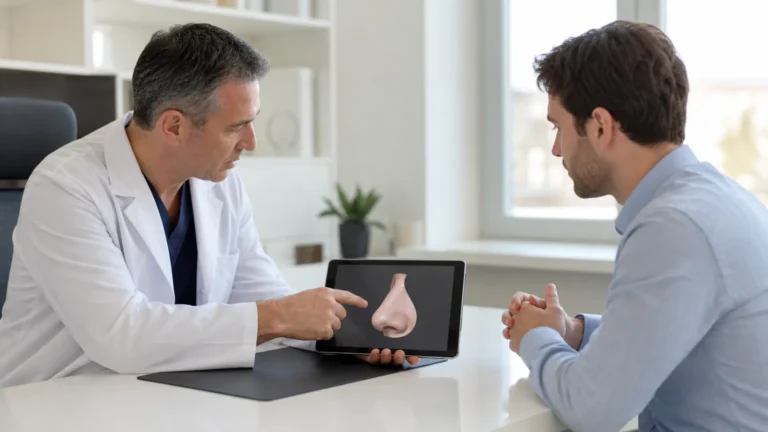
Choose a surgeon who performs tip refinement regularly, examines your skin and cartilage properly, explains a specific plan and sets realistic expectations. Before-and-after photos of noses with skin like yours are more useful than a surgeon’s overall gallery.
The NHS advises checking a surgeon’s training and experience, and having two consultations before surgery abroad, rather than dealing only with sales staff. The UK Foreign Office suggests checking the Turkish Ministry of Health’s approved providers and doing your own research, in its Turkey travel health advice.
You can browse facial refinement and rhinoplasty doctors in Istanbul, and our practical guide on how to choose a doctor and clinic in Turkey walks through credentials and red flags.

Questions to ask before booking bulbous tip surgery
- What is causing my bulbous tip: cartilage, skin, soft tissue, or a mix?
- How thick is my skin, and how much will it limit definition?
- Do you recommend open or closed surgery for me, and why?
- Will I need grafts? If so, where would the cartilage come from?
- Would you remove any soft tissue from my tip, and what are the limits?
- Can I see results for patients with skin and tips similar to mine?
- What is included in the price, and what would a revision cost?
- How will follow-up work once I am home, and who do I contact if something worries me?
Frequently asked questions
Can a bulbous nose be fixed without surgery?
A bulbous nose cannot be made smaller without surgery. Dermal fillers add volume, so they can sometimes balance the profile or lift a slightly drooping tip, but they cannot narrow wide cartilage or reduce thick skin. Filler injections in the nose also carry rare but serious risks, including blocked blood vessels, so they need an experienced, qualified injector and a frank discussion first.
Is bulbous tip rhinoplasty the same as tip rhinoplasty?
Bulbous tip rhinoplasty is a type of tip rhinoplasty focused on narrowing and defining a wide, round tip. Tip rhinoplasty is the broader term for surgery on the nasal tip, which can also address a drooping, over-projected or asymmetric tip. Either can be done on its own or as part of a full rhinoplasty that also changes the bridge or breathing.
Will my nose tip look sharp after surgery if I have thick skin?
With thick skin, a sharp or highly sculpted tip is usually not a realistic goal. Thick skin softens the changes made to the cartilage underneath, so the typical outcome is a narrower, better-supported and more balanced tip rather than fine definition. A surgeon should assess your skin in person or from good photos and explain what level of refinement is achievable for you.
How long until I see the final result of bulbous nose rhinoplasty?
The final result of bulbous nose rhinoplasty often takes up to a year to appear, because the tip is usually the last area to lose its swelling. BAPRAS says around 60% of tip changes are visible at three weeks, with the rest evolving over months. Open surgery causes more swelling than closed surgery, so early fullness is often still swelling rather than the final shape.
Is a bulbous nose correction covered by the NHS?
Nose reshaping for cosmetic reasons, including refining a bulbous tip, is not usually available on the NHS. The NHS may provide nose surgery where it is needed to help you breathe. Privately in the UK, the NHS gives a typical cost range of £4,000 to £7,000, with consultations and follow-up care possibly adding to the total.
What does bulbous nose rhinoplasty cost in Istanbul?
Rhinoplasty doctor profiles on Venoramed currently show starting prices from EUR 2,400 to EUR 4,000, with one profile showing USD 2,500, as of November 2026. These are starting figures rather than final quotes. The actual price depends on an individual assessment, including whether grafts or breathing surgery are needed and whether you have had previous nose surgery.
Next steps
If a wide or round tip bothers you, the most useful next step is an honest assessment of what is causing it and what your skin will allow. You can read more on rhinoplasty in Turkey and our facial refinement and rhinoplasty treatment page, then share your photos with doctors in Istanbul for an individual opinion.
Compare surgeons’ tip work and request a free, no-obligation consultation when you are ready.
This article is general educational information, not medical advice. Venoramed is a medical marketplace and coordination platform; it does not provide treatment, diagnose conditions or guarantee outcomes. Suitability, risks and recovery must be assessed individually by a qualified, treating clinician.



2 Comments
Share your question or experience. Venoramed reviews comments before publishing.
[…] your main concern is a rounded or wide tip rather than a low one, our guide to bulbous nose tip rhinoplasty covers that separate […]
[…] noses like mine?”. If your concern is a rounded tip, for example, a surgeon experienced in bulbous nose tip rhinoplasty is more relevant than any country […]