

Mommy Makeover Combined Surgery vs Staged Procedures
Patient information on individual planning, safety questions, recovery and travel
“Mommy makeover” is a marketing term, not one fixed operation and not a diagnosis. It is commonly used for an individual surgical plan that may address concerns affecting the breasts, abdomen or body contour after pregnancy, breastfeeding, weight change or ageing. It can include an abdominal procedure, breast surgery, liposuction or other procedures—but it does not mean that every person needs, wants or is suitable for the same combination.
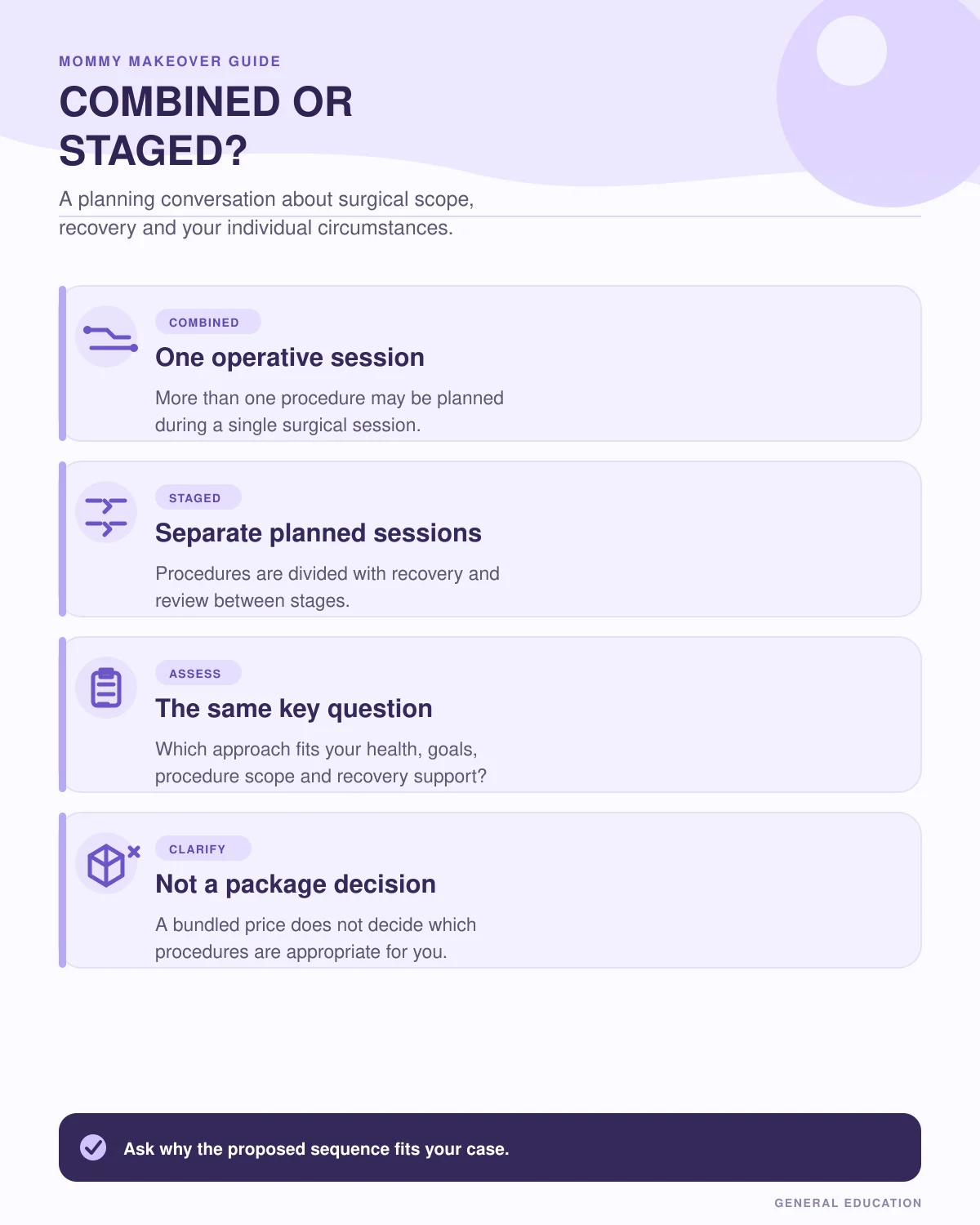
One of the most important planning questions is whether procedures should be carried out in one operative session or divided into stages. A combined plan can mean one anaesthetic, one hospital episode and one overall recovery period. A staged plan can mean more than one procedure and recovery period, but it may reduce the scope of each individual operation. Neither option is automatically safer, cheaper or more convenient for every patient.
The right decision requires an appropriately qualified surgeon’s assessment of the person’s health, proposed procedures, expected operating time, anaesthesia plan, facility, recovery support and travel arrangements. A package name or advertised price cannot make that decision.
Venoramed is a medical marketplace and coordination platform. It does not diagnose patients, choose which procedures should be combined, issue medical clearance or guarantee an outcome. Any treatment decision should follow an individual assessment by the clinician responsible for the procedure.
Explore Venoramed’s Body Contouring treatment information and compare published Body Contouring doctor profiles before requesting consultation support.
The phrase is broad. The American Society of Plastic Surgeons describes it as a customised combination of procedures intended to address body changes associated with childbearing, rather than as a standard treatment pathway. Depending on the individual assessment, a discussion may involve one or more of the following:
- Abdominal contouring, including an abdominoplasty (tummy tuck) where appropriate.
- Breast surgery, such as a lift, augmentation, reduction or a combination of these.
- Liposuction of selected areas.
- Other body-contouring procedures that the treating surgeon considers clinically appropriate.
That list is not a checklist to complete. Each operation has its own indications, scars, recovery requirements and risks. Someone may be interested only in an abdominal procedure, only in breast surgery, or in a combination. The term should never pressure a patient to add a procedure they do not understand or have not independently discussed with the surgeon.
The more useful starting point is: What concerns are being assessed, what does each proposed procedure address, what does it not address, and why is each step included in the plan?
| Planning question | Combined procedures | Staged procedures |
| Operative sessions | More than one procedure is completed during one planned session. | Procedures are divided into separate sessions with time to recover between them. |
| Anaesthesia and admission | One anaesthetic and one initial admission may be planned. | Each stage may have its own anaesthesia and recovery arrangements. |
| Recovery | There may be one overall period away from routine, but it can be more demanding because several operated areas are healing together. | There may be more than one recovery period, with restrictions and follow-up for each stage. |
| Travel planning | The stay must allow for post-operative review and individual travel clearance after the full procedure. | Each trip, review and return journey must be planned separately. |
| Costs | Some services may be shared, but a combined quotation is not automatically better value. | There may be repeated facility, travel or recovery costs; the exact scope still needs itemisation. |
| Decision-making | The surgeon must explain why the combined scope and duration are appropriate for this individual. | The surgeon must explain the proposed sequence, interval and what changes might affect the next stage. |
This is a planning comparison, not a scorecard. A combined operation can be reasonable for a carefully assessed patient and a defined surgical plan. Staging can be reasonable when the surgeon believes that limiting the scope of one session, observing healing first, or separating goals is more appropriate. The conclusion belongs to the treating clinical team, not to a generic online timetable.
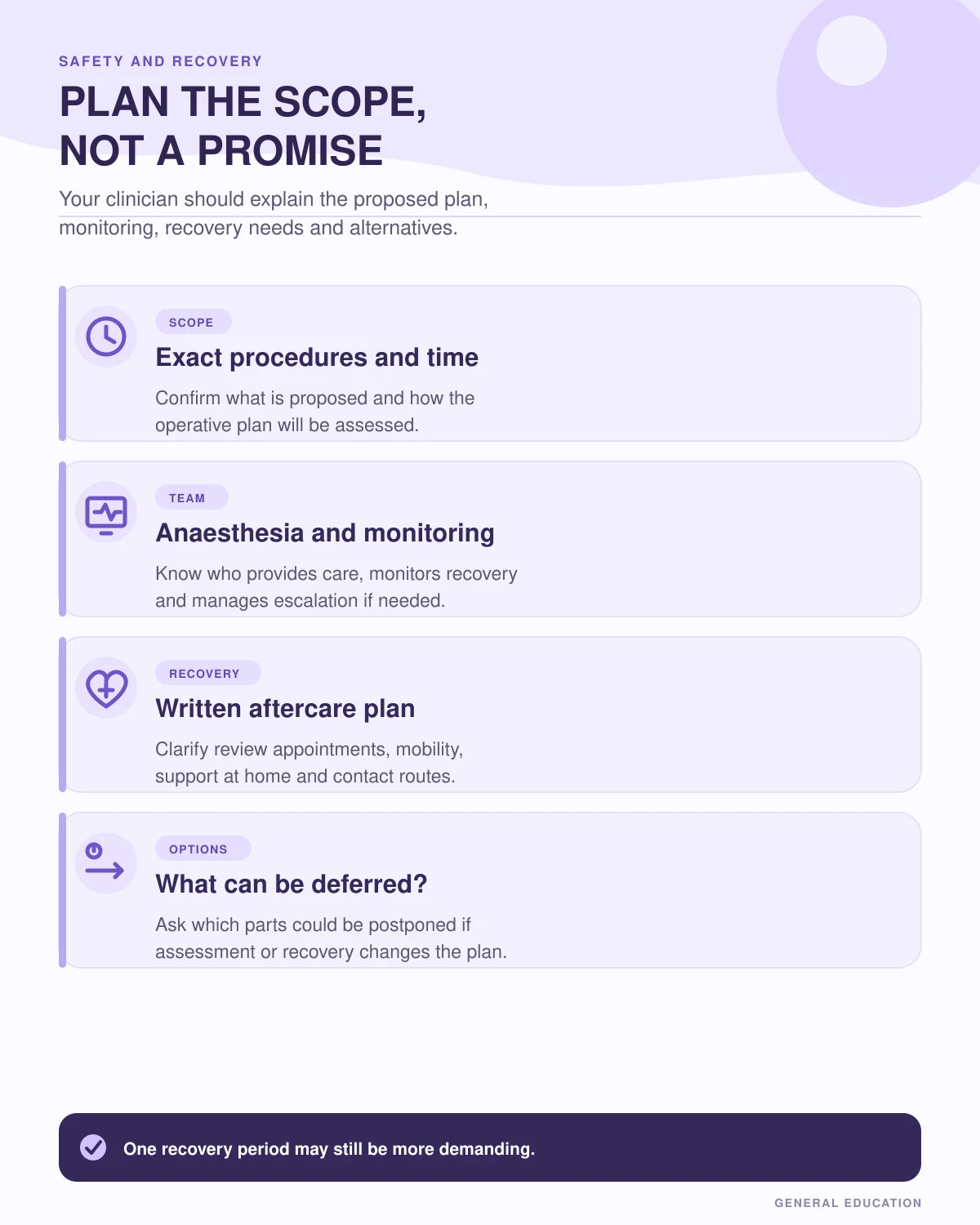
Counting procedures does not capture the whole clinical picture. A plan described as “two procedures” may involve a very different surgical burden from another plan with the same number. The important questions include the exact operations, extent of treatment, estimated operative time, anaesthesia, expected blood loss, need for admission, planned monitoring, medical history and the facility’s emergency arrangements.
Research on combined breast and abdominal surgery has produced different results depending on the procedures compared, the patient population and the outcomes measured. For example, a large database study reported higher complication rates with some combined plans, while more recent analysis has found more nuanced results for selected groups. These studies are useful context, but they do not provide personal clearance or establish a universal “safe” combination. A surgeon must interpret the individual risk factors and procedure scope.
During consultation, ask the surgeon to explain:
- Which individual risk factors matter in my case?
- What is the estimated operating time, and what would make the plan change on the day?
- What anaesthesia, monitoring and post-operative observation are planned?
- Why is a combined plan preferable to staging for me—or vice versa?
- If an unexpected finding occurs, which parts of the plan could be deferred?
Risk assessment should also include a clear discussion of factors such as relevant medical conditions, medications and supplements, nicotine use, previous surgery, a history of blood-clotting problems, healing concerns and support at home. Do not stop prescribed medicines or make changes to nicotine products, contraception or supplements based on an online article; ask the treating clinician and the relevant prescribing professional.
A surgeon may discuss combining procedures where the concerns, treatment areas and recovery demands can be planned coherently and where the individual assessment supports that approach. Potential practical advantages can include one initial anaesthetic and one consolidated period away from work or travel. Those advantages do not override medical suitability.
The discussion should be specific. For example, if abdominal surgery and breast surgery are proposed, the patient should know what each operation is intended to achieve, which scars are expected, whether an overnight stay is planned, who will perform each stage and how the clinical team will manage a change of plan.
Do not treat “all-inclusive” or “one-trip” wording as proof that every component should be performed together. A responsible plan should be able to explain why each operation is clinically justified, why the proposed sequence is appropriate and what the alternative would be if one element is deferred.
Staging is not a failure to offer a complete plan. It can be a deliberate decision to reduce the scope of a single operation, allow one area to heal before another procedure is considered, separate different recovery demands, or give the patient time to reconsider a later goal.
For an international patient, staging also changes logistics. It may mean a second assessment, another trip, more accommodation and different leave arrangements. It can also mean that the patient has a clearer opportunity to assess recovery before committing to another surgery. The surgeon should explain the proposed order, why that order matters, the likely range before the next stage is considered and which clinical findings could alter the plan.
Neither a clinic nor a coordinator should frame staging as an unnecessary upgrade if the surgeon considers it medically or practically appropriate.
The label “mommy makeover” does not make future pregnancy impossible, but future pregnancy or significant weight change can alter the appearance and durability of some surgical results. Professional patient guidance commonly advises discussing family-planning goals before elective abdominal and breast surgery. That is a planning conversation—not a guarantee about future appearance or a substitute for advice from an obstetric, primary-care or plastic-surgery professional.
Breastfeeding, recent pregnancy, general health, weight stability, nutritional status and the practical reality of caring for children can all affect timing. A patient should tell the surgeon about family-planning goals, breastfeeding status, any recent pregnancy-related medical issue and the level of support available during recovery. The treating team should then explain what needs to be assessed before a decision is made.
It is understandable to prefer one recovery period over two. But when several areas are healing at once, mobility, sleep, dressing care, personal hygiene, pain control, scar care and return to routine can be more complex. Recovery instructions depend on the exact procedures, the surgeon’s protocol, any drains or garments, healing progress and individual medical factors.
The Aesthetic Society notes that recovery after combined procedures depends on the specific operations and may feel more intensive even where there is a single overall recovery period. This is why a patient needs written, procedure-specific instructions rather than a generic “mommy makeover recovery timeline.”
Before booking, obtain written answers to these questions:
- How long should I remain near the treating facility for review?
- What help will I need with meals, bathing, dressing changes, medication and mobility?
- When can I safely lift a child, carry luggage, drive, return to desk work or resume a physically demanding job?
- Which garments, wound-care products or medications are included, and which are not?
- Who reviews the incisions, and what is the out-of-hours clinical contact route?
- What changes in pain, swelling, breathing, bleeding, wound appearance or general health require urgent assessment?
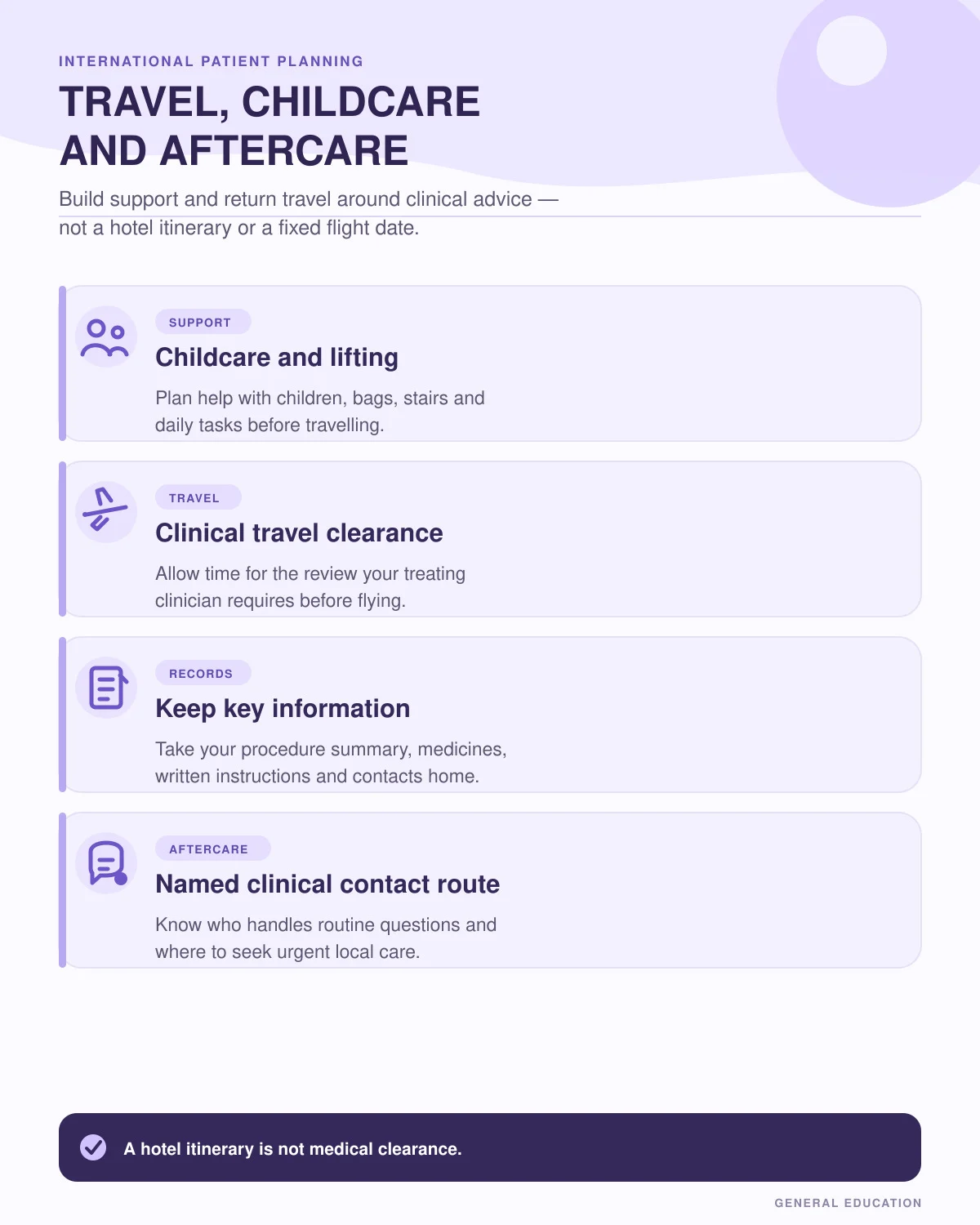
For many parents, childcare is not a side issue—it is a safety and recovery issue. A plan that is medically sound on paper may still be impractical if the patient is expected to lift a child, carry bags, manage stairs alone or travel without help before the clinical team has cleared those activities.
Discuss the home situation honestly. The clinical team should know whether there is a baby or young child at home, whether another adult can help, what type of work the patient does, whether the home has stairs and how far the patient must travel after discharge. Arrange practical support before travel rather than assuming that feeling well on one day means that all normal responsibilities can resume.
The return flight should be planned around clinical review and travel clearance, not around a pre-set hotel package or the lowest airfare. Surgery and long periods of sitting during travel can both contribute to blood-clot risk. The CDC’s medical-tourism guidance advises travellers to discuss the timing of travel after surgery with their healthcare provider.
For a combined procedure, ask before paying for a non-changeable flight:
- How many post-operative reviews are required before I leave Turkey?
- Does the clinician expect an overnight admission or a longer stay near the facility?
- What must be stable before travel is considered appropriate?
- What records, medication list and discharge summary will I take home?
- Who provides clinical follow-up after I return, and who should my local clinician contact if needed?
- What is the contingency plan if I need extra nights, a flight change or local urgent care?
Venoramed’s recovery-planning guide for staying in Turkey after surgery explains why a package itinerary should not replace an individual clinical plan. For broader preparation, read the guide to complications after treatment abroad.
Two offers using the words “mommy makeover” may describe entirely different medical plans. One may include a tummy tuck and breast lift; another may include liposuction, implants, a longer admission or additional aftercare. A lower headline price is not meaningful until the scope is comparable.
Ask for an itemised written quotation that identifies:
- Each proposed procedure and treatment area.
- The treating surgeon and the roles of every clinical team member.
- The legal name and location of the facility.
- Anaesthesia, operating-room or hospital charges, admission and planned monitoring.
- Tests, garments, medication, dressings, follow-up and interpreter services.
- Accommodation, transfers and the number of included nights, separately from medical care.
- Items excluded from the price and circumstances that could increase the total.
- Cancellation, complication, revision and refund policies.
Venoramed’s guide to comparing medical quotations and packages in Turkey explains the difference between a displayed starting price, a preliminary estimate and a final clinical quotation. The right comparison is not “Which package has more items?” but “Is the proposed treatment medically appropriate, clearly explained and fully costed?”
- What are the exact procedures you recommend, and what does each one address?
- Which elements are medically necessary for the proposed goal, and which are optional?
- Why do you recommend combining these procedures or staging them?
- What is the estimated operating time and anaesthesia plan?
- Who will perform each stage, administer anaesthesia and monitor recovery?
- Where will the procedure take place, and what emergency support is available there?
- What individual medical factors could change the plan or make a procedure unsuitable?
- What scars, recovery restrictions and follow-up needs should I expect from each procedure?
- What support will I need with childcare, lifting, work and travel?
- What would make you postpone, reduce or stage the surgery?
- What is included and excluded in the written quotation?
- Who will provide clinical aftercare after I return home?
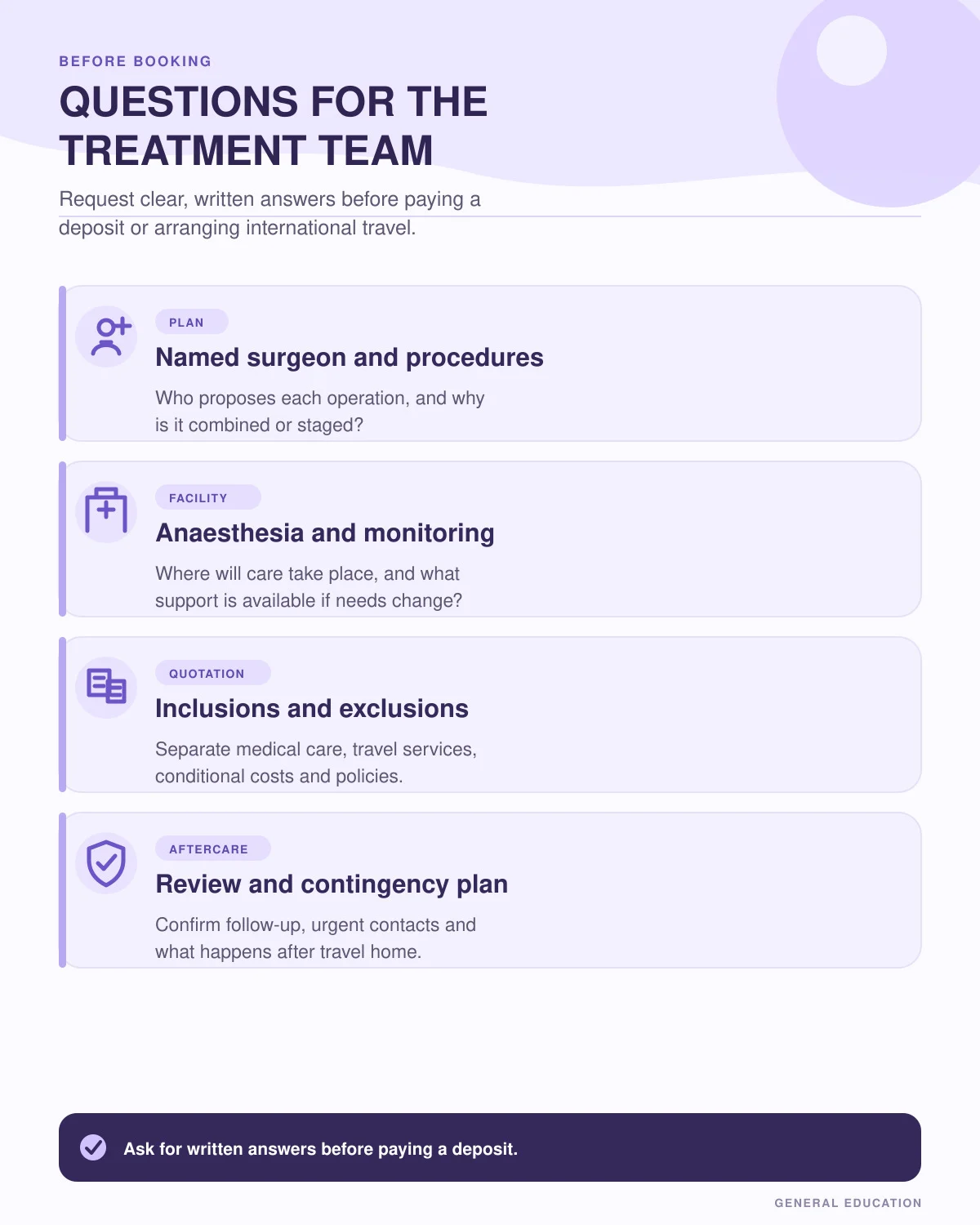
The decision should not rest on a social-media gallery, a coordinator’s assurance or a fixed package title. Confirm the surgeon’s identity, relevant specialty and role in the operation; the facility where the procedure will occur; the anaesthesia and monitoring plan; the named aftercare route; and how any emergency or complication is handled.
Venoramed’s doctor and clinic safety checklist can help patients structure these questions. A doctor profile can be a useful starting point for comparing published details, but it does not replace a personal consultation, medical history review or clinical examination.
Is a mommy makeover always one operation
No. The phrase can refer to a customised plan that may be performed in one session or divided into stages. The number and timing of procedures should follow individual clinical assessment.
Is it always better to combine procedures
No. A combined plan may offer one overall recovery period, but it can also increase the complexity of the operative and recovery plan. The appropriate choice depends on the person, the exact procedures, the facility and the surgeon’s assessment.
Is staging always safer
Not as a universal rule. Staging may be recommended to limit the scope of an individual operation or for other clinical or practical reasons, but the decision must be made by the treating clinician for the individual case.
Can I fly home as soon as my hotel nights are finished
Do not use a package itinerary as medical clearance. Your clinician should assess the need for post-operative review, your recovery, planned travel duration and any personal risk factors before you book a non-changeable return flight.
Should I wait if I may become pregnant in the future
Future pregnancy or significant weight change can affect some surgical results. Discuss family-planning goals, recent pregnancy and breastfeeding with the treating clinician before choosing the timing of elective surgery.
Can a provider guarantee the result of a mommy makeover
No responsible provider can guarantee an individual clinical or cosmetic outcome. Healing, scars, tissue characteristics, future weight change, pregnancy and unforeseen medical factors can affect the result.
Explore Body Contouring treatment information and compare available Body Contouring doctor profiles before requesting consultation or coordination support.
Venoramed is a medical marketplace and coordination platform. It does not provide direct treatment, determine whether procedures should be combined, issue travel clearance or guarantee outcomes. Any treatment, recovery and travel decision should follow an individual assessment by an appropriately qualified clinician.




Leave a Comment
Share your question or experience. Venoramed reviews comments before publishing.