

Travelling to another country for medical, dental or surgical treatment involves more than selecting a doctor, comparing a quotation and booking accommodation.
Patients also need to understand what will happen if recovery does not follow the expected course.
All medical and surgical procedures involve some degree of risk, regardless of where they are performed. The additional challenge of international treatment is that the treating team, the patient’s usual healthcare professionals and the patient may later be separated by distance, language, different medical-record systems and different insurance or legal arrangements.
CDC guidance on medical tourism advises patients not to delay seeking care if they suspect a complication during travel or after returning home. It also explains that follow-up treatment may be prolonged, expensive and not covered by ordinary insurance.
Before travelling, a patient should be able to answer four practical questions:
1. Who will provide routine aftercare?
2. Who should be contacted if symptoms change?
3. Where can urgent or emergency treatment be obtained?
4. Who will pay for additional treatment, accommodation or travel?
Patients who are still researching the wider process may begin with Venoramed’s practical guide to medical tourism in Turkey. This article focuses specifically on complications after treatment abroad, aftercare arrangements, insurance limitations, continuity of care and emergency planning.
Venoramed is a medical marketplace. It is not a clinic, hospital, insurer or emergency service. It does not diagnose complications, manage emergency care or guarantee that a healthcare provider or insurance company will cover additional treatment.
Why Complication Planning Should Begin Before Treatment
Complication planning is sometimes postponed because the patient expects the treatment to proceed successfully.
A positive outcome may be expected, but this does not remove the need to clarify:
- Expected recovery symptoms
- Possible complications
- Warning signs requiring medical review
- Emergency contacts
- Follow-up appointments
- Medical-record transfer
- Insurance exclusions
- Additional treatment costs
- Revision conditions
- Care after returning home
The NHS treatment-abroad checklist advises patients to understand possible complications and side effects, confirm how aftercare will be coordinated and remain in the treatment country for an appropriate recovery period before travelling home.
A clear contingency plan does not mean assuming that something will go wrong. It means ensuring that the patient still knows what to do when the original schedule changes.
Expected Recovery, Complication and Unsatisfactory Result Are Different
These three situations should not automatically be treated as the same thing.
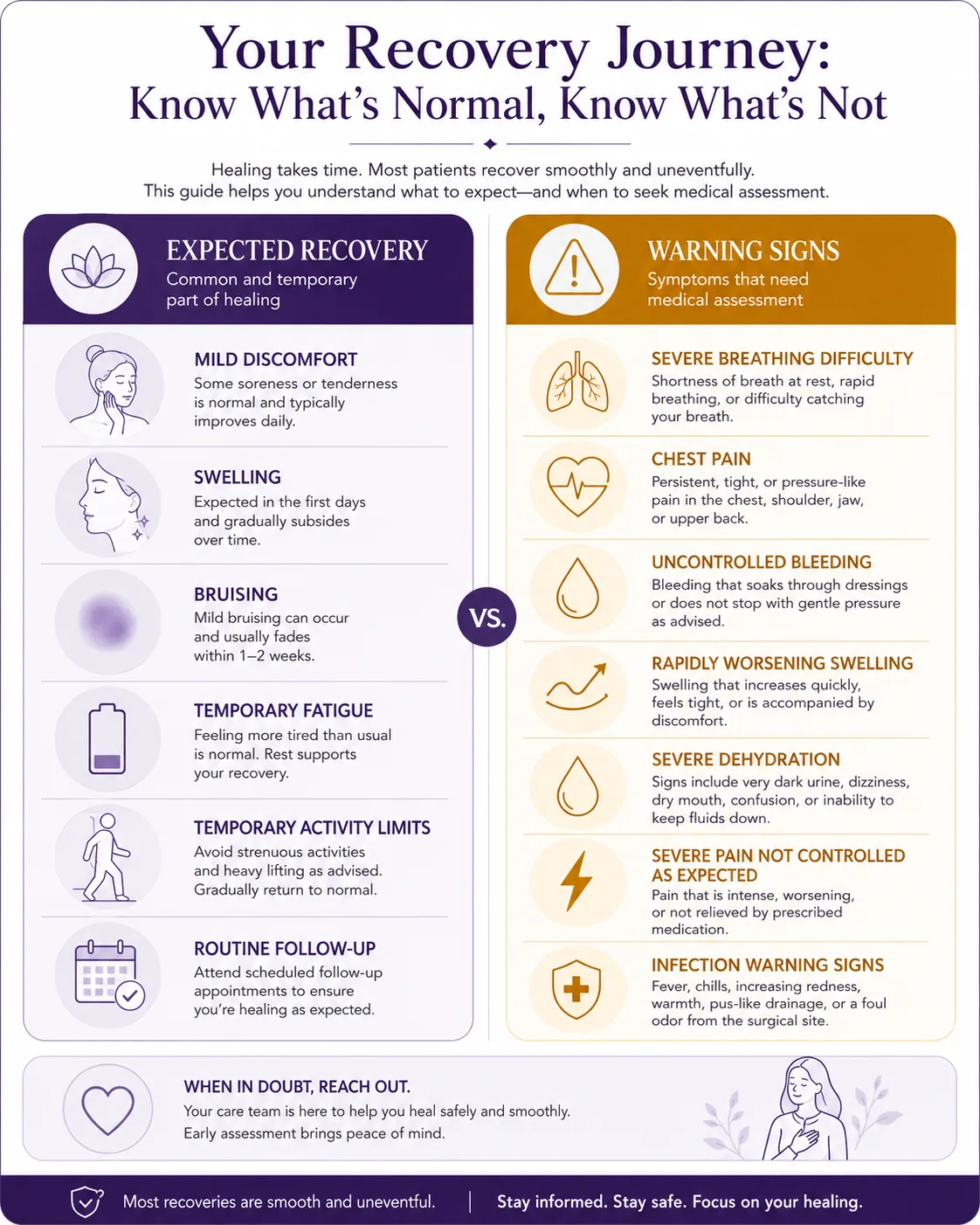
Expected Recovery
Expected recovery symptoms are temporary effects that the treating professional has explained as part of the normal healing process.
Depending on the procedure, these might include:
- Mild or moderate discomfort
- Swelling
- Bruising
- Fatigue
- Temporary sensitivity
- Temporary dietary restrictions
- Temporary activity restrictions
- Minor wound drainage
- Expected hair shedding
- Temporary changes in sensation
The expected pattern varies according to the exact treatment and the individual patient.
Medical Complication
A complication is a medical problem that develops during or after treatment and requires assessment, monitoring or additional care.
Examples may include infection, excessive bleeding, a wound problem, an adverse medication reaction, a blood clot, dehydration, a problem related to an implant or medical device, or a complication related to anaesthesia.
The relevant risks must be explained by the treating professional for the specific procedure.
Unsatisfactory Result
A patient may recover medically but remain dissatisfied with the functional or aesthetic result.
An unsatisfactory result does not necessarily represent an emergency or a medical complication. It may require further healing time, a new clinical assessment, comparison with the original treatment plan, discussion of realistic expectations, corrective treatment or revision surgery.
Emergency care, complication treatment and revision treatment must therefore be discussed separately.
Written Discharge Instructions Are Essential
Before leaving the healthcare facility, the patient should receive written discharge information in a language they understand.
The instructions should explain:
- The exact procedure performed
- What symptoms are expected
- How to care for the treatment area
- Medication names and doses
- Dietary instructions
- Activity restrictions
- Follow-up dates
- Travel restrictions
- Emergency warning signs
- Who to contact during working hours
- Who to contact outside working hours
- Which facility should be used for urgent review
General advice found on social media should not replace the instructions issued for the individual patient. Patients should ask questions immediately when part of the discharge plan is unclear.
When Should a Patient Seek Urgent Medical Care?
The exact warning signs depend on the treatment and must be explained by the treating professional.
However, a patient should not wait indefinitely for an overseas provider to answer a message when symptoms are severe, rapidly worsening or potentially life-threatening.
Urgent or emergency assessment may be required for symptoms such as:
- Severe difficulty breathing
- Chest pain
- Loss of consciousness
- Sudden weakness or neurological symptoms
- Severe or uncontrolled bleeding
- A severe allergic reaction
- Confusion
- Rapidly worsening swelling
- Severe dehydration
- Severe pain that is not controlled as expected
- Increasing redness, swelling, pain or abnormal wound drainage
- Any symptom identified as an emergency in the discharge instructions
The CDC advises medical travellers not to delay seeking medical care if they suspect a complication during travel or after returning home.
The provider’s WhatsApp number, email address or website chat should not be treated as an emergency service.
Emergency Services in Turkey
The national emergency number in Türkiye is 112. Official HealthTürkiye essential information explains that emergency support is available nationwide.
The Turkish Ministry of Health also operates an International Patient Assistance and Interpretation Call Centre at +90 850 288 38 38. This service can help international patients facing language barriers when communicating with health services.
For a potentially life-threatening situation:
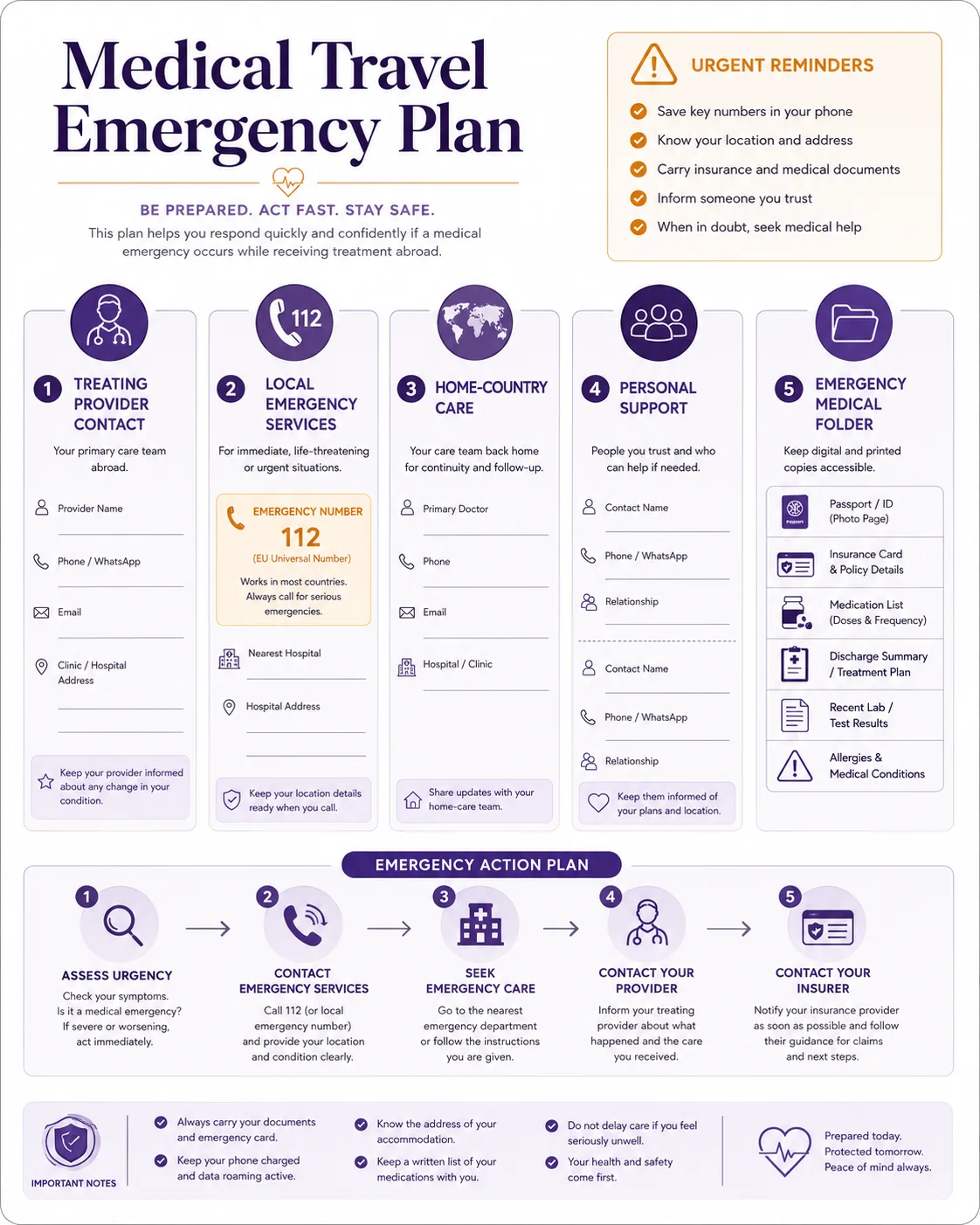
1. Call 112 or attend an appropriate emergency department.
2. Provide the procedure name and treatment date.
3. Show the medication and allergy list.
4. Provide the discharge summary and operation report.
5. Inform the original provider after emergency care has been arranged.
6. Contact the insurer as soon as reasonably possible.
Emergency treatment should not be delayed while waiting to learn whether the provider or insurer will accept financial responsibility.
What Is a Complete Aftercare Plan?
An aftercare plan explains how the patient will be monitored after treatment.
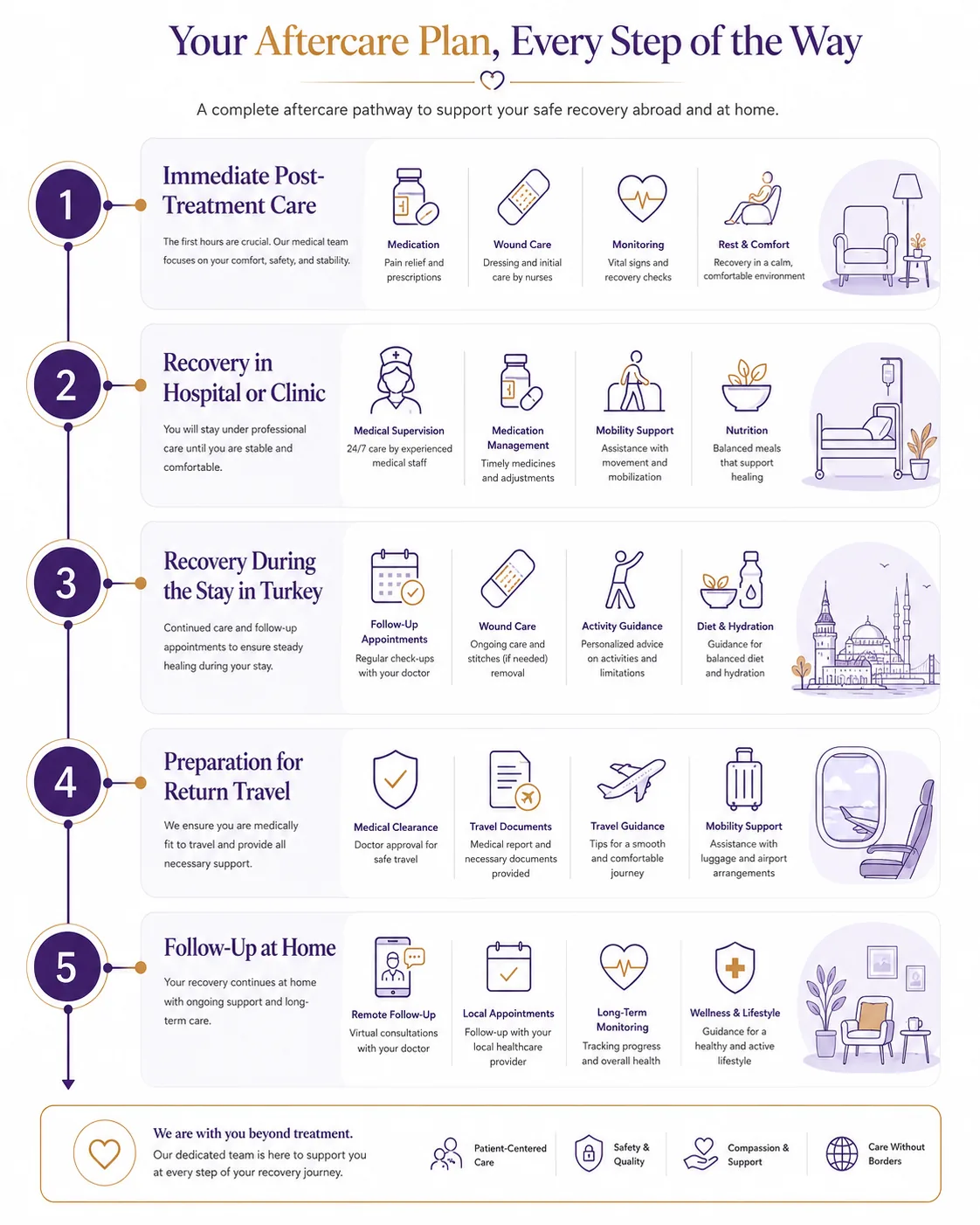
It should cover immediate post-treatment care, hospital or clinic recovery, recovery during the remaining stay in Turkey, preparation for the return journey, follow-up after returning home and long-term monitoring where required.
NHS guidance on going abroad for medical treatment advises patients to understand how aftercare will be provided after they return home.
A complete plan should identify:
- Treating doctor
- Named aftercare contact
- Out-of-hours contact
- Healthcare facility for urgent review
- Number and timing of follow-up appointments
- Wound or treatment-area care
- Medication instructions
- Mobility and activity restrictions
- Dietary instructions
- Required garments or devices
- Laboratory or imaging follow-up
- Travel restrictions
- Local follow-up at home
- Remote follow-up arrangements
- Emergency warning signs
The patient should know which services are included and which services require an additional payment.
Questions to Ask About Aftercare
Before accepting a treatment plan, ask:
1. Who is responsible for my aftercare?
2. Will the treating doctor personally review me?
3. How many follow-up appointments are included?
4. Is help available outside normal working hours?
5. Which healthcare facility should I attend in an emergency?
6. What should I do if the main contact does not respond?
7. Which symptoms are expected?
8. Which symptoms require an urgent examination?
9. How long should I remain in Turkey?
10. What must happen before I fly?
11. Who will provide follow-up after I return home?
12. Are remote follow-up appointments included?
13. What records will I receive?
14. Which complication costs are included?
15. What happens if another procedure is required?
Venoramed’s patient safety checklist for choosing a doctor and clinic in Turkey explains how to verify the doctor, healthcare facility and proposed aftercare arrangements before booking.
Package Duration Does Not Determine Medical Recovery
A treatment package may include a fixed number of hotel nights. That number does not automatically determine how long a patient should remain in Turkey.
Hospital discharge means that the patient no longer requires the same level of inpatient care. It does not necessarily mean that the patient is fully recovered or medically fit to fly.
The appropriate stay may depend on:
- Procedure type
- Anaesthesia
- Bleeding risk
- Infection risk
- Mobility
- Wound review
- Removal of drains or dressings
- Laboratory tests
- Imaging
- Risk of blood clots
- Need for another treatment stage
- Doctor’s travel assessment
- Airline requirements
The CDC also warns that strenuous activity, alcohol, swimming, sunbathing and other holiday activities during postoperative recovery may delay or interfere with healing.
Patients should review Venoramed’s how long to stay in Turkey after surgery before booking a fixed return flight.
Prepare a Medical Emergency Contact List
The patient should save emergency information both digitally and on paper.
Treating Provider
Record the doctor’s full name, specialty, clinic number, out-of-hours number, email, healthcare-facility name, facility address and international patient contact.
Local Emergency Services
Record the emergency number 112, the nearest appropriate emergency department, hospital address, transport route, interpreter contact and hotel reception number.
Home-Country Care
Record the family doctor, relevant specialist, local urgent-care provider, nearest emergency department and insurance emergency number.
Personal Support
Record the companion, family emergency contact, person authorised to receive medical information and employer contact where relevant.
Do not keep all essential information on one phone that may lose battery power, internet access or roaming service.
Prepare an Emergency Medical Folder
The patient’s emergency folder should contain:
- Passport identification information
- Insurance policy and emergency number
- Treating doctor and healthcare-facility details
- Diagnosis, procedure name and treatment date
- Treatment contract and itemised quotation
- Medication and allergy lists
- Laboratory and imaging reports
- Pathology reports where relevant
- Operation or treatment report
- Anaesthesia record where available
- Implant or device details
- Discharge summary and aftercare instructions
- Complication and revision policies
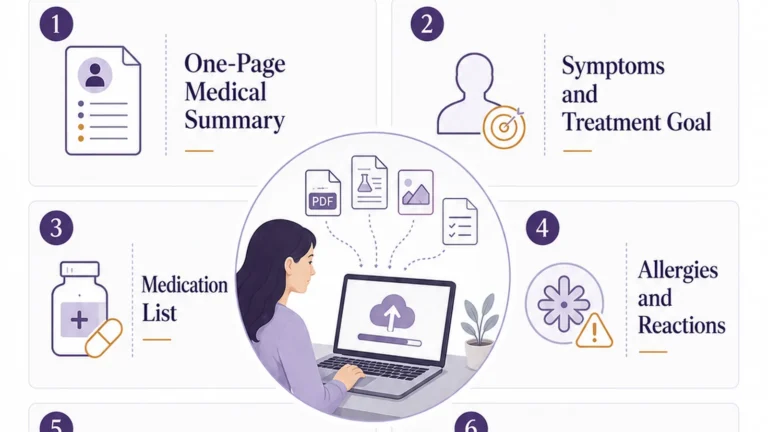
Patients should use Venoramed’s medical records for an online consultation to organise these documents before travelling.
CDC guidance for travellers who become sick abroad recommends requesting documentation of medical care received abroad and sharing this information with healthcare professionals after returning home.
Insurance Products Are Not All the Same
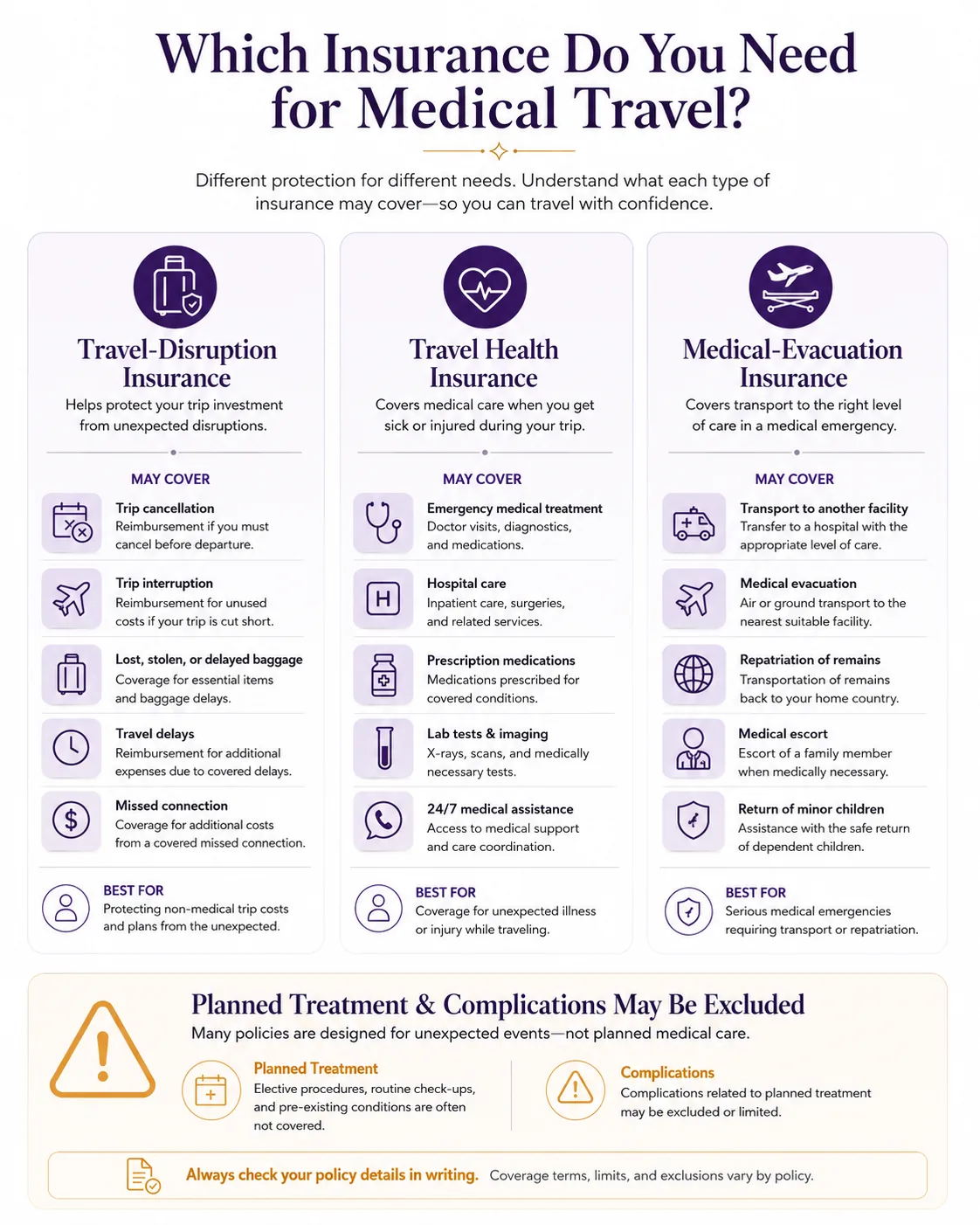
Patients frequently use the term “travel insurance” for several different products.
Travel-Disruption Insurance
This may cover certain events such as trip cancellation, travel delay, lost luggage, missed departure or interruption of the trip. It may not cover medical treatment.
Travel Health Insurance
This may cover certain illnesses or injuries that occur during the trip. It may exclude planned treatment, complications from planned treatment, pre-existing conditions, particular procedures or treatment without prior authorisation.
Medical-Evacuation Insurance
This may arrange or cover medically necessary transport to another facility or to the patient’s home country, depending on the policy.
Medical-evacuation cover is not necessarily the same as cover for hospital treatment, the planned procedure, revision surgery, routine return travel or extended accommodation.
CDC guidance on travel insurance explains that travel health and medical-evacuation policies vary and may not cover the full cost of emergency care, evacuation or itinerary changes.
Ordinary Travel Insurance May Not Cover Planned Treatment
Patients should not assume that a standard holiday-insurance policy covers planned medical, dental or cosmetic treatment.
The NHS states that most travel-insurance policies do not cover planned treatment abroad and specialist cover may be required.
UK Travel Aware guidance on surgery abroad also warns that ordinary policies may be invalidated by planned treatment abroad.
Before relying on a policy, disclose:
- Purpose of travel
- Planned procedure
- Destination
- Treatment dates
- Existing medical conditions
- Current medicines
- Previous complications
- Recovery accommodation
- Expected return date
- Companion details
Ask the insurer to confirm the relevant coverage in writing.
Questions to Ask the Insurer
Ask whether the policy covers planned medical treatment, complications caused by planned treatment, unrelated illness during the trip, emergency hospital admission, additional surgery, intensive care, medical evacuation, repatriation, extended accommodation, replacement flights, a companion’s extended stay, treatment after returning home, pre-existing conditions, cancellation because the patient is unsuitable, cancellation because the treatment plan changes and treatment at a different facility.
Also ask:
- Is prior authorisation required?
- Is there an excess?
- Is there a maximum benefit?
- Must the insurer approve the hospital?
- Must the patient pay first?
- Which procedures are excluded?
- Which documents are required for a claim?
- Is a 24-hour medical-assistance line available?
The name of the policy is less important than its exact wording.
Provider Complication Policies
A provider may offer a written complication policy.
This policy should explain:
- What qualifies as a complication
- What does not qualify
- Time limits and medical criteria
- Who decides whether further treatment is required
- Whether treatment must occur in Turkey
- Which doctor, facility and anaesthesia fees are covered
- Whether tests and medicines are covered
- Whether travel and accommodation are covered
- Whether treatment in the patient’s home country is covered
A general statement such as “complications are covered” is not detailed enough.
Ask for written answers to practical scenarios, including additional hospital nights, another specialist, emergency care at a different hospital, new tests, changed flights or the need to return to Turkey.
Venoramed’s medical treatment costs in Turkey explains how to include conditional and additional treatment expenses when comparing quotations.
Revision Policy Is Not Emergency Coverage
A revision policy usually concerns a later corrective treatment under specified conditions. Emergency care deals with an immediate medical problem.
A patient should not delay urgent assessment while waiting to discover whether the problem qualifies for a revision.
A revision procedure may involve a new medical assessment, new consent, another hospital admission, anaesthesia, additional recovery, new travel, accommodation, time away from work and further testing.
A “free revision” may refer only to the doctor’s professional fee.
Continuity of Care After Returning Home
Before travelling, the patient should identify who may provide follow-up at home.
Depending on the treatment, this could include:
- Family doctor
- Private surgeon
- Dentist
- Wound-care nurse
- Physiotherapist
- Dietitian
- Bariatric team
- Oncology team
- Mental-health professional
- Emergency department
Do not assume that a local healthcare professional will automatically provide specialist aftercare for treatment arranged privately abroad.
Patients should ask before travel which services are available, which records are required, whether a referral is needed, whether there will be a private charge and what happens outside working hours.
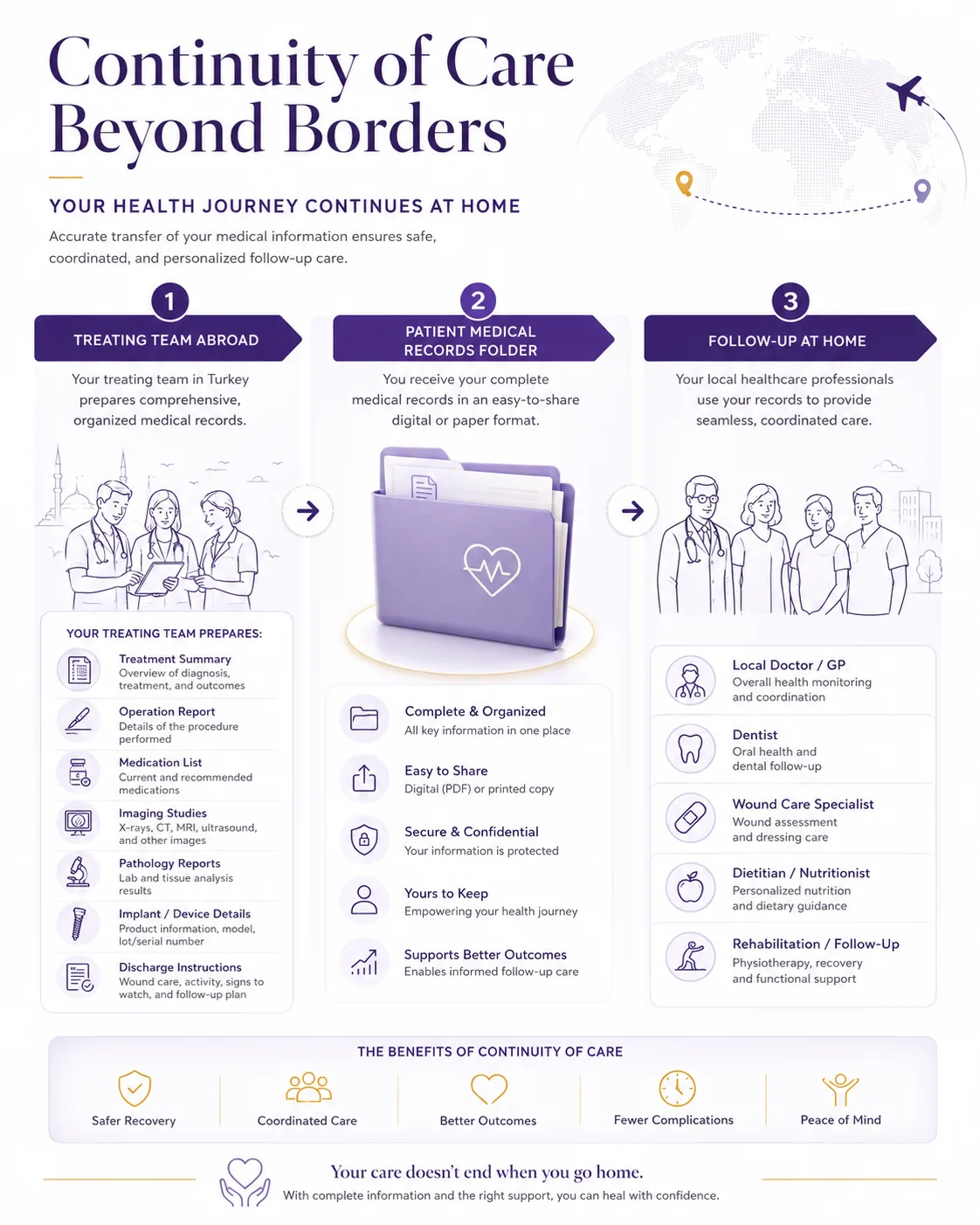
Continuity of care is easier when the next professional receives a complete and understandable medical record.
Records to Request Before Returning Home
Request:
- Final treatment summary
- Exact procedure name and date
- Operation report
- Anaesthesia record where relevant
- Implant or device information
- Medication list
- Laboratory results
- Imaging
- Pathology where relevant
- Discharge instructions
- Follow-up plan
- Emergency contact
- Treating professional’s details
The records should ideally be available in a language that the patient’s next healthcare team can understand.
Treatment-Specific Aftercare Considerations
The following examples are general and do not replace the individual treatment plan.
Dental Treatment
Follow-up may involve pain or swelling review, infection assessment, temporary restorations, bite adjustment, implant healing, suture removal, multiple visits and long-term maintenance.
Patients may explore the dental treatments in Turkey.
Hair Transplantation
Follow-up may involve first washing, donor-area care, swelling, scab management, medication, activity restrictions, infection monitoring and long-term hair-loss planning.
Patients may explore the hair transplant treatments in Turkey.
Facial and Body Surgery
Follow-up may involve wound review, drain care, compression garments, mobility, blood-clot prevention, swelling, scar care and travel clearance.
Patients may explore the facial refinement treatments in Turkey and body-contouring treatments in Turkey.
NHS advice on cosmetic surgery abroad notes that overseas clinics may not provide the same follow-up arrangements available after treatment at home, making it important to confirm aftercare before travelling.
Bariatric Surgery
Follow-up may involve diet stages, hydration, medication changes, vitamins and minerals, laboratory monitoring, wound care, long-term nutritional review and psychological support.
Patients may explore the bariatric surgery in Turkey.
Oncologic Surgery
Follow-up may involve pathology review, wound care, staging, further surgery, medical oncology, radiotherapy, rehabilitation, surveillance and communication with the home-country cancer team.
Patients may explore the oncologic surgery in Turkey.
What to Do If a Problem Develops in Turkey
Step 1: Assess the Urgency
Use 112 or attend an emergency department for severe, rapidly worsening or potentially life-threatening symptoms.
Step 2: Contact the Treating Provider
Provide the symptoms, time of onset, whether symptoms are worsening, current location, medicines taken, relevant measurements and photographs where appropriate.
Step 3: Request an In-Person Assessment
A photograph, message or video call may not be enough to evaluate a possible complication.
Step 4: Preserve Documentation
Keep new reports, prescriptions, test results, invoices, messages, names of professionals, dates and times.
Step 5: Contact the Insurer
Follow the insurer’s emergency or authorisation process where possible, without delaying urgent treatment.
Step 6: Reassess the Return Journey
Do not travel solely because the original flight is booked.
What to Do If a Problem Develops After Returning Home
1. Seek local medical assessment.
2. Explain that treatment was performed abroad.
3. Provide the procedure date and facility.
4. Provide the discharge summary and treatment records.
5. Provide medication, implant or device information.
6. Contact the original treating provider.
7. Inform the insurer where relevant.
8. Keep all medical reports and invoices.
9. Do not rely only on remote messaging.
10. Follow the advice of the professional providing the local examination.
The CDC advises patients not to delay care when they suspect a complication after returning home.
Financial Planning for Possible Complications
A medical-travel budget should consider possible expenses such as additional consultation, laboratory tests, imaging, medication, extra hospital nights, emergency treatment, intensive care, flight changes, extended accommodation, companion expenses, private follow-up at home, wound care, physiotherapy, return travel to Turkey, revision treatment and lost income.
The patient should understand which costs may be covered by the provider, covered by insurance, paid directly by the patient, reimbursed later or excluded.
A quotation for the planned treatment may not include any of these costs.
Complaints and Documentation
Before treatment, identify the legal name of the provider, contracting party, payment recipient, complaint contact, complaint procedure, medical-record request procedure, refund process, applicable jurisdiction and escalation route.
A complaints procedure does not replace medical treatment. If a complication occurs, obtain appropriate care first and preserve the documents required for later review.
Red Flags Before Booking Treatment Abroad
Pause before paying when:
- No written aftercare plan is available.
- No emergency contact is provided.
- The treating facility is unclear.
- The provider refuses to discuss complications.
- A result is guaranteed.
- The provider claims complications cannot occur.
- Insurance questions are dismissed.
- The revision policy is verbal only.
- The provider says follow-up at home is unnecessary.
- Medical records will not be supplied.
- The package encourages immediate holiday activities after surgery.
- The return flight is fixed before medical assessment.
- The patient is pressured to combine procedures.
- No one can explain what happens outside normal working hours.
- The payment recipient is unclear.
Emergency Planning Checklist
Before travelling, confirm that you have:
- Verified the treating doctor and healthcare facility
- Received a written treatment plan and reviewed the main risks
- Received an aftercare plan and emergency contact details
- Identified the nearest emergency hospital and saved 112
- Identified possible follow-up at home
- Reviewed appropriate insurance and disclosed planned treatment
- Reviewed the complication and revision policies
- Prepared a medical-record folder, medication list and allergy list
- Arranged flexible travel and sufficient recovery time
- Created a financial contingency
- Shared emergency details with a companion
- Confirmed how to obtain records after treatment
Frequently Asked Questions
Who Is Responsible for Complications After Treatment Abroad?
Responsibility depends on the provider’s contract, the complication policy, applicable law, insurance and the circumstances. The relevant terms should be obtained in writing before treatment.
Does Standard Travel Insurance Cover Planned Treatment Abroad?
Many ordinary policies do not cover planned treatment and may require specialist cover. The insurer should be informed about the purpose of travel.
What Should I Do If I Become Unwell After Returning Home?
Seek local medical assessment and provide the treatment records. Do not delay urgent care while waiting for the overseas provider to respond.
Does a Free Revision Include Flights and Accommodation?
Not necessarily. It may cover only part of the medical fee. Facility, anaesthesia, travel, accommodation, testing and medication may be excluded.
Should I Contact the Provider or Emergency Services First?
For potentially life-threatening symptoms, contact local emergency services first. Inform the provider after urgent care has been arranged.
What Is the Emergency Number in Turkey?
The national emergency number is 112.
Can My Usual Doctor Provide Aftercare?
Possibly, but it should not be assumed. Ask before travelling which services are available and whether specialist or private follow-up will be required.
How Long Should I Remain in Turkey?
The appropriate period depends on the treatment, recovery, follow-up requirements and medical fitness to travel. It should not be determined only by the package’s hotel nights.
Which Records Should I Take Home?
Request the treatment summary, operation report, medication information, test results, imaging, pathology where relevant, implant details, discharge instructions and follow-up plan.
What Is Medical-Evacuation Insurance?
It may cover medically necessary emergency transport under the conditions of the policy. It does not automatically cover the planned treatment, hospital bills or every additional cost.
Can Venoramed Manage a Medical Emergency?
No. Venoramed is a medical marketplace and is not an emergency or clinical service. Contact local emergency services or an appropriate healthcare facility.
Final Thoughts
Planning for complications after treatment abroad does not mean assuming that treatment will fail.
It means recognising that international treatment creates additional responsibilities involving communication, travel, medical records, insurance, emergency access, follow-up and financial planning.
Before treatment, the patient should understand what expected recovery may look like, which symptoms require assessment, how to contact the provider, where emergency care is available, how long to remain in Turkey, who may provide follow-up at home, what the insurance policy covers, what the provider’s policy excludes, which records will be provided and how additional costs will be handled.
A strong medical-travel plan is not limited to the expected procedure. It also explains what happens when the original plan changes.
Medical disclaimer: This article provides general information and is not a substitute for medical advice, diagnosis, emergency assessment or individual discharge instructions. Seek urgent local medical care for severe, rapidly worsening or potentially life-threatening symptoms.
Insurance disclaimer: Insurance coverage depends on the exact policy, disclosures, exclusions and circumstances. Obtain confirmation directly from the insurer.
Platform disclaimer: Venoramed is a medical marketplace and is not a clinic, hospital, emergency service or insurer. It does not manage complications or guarantee provider or insurance coverage.


Leave a Comment
Share your question or experience. Venoramed reviews comments before publishing.