

Blepharoplasty in Turkey (eyelid surgery) attracts a steady stream of patients from the UK and Europe who are tired of hooded upper lids or puffy lower lids. It is a small operation in terms of time, but it works on one of the most delicate, expressive parts of the face, so the details matter far more than the headline price.
This guide goes deeper than our broader comparison of facelift, neck lift and blepharoplasty. It covers upper and lower surgery, the scarless-looking transconjunctival approach, when eyelid surgery is functional rather than cosmetic, the eye checks that should come first, recovery, risks, and how to plan a trip to Istanbul sensibly.
Quick answer: Blepharoplasty removes or repositions excess skin and fat from the upper or lower eyelids. In Turkey it is usually done as a day case or short stay, with stitches removed after about a week and most people back to normal routines in one to two weeks. Plan to stay around 7 to 10 days, have your eyes checked first, and compare quotes on what they include.
Key takeaways
- Upper blepharoplasty treats hooded, heavy lids; lower blepharoplasty treats bags and loose skin under the eyes.
- Transconjunctival surgery works from inside the lower lid, so there is no visible skin scar, but it suits fat bags more than loose skin.
- A low brow can mimic hooded lids. If the brow is the cause, eyelid surgery alone may disappoint.
- Dry eye, previous eye surgery and contact lens use should be discussed before you book, not after.
- The NHS advises waiting 7 to 10 days before flying after facial cosmetic procedures, which shapes your stay in Istanbul.
What is blepharoplasty, and what can it change?
Blepharoplasty (eyelid reshaping surgery) removes excess skin, fat or muscle from the eyelids to change the look of hooded or drooping lids and eye bags. The NHS guide to eyelid surgery describes it in exactly those terms and suggests speaking to your GP first, because some medical conditions affect suitability.
What it does not do is just as important. It does not lift a low brow, erase crow’s feet or change the colour of dark circles caused by pigment. According to Cleveland Clinic’s overview of blepharoplasty, the operation itself typically takes between 30 minutes and two hours, with combined upper and lower surgery towards the longer end.
Many patients who search for eyelid surgery Turkey are also weighing up other facial procedures. You can see how eyelid surgery fits alongside them on our facial refinement treatment page.
Upper vs lower blepharoplasty: what is the difference?
Upper blepharoplasty treats the upper lid, usually through a cut hidden in the natural crease, while lower blepharoplasty treats under-eye bags through a cut just below the lashes or inside the lid. The two are different operations with different trade-offs, and many people only need one of them.
Upper eyelid surgery
In upper eyelid surgery, the surgeon removes a measured strip of skin, and sometimes a little fat or muscle, along the crease. The NHS notes that the scar usually sits in the natural fold. The BAAPS patient guide to eyelid surgery explains that the lower incision is usually marked 8 to 10mm above the lashes, and that surgeons typically leave about 10mm of skin below the brow so the eye can still close comfortably.
Lower eyelid surgery
Lower lid surgery is more about fat than skin. The NHS describes the surgeon repositioning or removing fat from the bags, sometimes removing a little skin, and sometimes supporting the lid’s muscles and tendon. It is the more technical of the two, because the lower lid’s position against the eyeball has to be protected.
Transconjunctival blepharoplasty
Transconjunctival blepharoplasty is lower lid surgery done through the conjunctiva (the pink lining inside the lid), so there is no external skin scar. Cleveland Clinic lists these inner-lid incisions as one option for lower blepharoplasty. It is generally considered for people whose main issue is bulging fat rather than surplus, crepey skin; where skin is loose, a surgeon may combine it with a small skin pinch or recommend an external approach instead.
| Approach | Main problem it treats | Where the incision is | Things to discuss |
|---|---|---|---|
| Upper blepharoplasty | Hooded, heavy upper lids; excess skin | In the upper lid crease | Brow position; how much skin can be removed safely |
| Lower blepharoplasty (external) | Bags plus loose lower lid skin | Just below the lower lashes | Lid support; risk of the lid pulling down |
| Transconjunctival lower blepharoplasty | Bags from bulging fat, with good skin tone | Inside the lower lid | Whether skin laxity also needs treating |
| Upper and lower together | Changes in both lids | Combination of the above | Longer operation; more swelling at first |
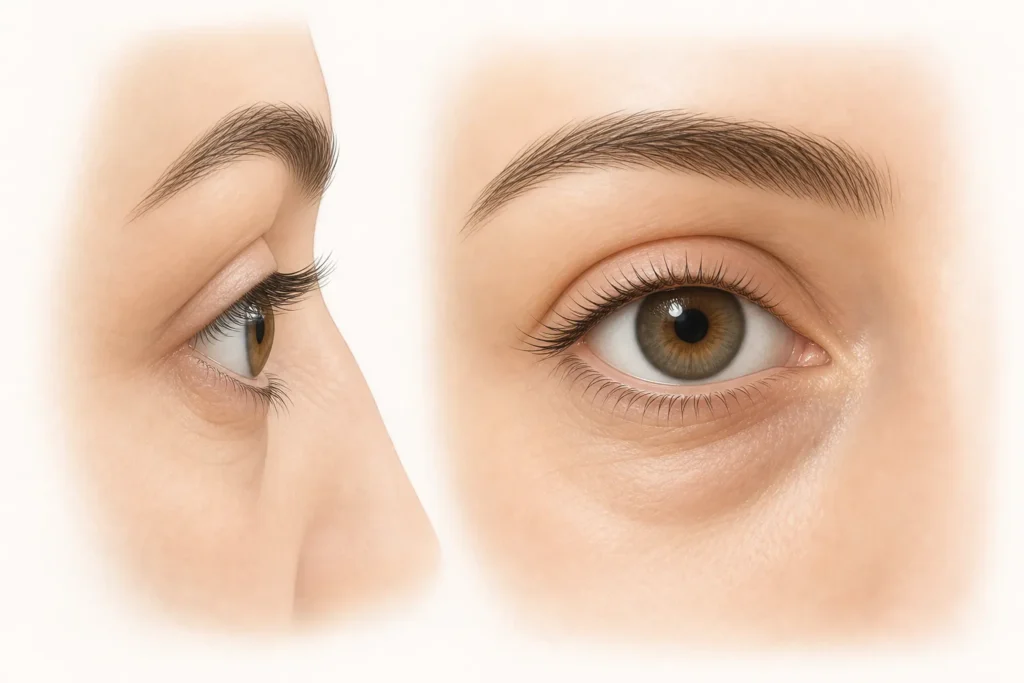
Is eyelid surgery functional or cosmetic?
Eyelid surgery is functional when excess upper lid skin measurably blocks your field of vision, and cosmetic when the aim is to look fresher or less tired. Cleveland Clinic notes that upper lid surgery may be medically necessary to improve peripheral vision when drooping lids get in the way.
In the UK, NHS funding is decided locally and the bar is high. Scotland’s NHS referral protocol for blepharoplasty says surgery may be considered where excess skin restricts the visual field, that visual field tests should be done before referral, and that it will not be considered where looking tired or older is the main concern.
Signs that your lids may be affecting function include lifting your eyebrows all day to see, a heavy, tired feeling by evening, or skin resting on the lashes. A visual field test at an optician or eye clinic is a useful, objective starting point. If you have a similar functional-versus-cosmetic question about your nose, our guide to functional vs cosmetic rhinoplasty works through the same logic.
Who is a good candidate for blepharoplasty?
A good candidate is an adult in stable general health, with a clear, specific concern about the eyelids, healthy eyes and realistic expectations. Suitability is always an individual decision made after an examination, not something a price list can tell you.
Factors that need careful discussion include smoking, blood-thinning medicines and existing eye conditions. BAAPS advises stopping smoking six weeks before surgery and not restarting. The NHS asks you to tell your surgeon about medicines that affect clotting, such as aspirin, warfarin or apixaban.
Dry eye and eye checks
Dry eye is the issue patients most often underestimate. BAAPS explains that swelling and stiffness after surgery can slow how quickly the lids close, causing dryness that is usually temporary, but in people already prone to dry eyes it can persist and lubricating drops may be needed long term.
Before booking, it is sensible to have an up-to-date eye examination, and to share the report with your surgeon. Mention any history of gritty or watery eyes, laser vision correction, thyroid eye problems or contact lens intolerance. Our guide to sharing medical records for an online consultation explains which documents and photos help a surgeon assess you remotely.
When do you need a brow lift instead of, or as well as, eyelid surgery?
You may need a brow lift when the heaviness comes from a brow that has descended, rather than from the eyelid skin itself. BAAPS notes that brow position affects the result of upper blepharoplasty and that a brow lift is sometimes needed.
Getting this wrong has consequences. A paper on brow height after brow lift and upper lid blepharoplasty in the Journal of Cutaneous and Aesthetic Surgery warns that failing to recognise a low brow before eyelid surgery can worsen the brow droop and lead to too much skin being removed from the outer part of the upper lid.
A simple mirror test gives a clue. Gently lift your eyebrows to where they sit naturally: if most of the hooding disappears, the brow is contributing. Only an in-person examination can confirm it, and some surgeons will suggest a combined plan.
If you would like a surgeon to look at your lids and brows together, you can start with a short shortlist.
What is blepharoplasty recovery like, day by day?
Recovery is usually quick in terms of time off, but slow in terms of final settling. Cleveland Clinic says most people return to their usual routine after a week or two, while full recovery takes a few months. The NHS says most people take about two weeks off work.
| Timeframe | What is typical | Source |
|---|---|---|
| First days | Puffy, possibly numb lids; irritated or watery eyes; rest and follow your surgeon’s aftercare instructions | NHS |
| First several days | No driving for a number of days; avoid strenuous activity and swimming | NHS |
| Up to about day 7 | Stitches or suture strips usually removed within a week, unless dissolvable | NHS; Cleveland Clinic |
| Weeks 1 to 2 | Most people back to usual routines and work; dry eyes may last a few weeks | Cleveland Clinic; NHS |
| Several weeks | Bruising and redness fade | NHS |
| A few months | Scars may feel tight and be visible, then fade | NHS |
| 9 to 12 months | Numbness after surgery usually resolves | BAAPS |
Contact lenses should be avoided during recovery; the NHS does not give a fixed date, so ask your surgeon. Sunglasses help with light sensitivity and keep curious looks to a minimum on the flight home.

What scars and risks should you expect?
Upper lid scars usually sit in the crease and fade over months, and transconjunctival surgery leaves no skin scar, but every approach carries risks. The NHS lists common, temporary effects such as puffy or numb lids, irritated or watery eyes, bruising and scarring.
Less common problems include blurred or double vision, uneven eyes, noticeable scarring and changed lid sensation. Rare but serious risks named by the NHS include eye muscle injury, ectropion (the lower lid turning outward), bleeding behind the eye and impaired vision. BAAPS adds corneal abrasion, delayed healing and unsatisfactory results.
Know the warning signs. Cleveland Clinic advises contacting your care team for bleeding, discharge, severe swelling, severe pain or any change in vision. If you are travelling, agree beforehand who you would call at home. Our guide to handling complications after treatment abroad covers this in detail.
How much does blepharoplasty cost, and how do you compare quotes?
The NHS puts UK private blepharoplasty at anywhere between £2,000 and £6,000, with consultations, further surgery and follow-up potentially adding to that. Venoramed does not publish eyelid surgery prices, and quotes in Istanbul vary with the lids treated, the technique and the type of anaesthesia.
For a US reference point, the American Society of Plastic Surgeons cost page gives average surgeon fees of $3,359 for upper and $3,876 for lower blepharoplasty, excluding anaesthesia and facility costs. That exclusion is a reminder to compare totals, not headline fees.
- Which lids: upper only, lower only or both, and which lower lid approach.
- Anaesthesia: local, sedation or general, and who gives it.
- Inclusions: tests, hospital fees, medicines, stitch removal, transfers and hotel nights.
- Aftercare: follow-up visits, remote reviews and what happens if a revision is needed.
Our overview of medical treatment costs in Turkey explains why prices differ and which extras commonly appear.

How long should you stay in Turkey after eyelid surgery?
Plan on roughly 7 to 10 days in Istanbul. The NHS advice on cosmetic surgery abroad recommends waiting 7 to 10 days before flying after facial cosmetic procedures, and that window also covers stitch removal and an early check.
Treat the trip as recovery, not a holiday. The NHS warns that a holiday straight after surgery is unrealistic and advises avoiding alcohol, sun, sightseeing and swimming. Our guide on how long to stay in Turkey after surgery sets out sample itineraries.
Check your insurance before you book. The UK government’s guidance on going abroad for medical treatment points out that standard travel insurance does not normally cover you if you travelled for elective surgery. The FCDO’s Turkey health advice says it is aware of 7 British nationals who died in Turkey in 2025 following medical procedures, and advises discussing plans with your UK doctor first. For wider context, see our guide to medical tourism in Turkey.
How do you choose an eyelid surgeon in Istanbul?
Choose on training, regular experience with the specific lid operation you need, and a clear aftercare plan, rather than on price or photos alone. Eyelid surgery is performed by plastic surgeons and oculoplastic surgeons (eye specialists who operate on the lids); what matters is that eyelids are a routine part of their practice.
The NHS suggests asking how many similar operations a surgeon has done, their complication experience and what follow-up care looks like. Our step-by-step guide to choosing a doctor and clinic in Turkey turns that into a practical checklist, and you can browse all doctor profiles on Venoramed.
Questions to ask before booking
- Do I need upper, lower or both, and is my brow contributing to the hooding?
- For my lower lids, would you use a transconjunctival or an external approach, and why?
- Which eye tests do you want before surgery, and how will my dry eye history change the plan?
- How many blepharoplasties do you perform, and what complications have you treated?
- What anaesthesia will you use, and where exactly will the operation take place?
- What does the quote include, and what costs extra?
- When are the stitches removed, and when do you consider it safe for me to fly?
- Who do I contact after I return home, and how are revisions handled?

Frequently asked questions
Is blepharoplasty in Turkey done under local or general anaesthesia?
Eyelid surgery can be carried out under local anaesthesia, local anaesthesia with sedation, or general anaesthesia. The choice depends on which lids are treated, the technique, your general health and the surgeon’s usual practice, so it should be agreed in advance. Ask who will give the anaesthetic and where the operation takes place, and arrange for someone to be with you afterwards if you are sedated or asleep.
Will eyelid surgery leave a visible scar?
Upper eyelid surgery leaves a fine scar that usually sits in the natural lid crease and fades over a few months, according to the NHS. External lower lid surgery leaves a scar just below the lashes. Transconjunctival lower blepharoplasty is done from inside the lid, so it leaves no skin scar. Healing varies between people, and some scars stay more noticeable than others.
How soon can I fly home after blepharoplasty?
The NHS advises waiting 7 to 10 days before flying after facial cosmetic procedures, which includes eyelid surgery. That window usually allows stitch removal and an early review before you leave Istanbul. Your surgeon may advise differently for your situation, so confirm the date before you book a return flight, and keep flexible tickets in case your recovery needs a little longer.
Can blepharoplasty make dry eyes worse?
It can. BAAPS explains that swelling and stiffness can slow lid closure after surgery, causing dryness that is usually temporary. In people already prone to dry eyes, the dryness can persist and lubricating drops may be needed long term. That is why a pre-operative eye examination and an honest history of eye symptoms matter so much before eyelid surgery.
Is upper eyelid surgery available on the NHS?
Only in limited circumstances. NHS funding for upper eyelid surgery is decided locally and usually requires evidence, such as visual field tests, that excess skin restricts your vision. Scotland’s referral protocol states that surgery will not be considered where looking tired or older is the main concern. Purely cosmetic upper eyelid surgery is paid for privately in the UK or abroad.
How long do blepharoplasty results last?
Results are long lasting, but eyelid surgery does not stop ageing. Skin continues to lose elasticity over time, and brows can descend further, so some people consider further treatment years later. Sun protection, not smoking and a stable weight all help. Your surgeon can explain how your own skin quality and anatomy are likely to influence how your result changes.
Can I combine eyelid surgery with rhinoplasty in Turkey?
Some surgeons do combine facial procedures in one session, while others prefer to stage them. Combining can mean a single recovery period and trip, but a longer operation and more swelling at once. Whether it is sensible depends on your health and the procedures involved. Our rhinoplasty in Turkey guide explains what nose surgery recovery involves, so you can discuss the options with your surgeon.
Next steps
If your eyelids or under-eye bags bother you, start with an eye check and clear photos, then compare surgeons on technique, experience and aftercare. If you are also thinking about your nose, our guide to rhinoplasty in Turkey covers that journey. When you are ready, ask a surgeon in Istanbul for an individual assessment.
Browse facial surgeons or send your details for a free, no-obligation consultation request.
This article is general educational information, not medical advice. Venoramed is a medical marketplace and coordination platform; it does not provide treatment, diagnose conditions or guarantee outcomes. Suitability, risks and recovery must be assessed individually by a qualified, treating clinician.



Leave a Comment
Share your question or experience. Venoramed reviews comments before publishing.