

Revision rhinoplasty in Turkey attracts patients who are unhappy with an earlier nose job, whether it was done in the UK, elsewhere in Europe or in Istanbul itself. A revision (also called secondary rhinoplasty) is a second or later operation to correct the look or the function of a nose that has already been operated on, and it is a different undertaking from a first rhinoplasty.
This guide explains why people need revision surgery, how long to wait, why it is more complex, how cartilage grafts from the septum, ear or rib are used, and how to choose a revision surgeon. It also covers the records to bring, how cost compares with a first operation and what a realistic outcome looks like.
Quick answer: Revision rhinoplasty in Turkey is a corrective nose operation for breathing problems, asymmetry, an over-reduced nose or a pinched tip after earlier surgery. It is more complex than a first rhinoplasty, often needs cartilage grafts from the ear or rib, and carries a higher chance of further revision. Plan it only once the first result has settled, usually at least a year after surgery.
Key takeaways
- The most common reasons for revision are tip problems, a crooked middle third and blocked breathing, often in combination.
- The final result of a rhinoplasty can take 12 to 18 months, so revisions are planned only after the nose has settled.
- Scar tissue and missing septal cartilage make revisions harder; ear or rib cartilage is often needed.
- The risk of needing yet another operation is higher after a revision than after a first rhinoplasty.
- Choose a surgeon with substantial revision experience, bring your full records, and set goals as improvement, not perfection.
What is revision rhinoplasty?
Revision rhinoplasty is any rhinoplasty performed on a nose that has had surgery before, to improve its appearance, its breathing or both. The American Society of Plastic Surgeons (ASPS) describes revision cases as among the most difficult that aesthetic plastic surgeons face.
Revisions range from a minor touch-up, such as smoothing a small irregularity on the bridge, to a full structural rebuild of a collapsed or over-reduced nose. Knowing where you sit on that range is the most useful thing a consultation can tell you, because it drives the technique, the cost and the recovery.
If you are still deciding whether your problem is about breathing, appearance or both, start with our explainer on functional versus cosmetic rhinoplasty. This article focuses on what changes when the nose has already been operated on.
Why do people need a second rhinoplasty?
People seek a second rhinoplasty mostly because of tip problems, a crooked nose or difficulty breathing, and many have both a cosmetic and a functional concern. In a prospective study of 104 revision patients (Archives of Facial Plastic Surgery, 2010), the most common aesthetic concerns were tip asymmetry, a crooked middle third and irregularity of the upper third; 94% of those who reported a blocked nose had physical findings to explain it.
A 2021 German comparison of 245 primary and revision patients in Plastic and Reconstructive Surgery found that almost two-thirds of revision patients had functional and aesthetic problems in combination. The common patterns are:
- Breathing problems: narrowed or collapsed nasal valves (the narrowest parts of the airway), a residual septal deviation or scarring.
- Asymmetry: a tip or bridge that has healed off-centre, or a nose that has drifted crooked.
- Over-resection: too much bone or cartilage removed, leaving a scooped or collapsed bridge, an “inverted V” shadow or a tip that has lost support.
- Pinched tip: a tip that looks narrow and shadowed at the sides, where the lower lateral cartilages (the curved cartilages of the tip) may need support.
- Under-correction: a hump or droop that remains, or has returned.
The tip is the most frequent focus. In a 2019 series of 150 secondary rhinoplasty patients (Plastic Surgery), 123 had complaints about the tip, including deviated and pinched tips. If your tip has dropped since your first operation, our guide to droopy nose tip surgery explains how support is rebuilt.

How long should I wait before revision rhinoplasty?
Plan on waiting at least 12 months after your previous rhinoplasty, and sometimes longer, because the nose has not finished healing before then. The British Association of Aesthetic Plastic Surgeons (BAAPS) says the final result may not be achieved for 12 to 18 months, and Cleveland Clinic says full results usually appear after about one year.
Some surgeons expect longer. In an ASPS article on choosing a corrective rhinoplasty surgeon, a surgeon says final results take at least a year and a half to arrive.
Why wait? Swelling hides the true shape, and operating too early risks correcting a problem that might have settled by itself. A surgeon may consider earlier intervention for a specific issue, such as a severe airway blockage, but that is an individual clinical judgement, not a shortcut to request.
Use the waiting time well. Track your breathing, take monthly photographs in the same light, and gather your records. Our week-by-week rhinoplasty recovery guide shows what is still normal at each stage.
Why is revision rhinoplasty more complex than a first nose job?
Revision rhinoplasty is more complex because the surgeon works through scar tissue, with altered anatomy and often too little cartilage left to rebuild with. ASPS notes that scar tissue from earlier surgery can limit results and may recur, and that revision cases often need cartilage to replace what was removed.
The 2021 Plastic and Reconstructive Surgery comparison found complex reconstructive techniques, extracorporeal septoplasty (removing, straightening and replacing the septum) and grafts taken from outside the nose were all used more often in revisions. Further revision during follow-up was also more common: 23.9% after revision surgery versus 10.5% after primary rhinoplasty in that clinic.
| Factor | Primary rhinoplasty | Revision rhinoplasty |
|---|---|---|
| Tissue planes | Untouched, predictable | Scarred, anatomy altered |
| Cartilage available | Usually septal cartilage | Septum often depleted; ear or rib often needed |
| Typical goal | Reshape | Repair, rebuild and reshape |
| Approach | Open or closed | Chosen case by case; an open approach gives direct access for rebuilding |
| Recovery | Standard rhinoplasty timeline | Can be more involved; donor-site recovery if ear or rib is used |
| Chance of further surgery | Lower | Higher (23.9% vs 10.5% in one specialist series) |
If you are comparing where to have this done, our guide to rhinoplasty abroad: Turkey versus Europe sets out the practical differences.
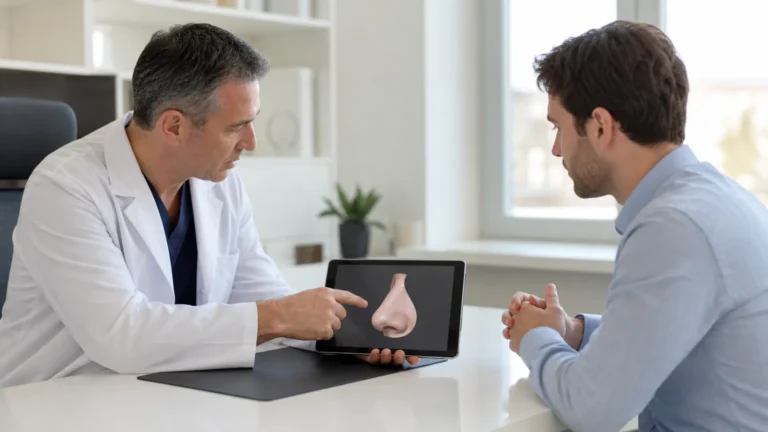
A revision starts with an honest assessment of your nose by a surgeon who does this work regularly.
Which cartilage grafts are used in revision rhinoplasty?
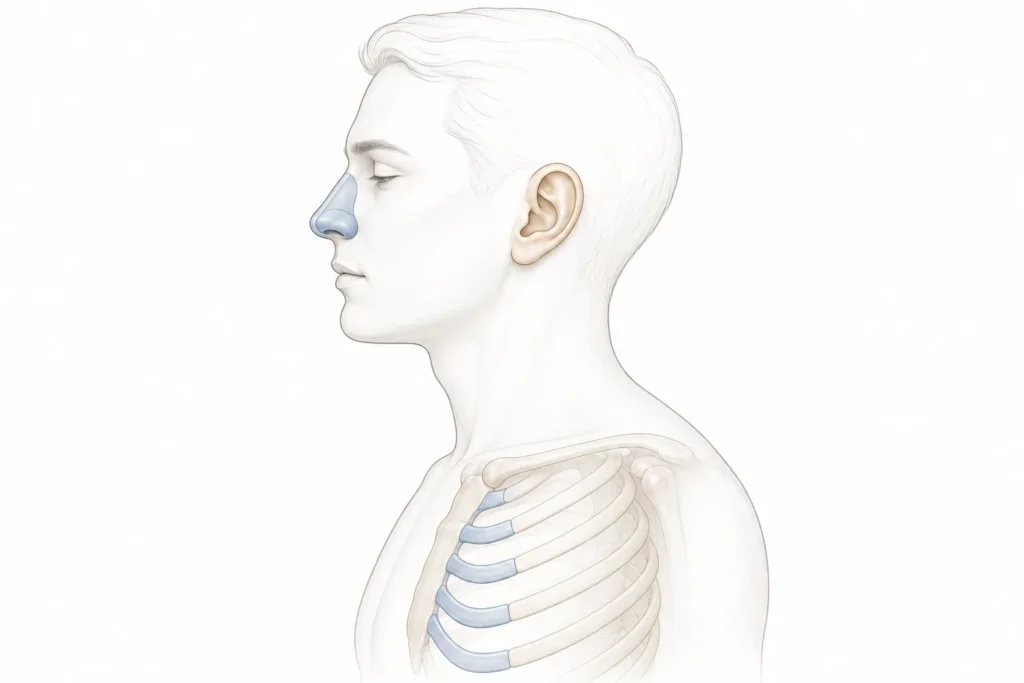
Revision surgeons use the patient’s own cartilage, from the septum where enough remains, otherwise from the ear or the rib. ASPS explains that septal cartilage is often deficient after earlier surgery, so surgeons often turn to the ear and occasionally the rib. BAAPS lists the septum, rib, hip and ear as possible sources.
| Graft source | Character | Often used for | Trade-offs |
|---|---|---|---|
| Septal cartilage (from inside the nose) | Straight, firm, no extra scar | Struts, spreader grafts, tip support | Often already used or removed in the first operation |
| Ear (conchal) cartilage | Curved, softer | Tip and nostril-rim shaping, small contour grafts | Small scar behind or inside the ear; less suited to strong structural support |
| Rib (costal) cartilage | Plentiful, strong | Major rebuilding of the bridge, septum or tip support | Chest scar and donor-site discomfort; risk of warping |
Rib cartilage is valuable but not risk-free. A 2023 meta-analysis of 1,648 patients in Aesthetic Plastic Surgery reported pooled rates of 3.05% for warping (bending of the graft), 1.2% for resorption, 1.45% for infection and 1.53% for contour irregularity, with a hypertrophic chest scar in 2.08%. Warping was the most common complication.
Ask your surgeon which graft they expect to need and why, whether they would harvest rib if they found less cartilage than expected, and how that would change your stay in Istanbul and your recovery.
How do I choose a revision rhinoplasty surgeon in Turkey?
Choose a surgeon who performs revision rhinoplasty regularly, can show long-term revision results, and explains clearly what can and cannot be improved in your nose. ASPS advises an experienced, certified surgeon who has earned your trust, a review of their rhinoplasty gallery, and speaking with former patients.
The ASPS corrective rhinoplasty article adds that galleries should include long-term photographs taken more than a year after surgery, and calls a gallery of only on-table photographs an immediate red flag. Ask how the surgeon communicates after surgery and how available they will be if an issue arises.
For Turkey specifically, the UK government’s Turkey health travel advice recommends discussing plans with your UK doctor first, doing your own research rather than relying on commercial material, and checking that a provider appears on the Turkish Ministry of Health’s HealthTürkiye list of approved providers. It also reports that 7 British nationals died in Turkey in 2025 following medical procedures, a reminder that due diligence matters.
Our guide on how to choose a doctor and clinic in Turkey turns these checks into a step-by-step process.

What records should I bring to a revision consultation?
Bring everything that tells the new surgeon what was done before: operation notes, photographs from before and after your first surgery, and any scans or ENT reports. A surgeon who knows which cartilage was removed, which grafts were placed and which approach was used can plan more accurately.
- Operation note from each previous nose surgery; request it from the hospital or clinic.
- Photographs from before your first surgery, plus current front, both profiles, three-quarter and base views in daylight.
- Breathing history: which side blocks, when, and what has been tried.
- Imaging and specialist letters, such as a CT scan of the sinuses or an ENT assessment, if you have them.
- Medical history: medication, allergies, smoking, previous fillers or threads in the nose.
- Your priorities, written as two or three specific goals in order of importance.
Our records checklist for an online consultation explains how to collect and share these securely before any travel is booked.
How much does revision rhinoplasty in Turkey cost compared with a first rhinoplasty?
Revision rhinoplasty is quoted individually, after the surgeon has reviewed your records and photographs, because the work can range from a small touch-up to a rebuild with ear or rib grafts. The rhinoplasty doctor profiles on Venoramed currently display starting prices from EUR 2,400 to EUR 4,000, and one profile displays USD 2,500 (November 2026). These are starting figures, not final quotes.
Ask whether a displayed starting price applies to revision work at all, and what changes it. For a sense of what typical packages include, see the Turkey rhinoplasty package price guide, and for a UK comparison, our UK nose job cost guide.
- Is rib harvest included, or charged only if needed?
- Does the price cover hospital nights, anaesthesia, splint removal and follow-up reviews?
- What is the policy, and the cost, if a further touch-up is needed?
- How long do I need to stay in Istanbul if a rib graft is used?
Budget for a stay long enough for your review; our guide to how long to stay in Turkey after surgery helps you plan it.

What results can I realistically expect from a revision?
Realistically, a revision aims for a clear improvement in the specific problems you named, not a flawless nose, and the result is shaped by scar tissue and skin as much as by technique. ASPS warns that another operation may not fully fix a problem, that revisions have a higher revision rate than primary surgery, and that no ethical surgeon can guarantee results.
There is encouraging evidence too. In a 2016 study comparing 54 revision and 54 primary patients (SpringerPlus), satisfaction scores improved in both groups; improvements were greater after primary surgery, but revision patients still reached high levels. Patients who were satisfied with the information given before surgery improved more.
That last finding is the practical lesson: a thorough consultation is part of the treatment. Our guide to complications after treatment abroad covers what to agree before you travel.
Questions to ask before booking a revision rhinoplasty
- How many revision rhinoplasties do you perform each year, and can I see results at least a year after surgery?
- What exactly do you think went wrong, and which of my concerns can be improved?
- Will you address breathing and appearance together?
- Which grafts will you use, from where, and what is the plan if there is less cartilage than expected?
- Open or closed approach, and why?
- Has enough time passed since my last operation, in your view?
- What is included in the quote, and what happens if a further procedure is needed?
- Who is my named contact once I am home, and how are reviews done?
Frequently asked questions
Can a botched nose job be fixed?
Many problems after a nose job can be improved with revision rhinoplasty, including asymmetry, a pinched or drooping tip, an over-reduced bridge and blocked breathing. How much improvement is possible depends on scar tissue, skin thickness and the cartilage available for grafts. A full correction is not always achievable, so a good revision surgeon will explain which concerns can realistically be improved and which may not change.
How soon after rhinoplasty can I have a revision?
Most patients should plan for at least 12 months after their previous rhinoplasty before a revision, because the nose is still healing. BAAPS says the final result may take 12 to 18 months, and Cleveland Clinic says full results usually appear after about a year. Earlier surgery is a clinical decision for specific problems, not something to request because the early result is disappointing.
Is revision rhinoplasty more painful than the first operation?
Revision rhinoplasty is not necessarily more painful, but recovery can be more involved. If ear or rib cartilage is used there is a second wound, and a rib graft in particular adds discomfort and a scar on the chest. Ask your surgeon which grafts are likely, what pain relief you will take home and how long the chest or ear donor site takes to settle.
Should I go back to my original surgeon for a revision?
That depends on the problem and your confidence in them. A small, clearly defined issue may be best handled by the surgeon who knows exactly what was done. For a complex correction, or if trust has broken down, it is reasonable to seek a second opinion from a surgeon with substantial revision experience. Either way, obtain your operation notes, because any surgeon will need them.
Why might I need rib cartilage for a second rhinoplasty?
Rib cartilage may be needed when the septum no longer has enough cartilage after the first operation and the nose needs strong structural support, for example to rebuild a collapsed bridge or support a weak tip. It is plentiful and strong, but a 2023 meta-analysis found warping in about 3% of cases and a thickened chest scar in about 2%, so it is used when the benefit justifies it.
How long should I stay in Istanbul for revision rhinoplasty?
Plan to stay at least until the splint is removed and the surgeon has reviewed your nose, typically about a week after rhinoplasty, and allow extra days if rib cartilage is harvested or your surgeon wants a later check. Book flexible flights, keep your operation notes with you, and make sure you have a named contact at the clinic for questions once you are home.
Is revision rhinoplasty in Turkey safe?
No surgery is risk-free, and revision rhinoplasty carries higher complexity and a higher chance of further surgery than a first operation, wherever it is done. Safety depends on the individual surgeon, the hospital and the aftercare plan. UK government advice for Turkey recommends talking to your UK doctor first, researching independently and checking a provider against the Turkish Ministry of Health’s approved list.
Next steps
If your first rhinoplasty is more than a year old and you have clear concerns, gather your records and photographs and ask for an assessment by a surgeon with revision experience. Our rhinoplasty in Istanbul page introduces the surgeons you can compare, and a free consultation request lets a doctor review your case before you commit to travel.
This article is general educational information, not medical advice. Venoramed is a medical marketplace and coordination platform; it does not provide treatment, diagnose conditions or guarantee outcomes. Suitability, risks and recovery must be assessed individually by a qualified, treating clinician.



Leave a Comment
Share your question or experience. Venoramed reviews comments before publishing.