

Facelift vs Neck Lift vs Blepharoplasty What Does Each Procedure Address
Facelift, neck lift and blepharoplasty are often discussed together because they relate to the face and neck. They do not address the same area, and none of the names tells a patient which procedure is appropriate. A useful consultation begins by separating the concern: upper or lower eyelids, lower face and jowls, jawline and neck, or a combination. The treating clinician then considers anatomy, health history, skin quality, prior procedures, recovery demands and the patient’s own priorities.
This guide explains the difference at a general educational level. It does not diagnose facial features from a photograph, recommend surgery, or predict an individual result. A written plan from an appropriately qualified clinical team should explain the proposed scope, alternatives, risks, scars, recovery and follow-up before a patient makes a decision.
For general pathways and provider comparison, see Venoramed’s Facial Refinement and Rhinoplasty information. Venoramed is a medical marketplace and coordination platform. It does not provide direct treatment, select a procedure, prescribe aftercare or guarantee outcomes.
[WORD_MEDIA]
[WORD_MEDIA]
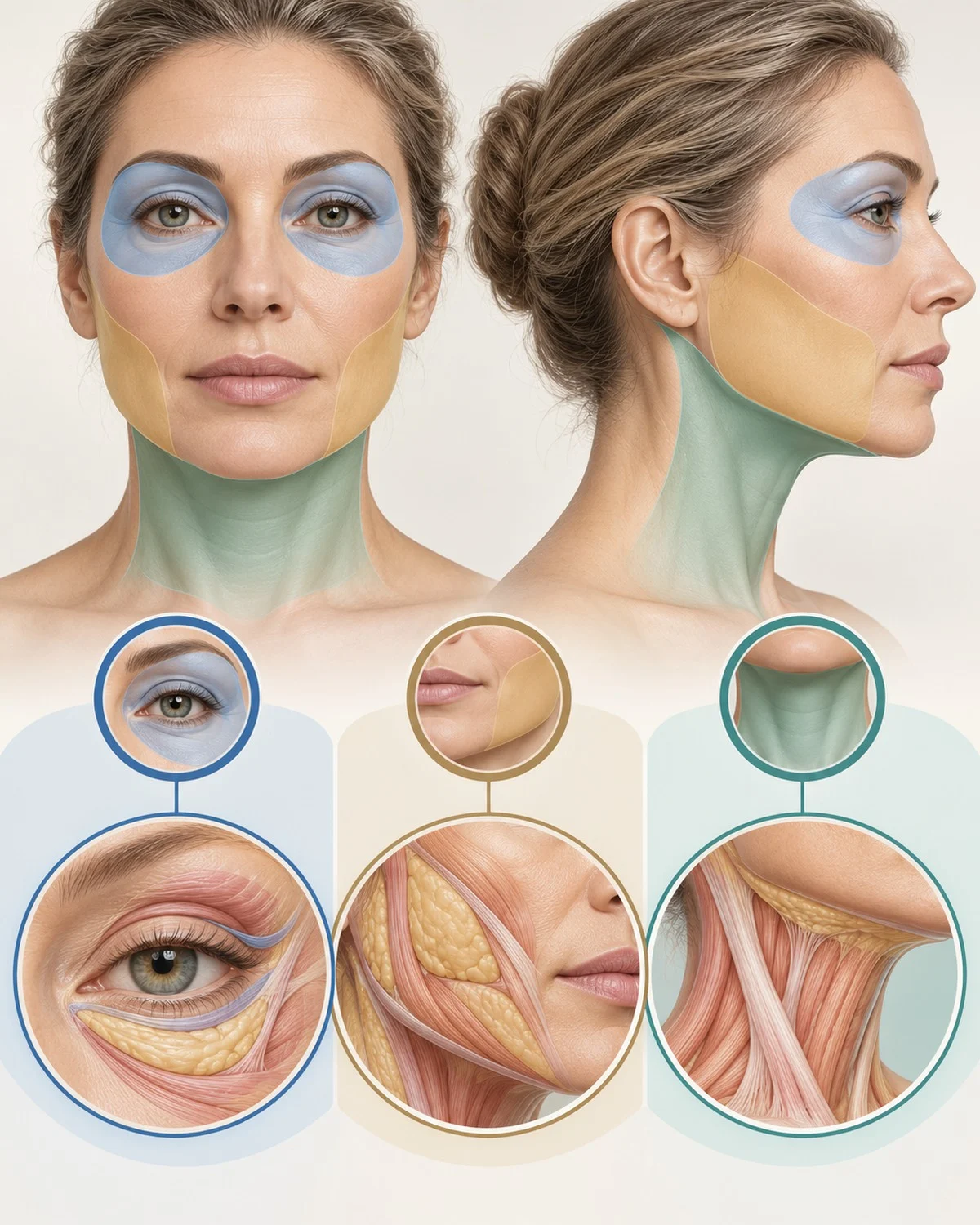
The clearest way to compare these procedures is to start with the area being discussed rather than a popular label. A facelift, also called rhytidectomy, is generally discussed for visible laxity and contour changes in the lower face and may also be relevant to the jawline and upper neck. A neck lift is generally discussed for the neck and the angle below the chin. Blepharoplasty concerns the upper eyelids, lower eyelids or both. These broad descriptions overlap in a full-face consultation, but they are not interchangeable.
The NHS describes facelift surgery as an operation intended to lift and pull back facial skin, commonly focused on loose skin around the lower half of the face and neck. The American Society of Plastic Surgeons describes neck lift surgery as addressing visible ageing changes in the jawline and neck. Eyelid surgery has a different focus: it may involve excess skin or fat around the eyelids, with upper and lower eyelids requiring different approaches. Those descriptions guide a conversation; only an individual assessment can determine whether any finding applies to a particular person.
A facelift is usually discussed when a person’s main concern is the lower face: jowling, changes in the cheek-to-jawline transition, laxity around the mouth or a softer lower facial contour. Depending on the plan, the conversation may include the relationship between skin, deeper soft tissues and the jawline. It is not simply a skin-tightening label, and it is not designed to correct every feature of the face.
The exact incisions, depth of dissection and use of additional procedures vary. A responsible clinician should explain which layers and areas are being considered, why they are relevant, and which concerns are outside the proposed scope. A patient should not assume that a facelift will correct eyelid hooding, lower-eye bags, a prominent neck band, pigmentation, volume loss, skin texture or a concern in the forehead. Those may require a different discussion, a staged plan or no procedure at all.
Recovery is individual. The NHS notes that bruising and swelling are expected after a facelift, that early recovery commonly takes weeks and that final settling can take longer. The American Society of Plastic Surgeons also highlights that a patient needs specific instructions for dressings, medicines, activity and follow-up. No general timeline should be treated as a promise for a particular patient or as travel clearance.
A neck lift is generally discussed for the contour below the jaw, the neck itself and the transition between them. A person may ask about skin laxity, vertical neck bands, fullness below the chin or a loss of definition at the cervicomental angle. These observations do not establish a diagnosis or a suitable treatment. The clinician has to decide whether the concern relates primarily to skin, fat distribution, muscle, deeper support, weight change, jaw structure or a combination of factors.
A neck lift may be planned on its own or discussed alongside a facelift when both lower-face and neck concerns are relevant. Combining names on a quotation does not explain the medical rationale. Ask which part of the lower face or neck each component is intended to address, whether an additional incision is expected, and what result the clinician considers realistically achievable in that anatomy.
The risks of neck-lift surgery include bleeding, infection, fluid collection, numbness or sensation change, scarring, prolonged swelling, healing problems and an unsatisfactory result. The ASPS lists these as potential complications and notes that rare nerve injury may affect lower-lip movement. The consent conversation should explain risk in the context of the actual proposed plan, not as a generic list copied from the internet.

[WORD_MEDIA]
Blepharoplasty is eyelid surgery. Upper-lid discussions often concern excess skin, a heavy fold or contour changes around the eyelid. Lower-lid discussions may concern bags, skin excess or the relationship between the lower lid and cheek. The procedure is local to the eyelid region; it does not replace a facelift or neck lift, and it does not treat the jawline or neck.
The NHS explains that upper-eyelid surgery commonly uses an incision placed in the natural eyelid crease. Lower-eyelid techniques may use an incision below the lashes or inside the lower lid, depending on what a clinician considers appropriate. These general pathways should not be used to select a technique online. Eye health, lid position, dry-eye symptoms, previous eye surgery, medications and facial anatomy may matter to the assessment.
Early healing can include swelling, bruising, irritation, tearing, dry-eye symptoms and temporary difficulty closing the eyelids. The ASPS recommends following the surgeon’s individual aftercare instructions and practicing careful sun protection during healing. Serious complications are uncommon but can include lid-position problems, bleeding, eye-muscle injury or visual impairment; an individual clinician should explain the relevant risks and when urgent assessment is needed.
| Procedure | Main discussion area | May be discussed with | Does not automatically address |
| Facelift | Lower face, jowls and sometimes the jawline or upper neck | Neck lift or eyelid surgery when a clinician identifies separate concerns | Every eyelid, forehead, neck, skin-quality or volume concern |
| Neck lift | Jawline, beneath-chin contour and neck | Facelift when lower-face and neck concerns are both relevant | Upper or lower eyelid concerns, or every lower-face concern |
| Blepharoplasty | Upper lids, lower lids or both | Facelift or neck lift when those other areas need separate evaluation | Jowls, jawline definition, neck laxity or a brow concern |
This table is a conversation guide, not a treatment-selection tool. The same person may have concerns in more than one area, while another person may be better served by a single focused plan, a non-surgical option, more time to decide or no procedure.
Some patients ask whether several areas can be treated during one operation. There is no universal answer. Combining procedures can change operating time, anaesthesia considerations, the recovery experience, cost structure, wound-care needs and the planning of early review. Staging can create separate recovery periods and may change the order in which concerns are addressed. Neither approach is automatically safer, easier or better value.
A responsible conversation should make the choice transparent. Ask what the team believes each component would contribute, whether the benefit of combining outweighs the added burden for that individual, what would happen if an in-person examination changes the plan, and whether postponing or declining one component would alter the others. Ask for the proposed procedure names, facility, named clinician and inclusions in writing.
For broader international-care preparation, use the doctor and clinic safety checklist and read the guidance on how long to stay in Turkey after surgery. A travel itinerary should follow the clinical plan rather than determine it.
Every surgical procedure leaves scars, although their location and visibility vary by approach and by individual healing. A clinician can explain the likely incision areas, how scars are expected to mature, what may make healing more difficult and which limitations cannot be removed by surgery. Skin quality, tissue thickness, facial asymmetry, pre-existing conditions, smoking or nicotine exposure, previous procedures and healing response can all affect the conversation.
It is reasonable to bring reference images to explain an aesthetic preference, but they are not a guarantee that a similar result can be achieved. Do not rely on a filtered image, a single before-and-after photograph or an online opinion as proof that a specific plan is right for you. Ask what the clinician believes is achievable, what trade-offs are involved, and what uncertainty remains until an in-person examination.
Informed consent should cover anaesthesia, bleeding, infection, fluid collection, wound healing, scarring, sensory change, asymmetry, prolonged swelling, revision surgery and procedure-specific concerns. The clinician should also explain whom to contact after discharge and when a symptom needs urgent local care. If severe pain, sudden visual symptoms, breathing difficulty or another urgent symptom occurs, seek emergency medical attention locally rather than waiting for an online reply.

[WORD_MEDIA]
Bring a clear description of what concerns you, any previous facial or eyelid procedures, significant medical history, allergies, medicines and supplements. Mention eye symptoms, dry eye, previous injury, wound-healing history, nicotine use and any concerns about anaesthesia. If you are travelling for care, ask what records will be needed, when the in-person assessment occurs, how early review is arranged, what written discharge information you will receive and how follow-up is coordinated after you return home.
If your question began with a nose concern as well as broader facial planning, Venoramed’s rhinoplasty in Turkey patient guide can help distinguish that separate conversation. You can also review available doctor profiles before requesting coordination support.

[WORD_MEDIA]
- Which area is each proposed procedure intended to address, and what is outside its scope?
- What can you assess from photographs and records, and what must be assessed in person?
- Is my main concern upper or lower eyelids, lower face, jawline, neck, or more than one area?
- Why are you recommending a combined plan, a staged plan or no procedure at this stage?
- Where will incisions be placed, and what scar or healing limitations should I understand?
- What risks are most relevant to my health history and the exact procedure being discussed?
- Who is the named clinician, where will care take place and who provides early review?
- What is included and excluded in the written quotation, including follow-up and any revision policy?
- What symptoms require urgent local care, and who is my clinical contact after discharge?
- When does the treating team consider it safe to travel, and what must be checked first?
Does a facelift treat the neck?
A facelift may include a discussion of the jawline or upper neck, but its exact scope varies. A neck concern should be assessed separately rather than assuming every facelift includes a neck lift.
Can a neck lift replace a facelift?
Not necessarily. A neck lift and a facelift are discussed for different but sometimes overlapping areas. A clinician should explain which concern each procedure is intended to address.
Does blepharoplasty lift the brow?
Blepharoplasty addresses the eyelids. A brow position or forehead concern may need a separate assessment, and an eyelid procedure should not be assumed to correct it.
Can I choose surgery from photos alone?
No. Photographs can support an early conversation but cannot replace an assessment of anatomy, eye health, medical history, skin quality or surgical risk.
How long should I stay after facial surgery abroad?
There is no single safe number of days. The required review, procedure scope, recovery course and travel clearance must be decided by the treating clinical team.
Can several facial procedures be done together?
Sometimes they may be discussed together, but this is an individual decision. Combined surgery changes the scope and recovery burden and should not be chosen because it sounds more convenient online.
Explore Facial Refinement and Rhinoplasty information and compare available doctor profiles before requesting consultation or coordination support.
Venoramed is a medical marketplace and coordination platform. It does not provide direct treatment, diagnose facial conditions, select a facelift, neck lift or blepharoplasty technique, prescribe aftercare or guarantee results. Treatment, recovery and travel decisions should follow an individual assessment by an appropriately qualified clinical team.



Leave a Comment
Share your question or experience. Venoramed reviews comments before publishing.