

Functional vs Cosmetic Rhinoplasty: Breathing and Aesthetic Goals
Functional vs cosmetic rhinoplasty is often described as a choice between breathing and appearance. In real consultations, it is usually more useful to think of those as two separate questions. A person may have a cosmetic goal without a breathing complaint, a breathing complaint without wanting a visible change, or both. The label attached to a procedure does not diagnose the cause of a symptom, confirm what surgery is appropriate, or predict an outcome.
Functional concerns need a clinical assessment of symptoms and nasal structure. Cosmetic goals need a clear, realistic discussion about the appearance a patient would like to change and the limits of altering an individual nose. When both are raised, the team should explain whether they are related, what can be assessed remotely, what requires an examination, and who is responsible for each part of the plan.
For broader planning, read Venoramed’s guide to rhinoplasty in Turkey and explore the published Facial Refinement and Rhinoplasty information. Venoramed is a medical marketplace and coordination platform. It does not diagnose nasal conditions, select a technique, prescribe aftercare or guarantee a functional or cosmetic result.
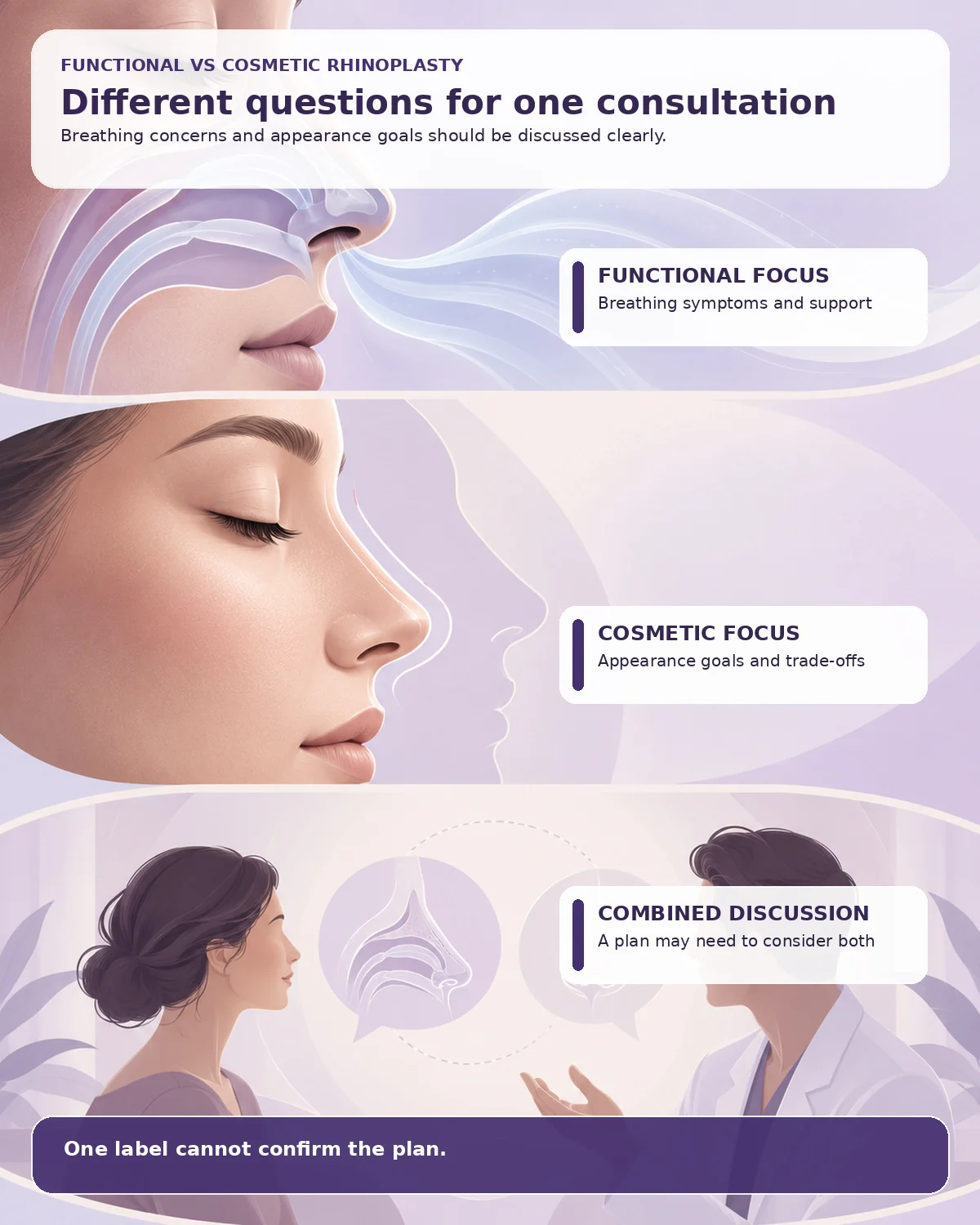
The term functional rhinoplasty is commonly used when a clinician is considering a nasal operation in relation to breathing or internal support. It may be relevant when a patient reports persistent obstruction, reduced airflow, trouble breathing through one or both sides of the nose, or a change after injury or earlier surgery. A responsible assessment still needs to establish what the symptom is, how long it has been present, whether it changes over time and whether another health issue may also be relevant.
The term cosmetic rhinoplasty is commonly used when the main discussion is about visible features, such as a bridge, tip, width, asymmetry or the relationship of the nose to the face. It is not a catalogue of guaranteed changes. A clinician needs to assess anatomy, skin and support, discuss what the patient means by the requested change, and explain uncertainty and trade-offs.
Some people discuss both. For example, a person with a history of injury may want to ask about a change in appearance and a change in airflow. Another person may be interested in an aesthetic refinement but discover that a clinician needs to consider how a proposed change could affect support. These examples do not establish treatment. They show why a consultation should be specific rather than driven by a marketing label.
| Starting point | Main question for the consultation | What should not be assumed |
| Functional concern | What symptoms are present, what structures may be relevant, and what assessment is needed? | That a breathing symptom proves one diagnosis or one procedure. |
| Cosmetic goal | What appearance concern is being discussed, and what limits and trade-offs apply? | That a reference photo can be copied or that one desired change is automatically suitable. |
| Combined discussion | How do appearance, support, symptoms and individual priorities relate? | That combining two goals makes either result predictable or removes the need for careful assessment. |
The American Society of Plastic Surgeons describes cosmetic and functional rhinoplasty as different purposes that can sometimes overlap. That general distinction is useful for asking questions. It is not a substitute for an individual clinical decision.
Breathing symptoms need clinical assessment
Difficulty breathing through the nose can have several possible explanations. A patient may describe blockage that is constant, comes and goes, is worse at night, follows an injury, changes after a previous operation or occurs alongside allergy symptoms. The clinician needs the history before attributing the problem to a particular structure. A photograph cannot show airflow, symptoms, internal lining or how the nose responds during breathing.
The assessment may include questions about previous injury, nasal surgery, medical conditions, medicines, allergies and day-to-day impact. Depending on the situation, it may also involve an in-person nasal examination and other tests or referral. The purpose is not to turn a patient into their own diagnostician. It is to make sure the consultation is based on a clear clinical question rather than an assumption.
If breathing becomes severely difficult, rapidly worsens, or is accompanied by serious symptoms, seek urgent local medical care. Do not wait for an online coordinator, an image review or a social-media response.
The septum, nasal valve and support structures are not photo diagnoses
Patients may encounter terms such as a deviated septum, nasal valve collapse, narrow nostrils or turbinate enlargement. These terms describe different structures or findings; they are not interchangeable labels for every blocked-nose symptom. A septum is the internal wall that separates the nasal passages. The nasal valve refers to areas that can influence airflow and support. Other tissues, inflammation, past injury and the effects of previous surgery can also be relevant.
ENT Health notes that nasal valve collapse and narrow nostrils can contribute to airflow obstruction, while the American Society of Plastic Surgeons notes that nasal structure may be evaluated when an operation is intended to improve an obstructed airway. Those are general educational points. Only an appropriately qualified clinician can determine whether any one of them applies to a specific person.
A procedure name does not confirm which structure needs treatment
Septoplasty and rhinoplasty are not identical terms. Septoplasty refers to surgery involving the septum; rhinoplasty refers to surgery that changes the nose and may involve external appearance, support or both. In some cases a clinician may discuss procedures together, while in other cases they may not. A name on a quotation should not be treated as a diagnosis, a complete scope of care or proof of a predicted breathing result.
Ask the team to explain the exact problem they are assessing, which part of the nose they believe may be relevant, what information is still missing, and what the alternatives are. If an online consultation suggests a possible route, ask what must be confirmed in person before any decision is made.
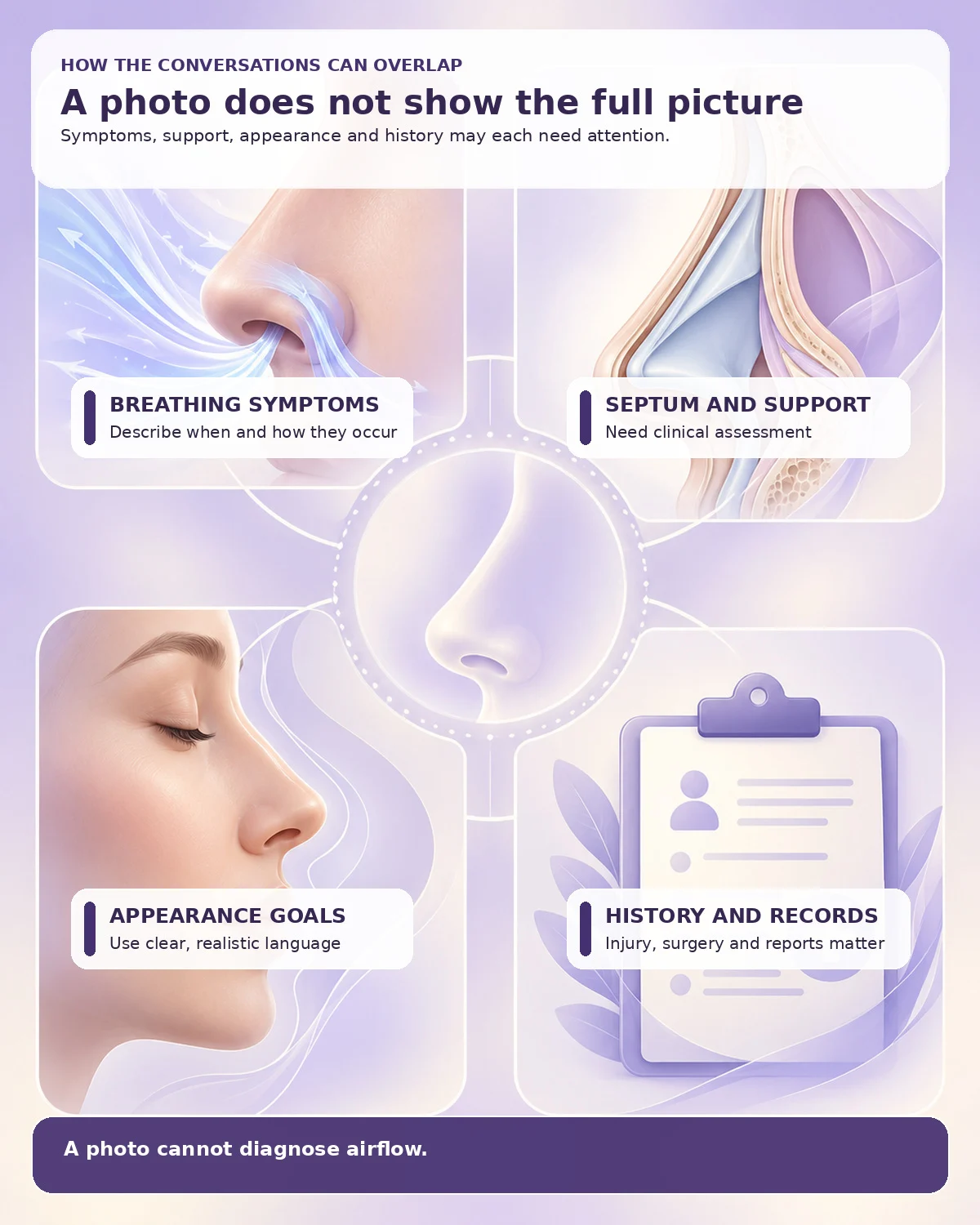
Cosmetic rhinoplasty begins with the patient’s own concern, not a standard nose shape. One person may be focused on a visible feature in profile; another may be concerned with front-view balance or a change after injury. The clinician should ask what matters most, review the whole face rather than a single cropped image, and explain which goals may be limited by existing anatomy, skin thickness, support and healing.
Reference images can help a patient describe a preference, but they should be treated as conversation aids. They do not predict an identical result, account for the patient’s anatomy or show how breathing might be affected. A responsible consultation should avoid promises based on a celebrity image, an app filter or a before-and-after gallery.
The patient should also understand who will perform the assessment and procedure, what the named clinician’s role is, where care would take place, and how questions are handled after discharge. A useful plan explains what is being considered and what is not being promised.
It is possible for an appearance concern and a breathing concern to be discussed in the same consultation. The link between them should be explained, not assumed. A visible deviation after injury, for example, may prompt questions about both symmetry and airflow. In another situation, an aesthetic request may make it important for the clinician to consider existing support and the possibility of functional trade-offs.
The central issue is not whether the plan sounds more “functional” or more “cosmetic.” It is whether the assessment has separated the goals clearly enough to make a responsible decision. The treating clinician should be able to say:
- What symptoms or appearance concerns are being assessed.
- What has been confirmed and what remains uncertain before an examination.
- Whether an ENT or another specialist needs to contribute.
- What each part of a proposed procedure would aim to address.
- What risks, limits and alternatives need to be considered.
Do not assume that a combined procedure is always necessary, less risky, less expensive, or easier to recover from than separate discussions. The scope, timing, facility, anaesthesia, aftercare and travel plan should follow the individual’s clinical plan.
Patients who have had earlier nasal surgery may also need a different starting-point discussion. Venoramed’s guide to primary and revision rhinoplasty can help frame the extra questions about previous operations, healing and records. It does not replace an assessment of current breathing or appearance concerns.
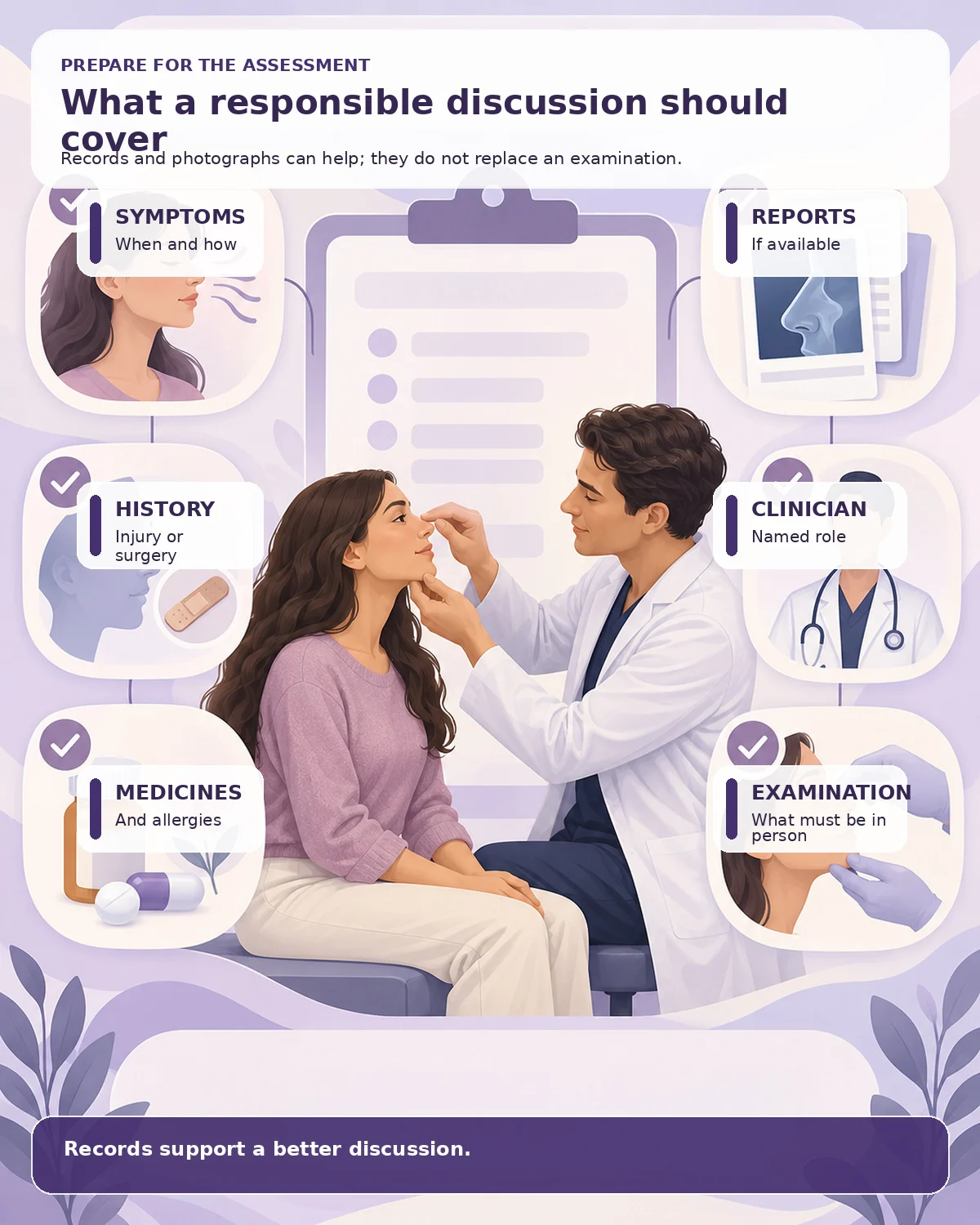
The exact process varies, but a patient can prepare for a better discussion by collecting relevant information and asking how it will be used. The American Society of Plastic Surgeons’ rhinoplasty consultation guidance includes goals, medical conditions, allergies, medicines, supplements and previous surgery among the topics worth discussing.
Useful information may include:
- A description of the breathing concern, when it occurs and whether it followed injury, illness or surgery.
- The cosmetic concern in the patient’s own words, including what matters most and what would be acceptable if a perfect change is not possible.
- Previous nasal operations, injuries, hospital discharge information and any available operative notes.
- Relevant ENT reports, imaging or test results if they exist and the clinical team asks for them.
- Current medicines, allergies, nicotine use and health conditions that may affect assessment or surgery.
- Standardised photographs only if requested, with the understanding that they support a conversation rather than replace an examination.
Venoramed’s medical-records checklist for an online consultation can help an international patient organise information. Missing records do not automatically prevent care, but they can limit what a remote review can safely conclude.
The consultation should identify the named clinician, the facility where any proposed care would occur, the role of an ENT or other specialist if needed, and the decision point at which a remote discussion must give way to an in-person assessment. A patient should never be pressured to treat an image-only review as final clinical clearance.
Compare written plans, not slogans, rankings or a single headline price. Two proposals may use similar words while describing very different assessments, responsibilities and follow-up arrangements.
| Ask for this in writing | Why it matters |
| The named clinical question | Clarifies whether the discussion concerns symptoms, appearance, prior surgery, injury or more than one issue. |
| The named clinician and their role | Separates coordination, consultation, anaesthesia, surgery and follow-up responsibilities. |
| What needs in-person confirmation | Prevents a remote opinion from being mistaken for a final diagnosis or operative commitment. |
| Proposed scope and alternatives | Shows what each part of the plan is intended to address and whether non-surgical or no-procedure options were considered. |
| Functional and cosmetic limits | Makes it easier to recognise uncertainty instead of relying on a promise. |
| Facility and safety arrangements | Confirms where treatment, monitoring and early review would take place. |
| Complete quotation and follow-up plan | Helps compare included clinical care, medicines, tests, reviews, accommodation and changes to the plan. |
Use Venoramed’s doctor and clinic safety checklist to review identity, specialty, facility and aftercare arrangements. If the proposal includes a price, compare its written scope rather than a promotional starting figure; the medical treatment costs guide explains why quotes may not describe the same plan.
International treatment adds practical questions, but a hotel stay or fixed return flight is not a medical recovery promise. Travel timing depends on the individual procedure, symptoms, required review, medication, wound care, flight length and the treating team’s assessment. This remains true whether a plan is described as functional, cosmetic or combined.
Before making non-changeable travel bookings, ask when early review is expected, who decides you are fit to travel, what written records you will receive, how you can contact the clinical team, and what local follow-up or urgent-care plan you should have after returning home. Venoramed’s guide to how long to stay in Turkey after surgery explains why travel planning should follow the clinical plan rather than lead it.
After discharge, use the written clinical contact route for routine concerns. For severe, rapidly worsening or potentially life-threatening symptoms, seek urgent local medical care. Venoramed’s guide to complications after treatment abroad explains the importance of knowing where to seek help after travel.

- Are my concerns being discussed as breathing symptoms, appearance goals, previous-surgery concerns, or more than one of these?
- What can you assess from my records and photographs, and what must be checked in person?
- Which structures or clinical issues are you assessing, and what remains uncertain?
- Is an ENT or another specialist involved? If so, what is their role?
- What would each proposed part of the procedure aim to address?
- What functional or cosmetic limitations should I understand before deciding?
- Are there non-surgical, delayed or no-procedure options that should be considered?
- Who is the named clinician, and what will they personally do at each stage?
- Where would care and early review take place, and what safety arrangements apply?
- What is included and excluded in the written quotation?
- What follow-up is required, who decides travel clearance and what records will I take home?
Is functional rhinoplasty only for a deviated septum?
No. A deviated septum is one possible finding, but breathing symptoms can have different causes and may involve more than one issue. A clinician should assess the history and nasal structure rather than assume the cause from a label, photograph or online questionnaire.
Can cosmetic rhinoplasty affect breathing?
Changes to the external nose can be relevant to nasal support and airflow, which is why a responsible cosmetic consultation should include a discussion of existing breathing concerns and functional trade-offs. It does not mean that every cosmetic procedure causes a breathing problem or that a specific result can be predicted.
Can I choose a combined functional and cosmetic procedure from photos?
No. Photographs can support an early conversation about appearance but cannot measure airflow, examine internal anatomy or provide final clinical clearance. A combined plan should follow the assessment that the responsible clinical team considers necessary.
Is septoplasty the same as rhinoplasty?
No. Septoplasty concerns the septum, while rhinoplasty refers to surgery that changes the nose and may involve visible appearance, support or both. A clinician can explain whether either term is relevant to a particular plan and whether they are being considered together.
What records should I bring to a consultation?
Bring or send any available previous operation notes, discharge summaries, relevant ENT reports or imaging, current medicines, allergies, medical history and a clear description of breathing symptoms or appearance goals. The clinician can then explain what additional information is needed.
When can I travel after rhinoplasty?
There is no universal calendar that is safe for every functional, cosmetic or combined plan. Travel should be discussed with the treating team after they know the procedure, recovery course, required review and your flight arrangements. Do not treat an itinerary as medical clearance.
Explore Facial Refinement and Rhinoplasty information and compare the available doctor profiles before requesting consultation or coordination support.
Venoramed is a medical marketplace and coordination platform. It does not provide direct treatment, diagnose breathing problems, select a rhinoplasty procedure, prescribe aftercare or guarantee outcomes. Any treatment, recovery and travel decision should follow an individual assessment by an appropriately qualified clinical team.




Leave a Comment
Share your question or experience. Venoramed reviews comments before publishing.