

Introduction
A full mouth restoration in Turkey can sound like a single treatment or a ready-made package. In reality, it is usually an umbrella term for a coordinated plan involving several teeth, the gums, the bite, missing teeth, existing restorations and the long-term function of the mouth.
One person may need to stabilise gum disease and repair several damaged teeth. Another may need a combination of crowns, bridges and replacement teeth. Someone else may have failing restorations, missing teeth, bite changes or a full-arch implant plan. These situations can all be described online as “full mouth restoration,” but they are not the same clinical problem and should not automatically receive the same treatment.
A responsible plan should not begin with a promise that all work can be completed in one short trip. It should begin with diagnosis: what can be preserved, what needs treatment, how the upper and lower teeth meet, which stages may require healing, what temporary restorations are needed and who will provide maintenance after treatment.
Venoramed is a medical marketplace and coordination platform. It does not diagnose dental conditions, decide whether teeth should be removed or confirm that a particular treatment is suitable. The final treatment plan must come from an appropriately qualified dental professional after an individual examination and review of relevant records.
What does “full mouth restoration” mean?
The terms full mouth restoration, full mouth rehabilitation and full mouth reconstruction are often used interchangeably. They can describe a broader plan to restore oral health, comfort, function and appearance when several parts of the mouth need coordinated care.
This does not automatically mean replacing every tooth, extracting all remaining teeth or placing implants throughout the mouth. Depending on the individual case, a plan may include:
- Treating active gum or periodontal disease.
- Repairing or retaining suitable natural teeth.
- Replacing damaged crowns, bridges or fillings.
- Treating infection or root-canal-related problems where appropriate.
- Replacing one or more missing teeth.
- Planning implants, bridges, removable restorations or full-arch teeth when clinically indicated.
- Reviewing bite, chewing forces, speech, tooth wear and cleaning access.
- Using temporary restorations while healing or treatment planning continues.
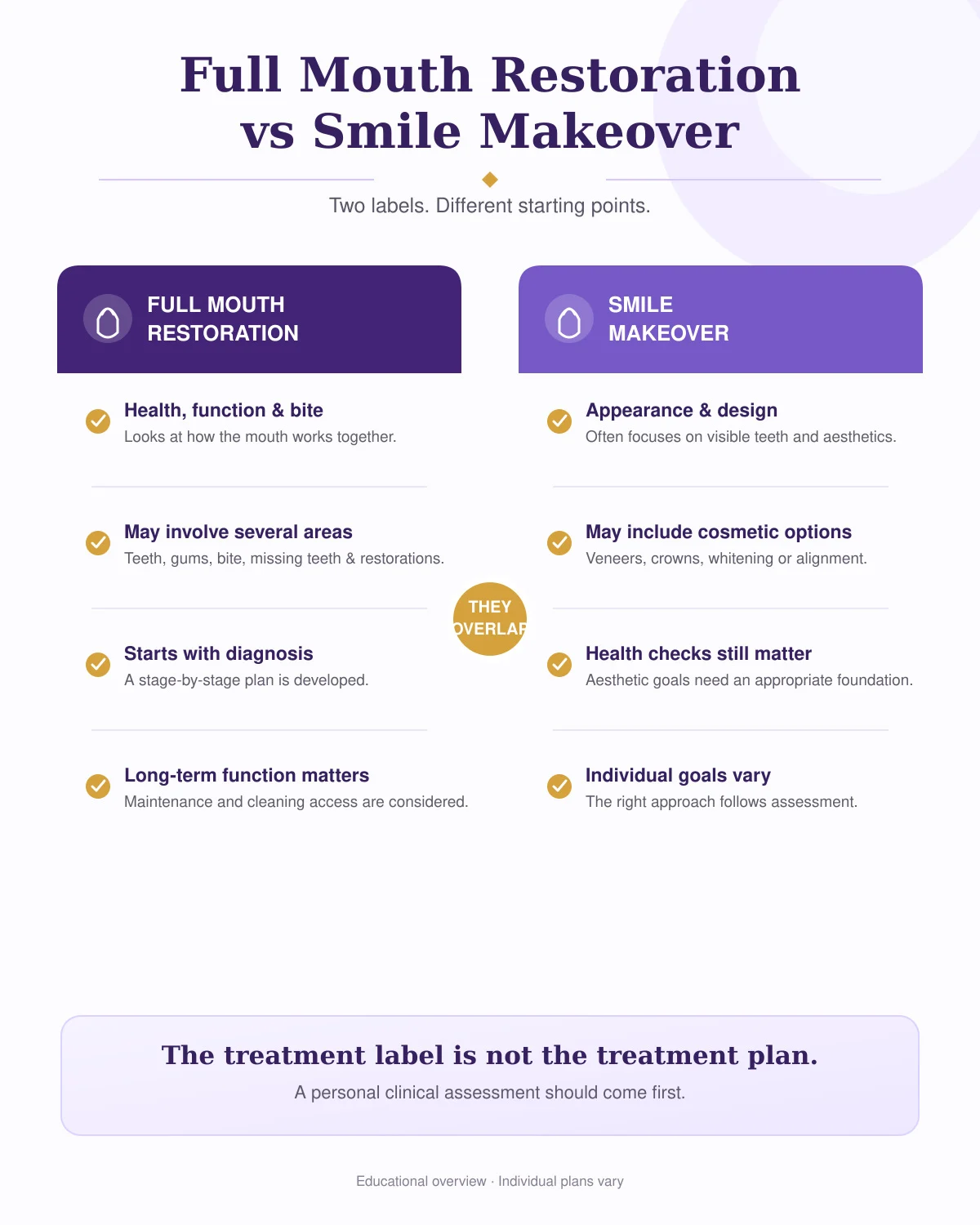
| Area | Full mouth restoration | Smile makeover |
| Main scope | May involve function, health, bite, missing teeth and existing restorations. | Often focuses more heavily on visible appearance. |
| Starting point | Diagnosis of teeth, gums, bite, records and long-term needs. | Aesthetic goals still need to be assessed alongside tooth and gum health. |
| Possible components | Preservation, restorative dentistry, periodontal care, implants, bridges, temporary and final restorations. | Whitening, veneers, crowns, alignment or other aesthetic changes may be discussed. |
| Key question | What needs coordinated treatment for this individual mouth? | What change is desired, and is it appropriate for the individual teeth and gums? |
The two categories can overlap. A full mouth plan may include aesthetic goals, and an aesthetic request may reveal a functional or health issue that needs attention first. Neither label replaces examination, informed consent or a written treatment plan.
Start with diagnosis, function and bite
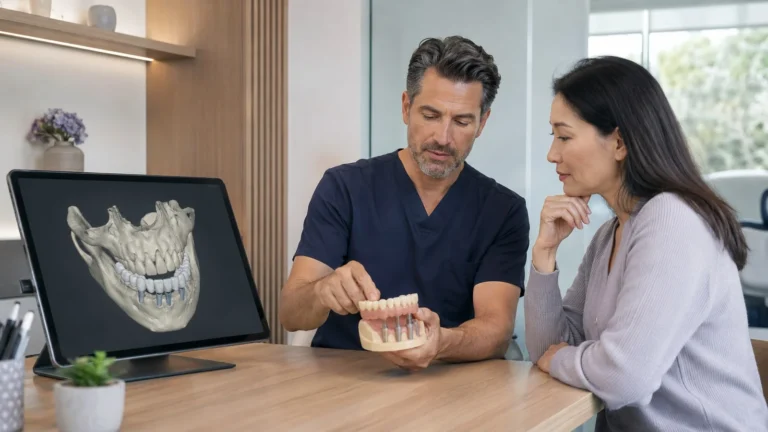
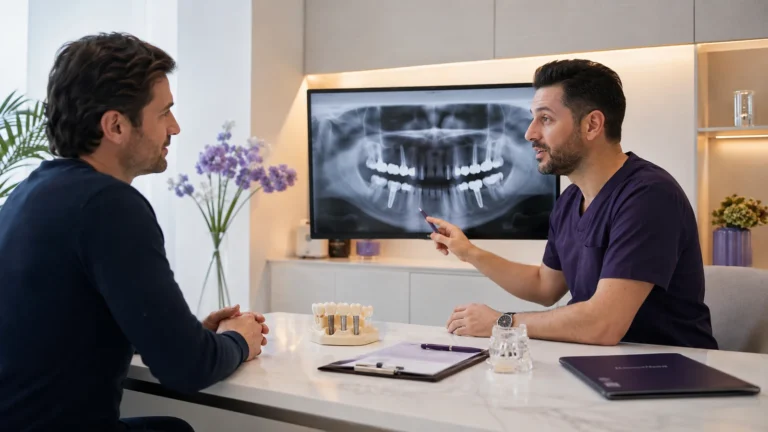
A comprehensive dental plan should begin with records and clinical assessment rather than a package quotation or a smile photograph alone. Depending on the case, the treating team may need medical and dental history, photographs, periodontal records, X-rays, CBCT imaging where appropriate, digital scans or impressions, and information about current restorations.
The bite is the way the upper and lower teeth meet and move against each other. It can influence tooth wear, fracture risk, comfort, chewing, speech and the design of new restorations. When several teeth are being restored together, a clinician may need to consider the bite before deciding the shape, material or position of final teeth.
A plan should also address whether any natural teeth can be retained safely. The International Team for Implantology notes that treatment alternatives, including preservation of teeth where appropriate, should be considered before a full-arch implant rehabilitation is chosen. Read the ITI guidance on complete-arch planning.
Before agreeing to a plan, ask:
- Which records have been reviewed?
- Which teeth are considered stable, treatable or not maintainable?
- What is the condition of the gums and supporting bone?
- Has the bite been assessed?
- What alternatives have been considered before extraction?
- Which parts of the plan are confirmed, and which may change after an in-person examination?
If the question concerns one tooth or a small group of teeth rather than the entire mouth, Venoramed’s guide to veneers versus crowns can help clarify why those restorations serve different clinical purposes.
Planning a full mouth restoration in Turkey: see the sequence, not one appointment
A full mouth restoration may involve several connected stages. Not every patient needs every stage, and the sequence can change when the clinical examination, imaging, healing or laboratory records reveal new information.
A written plan may include the following pathway:
- Assessment and diagnosis: review of teeth, gums, bone, bite, medical history, current restorations and treatment goals.
- Stabilising oral health: treatment of active infection, gum disease, unstable teeth, decay, failed restorations or hygiene issues before more complex work begins.
- Foundation treatment: preservation or extraction of teeth where clinically indicated, root-canal treatment, periodontal treatment, grafting, implant placement or other preparatory procedures.
- Temporary or provisional restorations: a temporary phase may help protect prepared teeth, provide a short-term replacement, support appearance and speech, or allow the team to assess the planned bite.
- Healing and review: some implant, grafting or soft-tissue stages need a healing period. The provider may review comfort, hygiene, bite and stability before the final prosthetic stage.
- Laboratory and definitive restoration: digital scans or impressions, bite records, laboratory design, trial fitting, adjustments and final delivery may be needed before the definitive teeth are fitted.
- Maintenance and long-term follow-up: the final restoration still needs daily hygiene, professional review, bite checks and a clear pathway for repairs or complications.
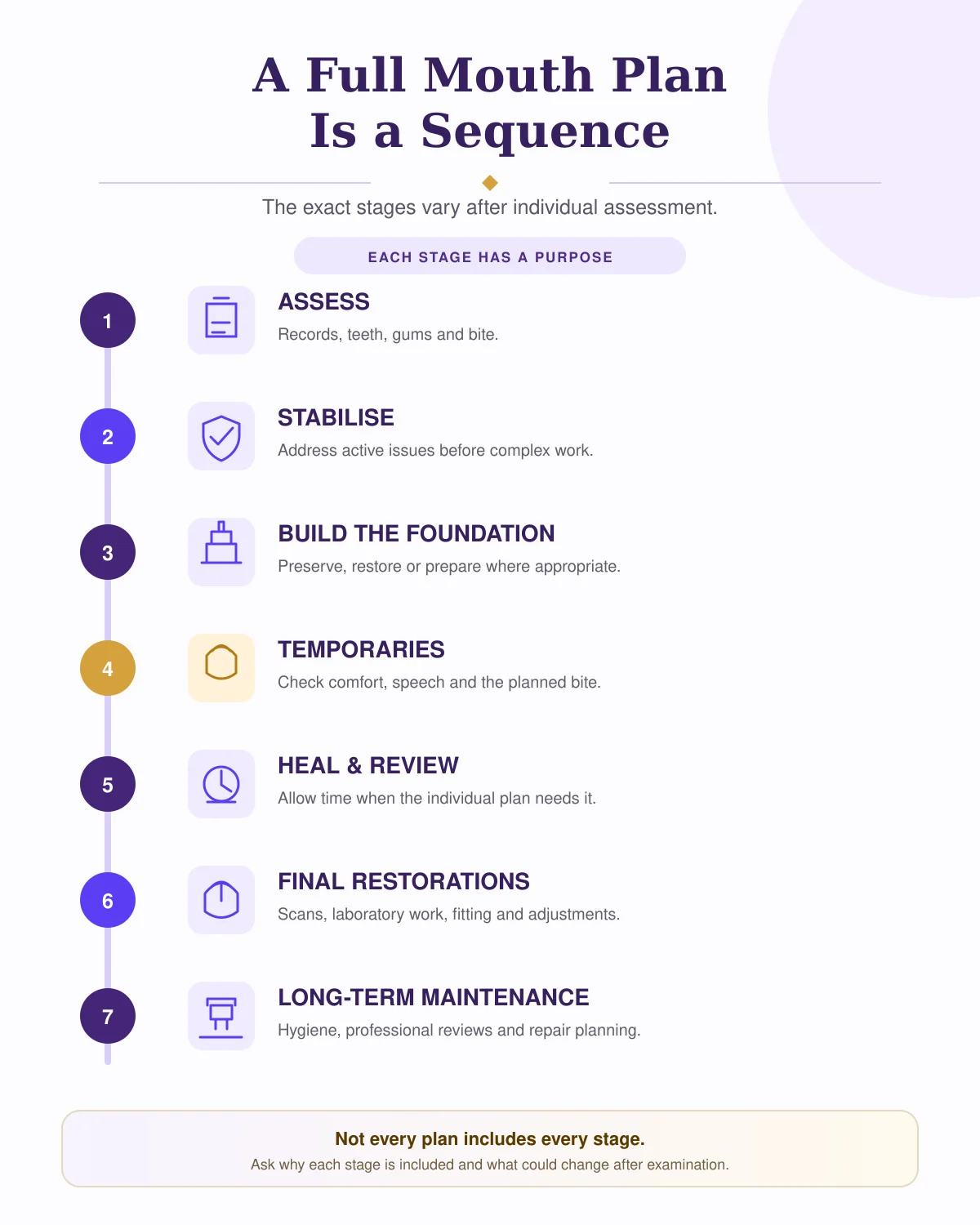
The key is not whether a plan has the fewest stages. The key is whether each stage has a clear purpose and whether the patient understands what may change before irreversible treatment begins.
Why temporary restorations are not simply a delay
Temporary, interim or provisional restorations can be an important part of full mouth planning. They may be fixed or removable, and they are not necessarily the same material, design or finish as the final restoration.
A temporary phase can allow the treating team to assess:
- Comfort and speech.
- Bite position and chewing function.
- Tooth shape, length and appearance.
- Hygiene access around the planned restoration.
- Healing of gums, bone grafts or implants.
- Whether adjustments are needed before the final laboratory work is completed.
Patients should not assume that “teeth on the same day” means final teeth in every case. In implant dentistry, immediate loading refers to connecting a prosthesis within a short period after implant placement; it does not automatically mean that the definitive restoration is appropriate or complete. See ITI definitions for placement and loading protocols.
Ask the provider to state clearly:
- Whether the teeth fitted during the first visit are temporary or final.
- Whether they are fixed or removable.
- What changes may be made before the final restoration.
- What happens if healing or implant stability changes the schedule.
- Whether temporary restorations, laboratory work and later adjustments are included in the quotation.
When implants are part of a full mouth plan
Implants may be one part of a full mouth restoration, but they are not the only route. The decision depends on the condition of remaining teeth, gums, bone, anatomy, bite, expected chewing forces, prosthetic design and the patient’s ability to maintain the restoration.
For patients considering a fixed full-arch implant design, the separate All-on-4 vs All-on-6 guide should be read alongside this article. The number of implants is only one part of planning; the final prosthetic design, cleaning access, implant distribution, available bone and opposing teeth also matter.
The International Team for Implantology specifically emphasises that the final prosthetic plan should inform the surgical plan for a complete-arch restoration. That planning includes factors such as anatomy, available space, opposing teeth, hygiene access and the future design of the restoration. Read the ITI consensus on implant number and prosthetic planning.
For the implant-specific stages, risks, components and aftercare questions, see Venoramed’s guide to dental implants in Turkey.
Laboratory and restorative stages: who is responsible?
A full mouth case may involve more than one professional role. Depending on the treatment plan, one dentist may coordinate all stages or different professionals may perform surgical, periodontal, restorative and laboratory-related work.
The patient should know:
- Who makes the final treatment decision.
- Who is responsible for any extraction, grafting or implant placement.
- Who plans the bite and final prosthetic design.
- Who fits and adjusts temporary restorations.
- Who communicates the clinical requirements to the dental laboratory.
- Who fits the final restorations and checks their function.
- Who handles a fracture, loose component, bite problem or discomfort after the patient returns home.
A dental laboratory can manufacture technical components, but clinical responsibility for diagnosis, fitting and follow-up should be clear. The written plan should name the treating professionals rather than describing the case only as a generic “team package.”
Multiple visits: turn a quotation into a visit-by-visit plan
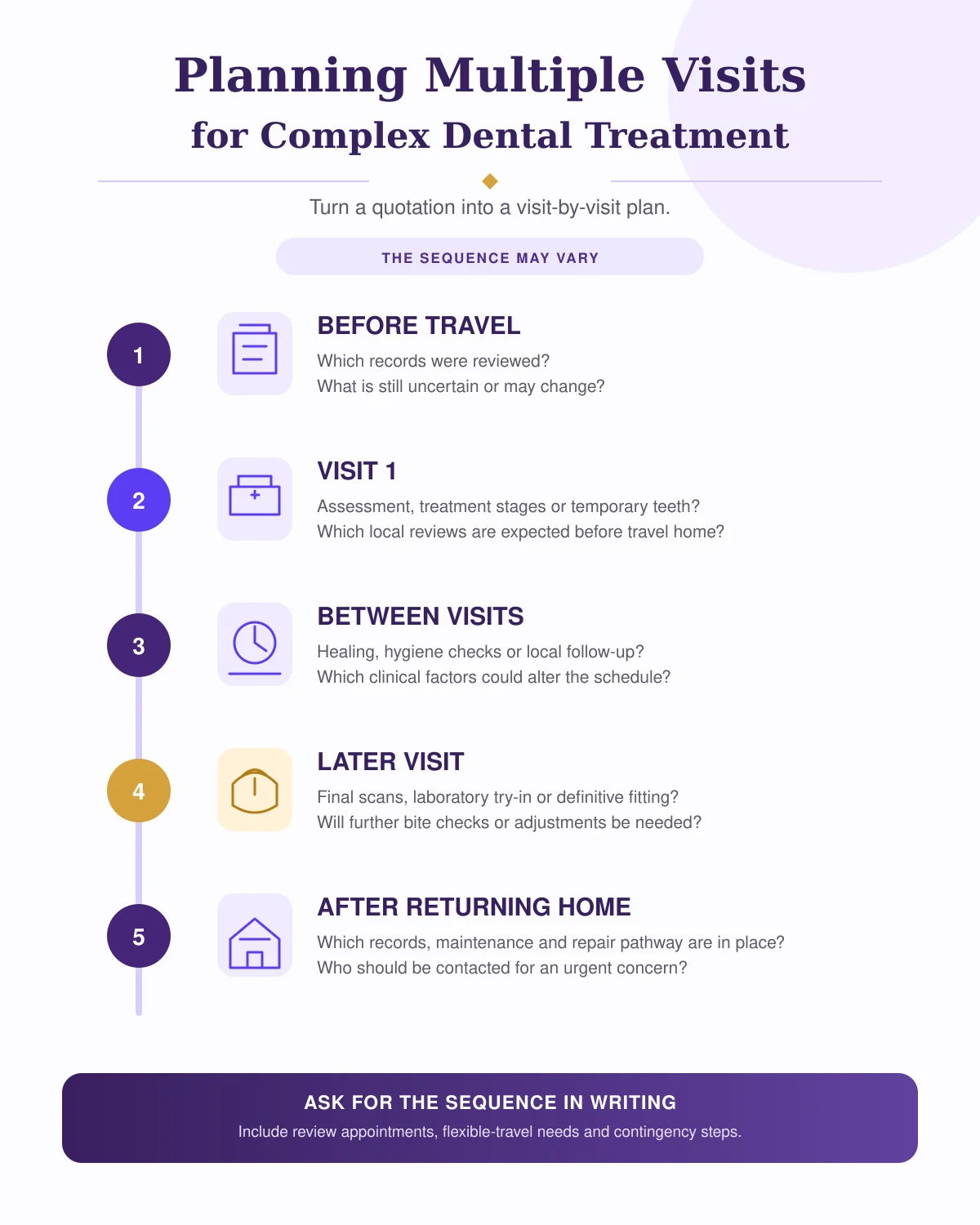
A short trip is not automatically evidence of a complete treatment plan. Some patients may complete selected stages during one visit. Others may need two or more visits because of healing, temporary restorations, grafting, implant integration, laboratory stages, bite adjustments or clinical changes discovered during treatment.
| Planning point | What to clarify |
| Before travel | Which records were reviewed, what remains uncertain, and what could change after examination. |
| First visit | Whether the visit may include final assessment, stabilising treatment, extractions, surgery, temporary restorations or only diagnostic planning. |
| Between visits | Whether healing, hygiene reviews, temporary restoration adjustments or local follow-up are expected. |
| Later visit | Whether final scans, laboratory try-ins, delivery of definitive restorations or bite adjustments are planned. |
| After return home | Who provides maintenance, what records are supplied and how urgent concerns are handled. |
This is a planning framework, not a universal timetable. Before booking flights, ask the treating team to provide the expected stages for each visit, the minimum local review appointments, whether flexible travel arrangements are sensible and what clinical factors could alter the itinerary.
For general travel and recovery planning, read Venoramed’s guide to how long to stay in Turkey after surgery. Individual travel clearance and the appropriate duration of stay should always come from the treating healthcare professional.
What should a written full mouth treatment plan include?
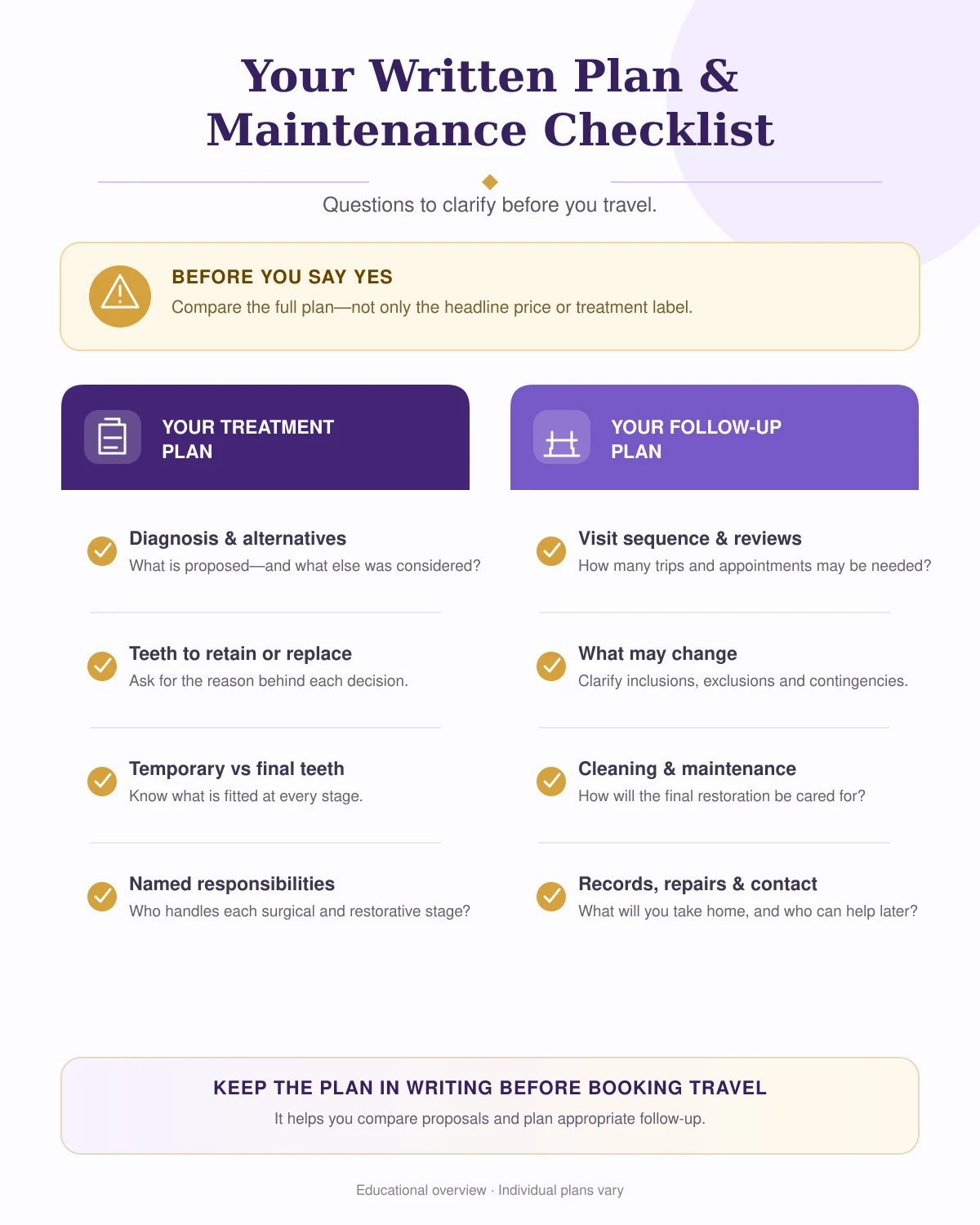
A useful written plan should make it possible to compare two proposals without relying only on a headline price, a treatment label or a promise of fast completion.
Ask for clarity on:
- The diagnosis for each important tooth or area of the mouth.
- Teeth to be retained, restored, monitored or removed, and the reason for each decision.
- Gum, periodontal, bite or infection treatment required before definitive work.
- Proposed implants, bridges, crowns, removable restorations or full-arch components.
- Temporary versus final restorations.
- Proposed materials and laboratory stages.
- Named treating professionals and their responsibilities.
- Expected visits, healing periods and review appointments.
- What is included, excluded or subject to change after examination.
- Maintenance needs, complication arrangements and the records supplied for future care.
Be cautious if a provider cannot explain the difference between a temporary and final restoration, cannot identify the treating professionals, recommends removing multiple teeth without a clear rationale or presents a fixed plan before adequate records are reviewed.
Maintenance and record transfer are part of the treatment
The end of treatment is not the end of care. Crowns, bridges, implant-supported restorations and full-arch prostheses need regular hygiene, professional assessment and a plan for technical maintenance.
Depending on the restoration, long-term care may involve checking the gums and tissues, reviewing the bite, monitoring wear, addressing loose or damaged components and making sure the patient can clean around the restoration effectively.
The American College of Prosthodontists identifies prosthetic design and maintenance as central considerations for full-arch implant restorations. Read the ACP maintenance guidance.
Before leaving Turkey, ask for copies of relevant records, which may include:
- Treatment plan and itemised clinical summary.
- Imaging and radiographs where appropriate.
- Implant brand, model, dimensions and component details if implants were placed.
- Surgical and grafting information where relevant.
- Details of temporary and final prostheses.
- Laboratory or restoration information needed for repairs.
- Written aftercare and emergency-contact instructions.
Questions to ask before saying yes
- What is the diagnosis for the teeth and gums involved?
- Which teeth can be preserved, and why?
- Has my bite been assessed?
- What is the goal of each treatment stage?
- Which restoration is temporary, and which is final?
- Do I need implant treatment, grafting or another surgical procedure?
- Who performs the surgical and restorative stages?
- Who is responsible for the final bite and fit?
- How many visits may be required?
- What may change after an in-person examination?
- What laboratory work is included?
- How will I clean and maintain the final restorations?
- Which records will I receive before returning home?
- Who can provide local follow-up or emergency help?
- What is included and excluded from the written quotation?
Frequently Asked Questions
Is full mouth restoration the same as getting implants?
No. A full mouth restoration can include implants, but it may also include preservation of natural teeth, gum treatment, crowns, bridges, temporary restorations or other approaches. The correct plan depends on individual diagnosis.
Is a full mouth restoration the same as a smile makeover?
Not always. A smile makeover often focuses more strongly on aesthetic change, while a full mouth plan may address function, health, bite, missing teeth and existing restorations as well. The two can overlap.
Can full mouth restoration in Turkey be completed in one trip?
Some selected stages may be completed in one visit, but a complete pathway may require more than one trip. Healing, grafting, implant integration, laboratory work, temporary restorations and bite adjustments can affect the number of visits.
Why might I receive temporary teeth first?
Temporary restorations may protect prepared teeth, replace missing teeth during healing or allow the team to assess speech, comfort, appearance, bite and hygiene before final teeth are made.
Should all damaged teeth be removed?
Not automatically. A qualified dental professional should explain the condition and prognosis of each tooth, possible tooth-preserving options and the reason for any recommended extraction.
How do I compare two full mouth restoration plans?
Compare the diagnosis, tooth-preservation decisions, bite assessment, treatment stages, temporary and final restorations, named professionals, laboratory work, expected visits, maintenance plan, records and inclusions or exclusions. Do not compare only a treatment label or a headline price.
Explore options with Venoramed
Explore Dental Treatments on Venoramed and compare available dental doctor profiles before requesting consultation or coordination support.
Venoramed is a medical marketplace and coordination platform. It does not provide direct dental treatment, diagnose dental conditions, determine whether teeth should be removed or guarantee a treatment outcome. Individual assessment by an appropriately qualified dental professional is essential before any treatment decision or travel booking.


Leave a Comment
Share your question or experience. Venoramed reviews comments before publishing.