

Introduction for Turkey teeth
The phrase “Turkey teeth” appears everywhere in online dental marketing, yet it does not describe one diagnosis, one material, or one standard treatment plan. In practice, it can be used loosely to describe cosmetic veneers, crowns, implant-supported teeth, or a larger restorative plan. That is why a country name, a smile photo, or a package label is not enough information to decide what should happen to your teeth.
A safer starting point is to ask a different question: what does each tooth need, and what is the least invasive option that can meet the clinical and aesthetic goal? The answer may involve a veneer, a crown, a filling, orthodontic treatment, gum care, implant treatment, or no irreversible treatment at all. A qualified dental professional should assess the teeth, gums, bite, medical history, and relevant records before recommending a plan.
What does “Turkey teeth” actually mean?
“Turkey teeth” is a marketing phrase, not a dental diagnosis. It does not tell you whether a person has healthy enamel, old fillings, cracks, decay, gum disease, missing teeth, tooth wear, or a bite problem. It also does not tell you whether the proposed result uses veneers, crowns, implants, or a combination of treatments.
That distinction matters because the same visible concern can have very different causes. A tooth that looks dark may need a simple cosmetic approach in one person, while another person may have a large restoration, a weakened tooth, or active disease that must be treated first. A written, tooth-by-tooth plan is more useful than a generic promise of a “new smile.”
The phrase should therefore be interpreted as a prompt to research carefully, not as a treatment category to buy. The final recommendation should be based on an individual assessment by an appropriately qualified dental professional.
Veneers vs crowns: the practical difference
A veneer is a thin restoration that is usually bonded to the front surface of a tooth. It is often discussed when the main goal is to change the visible colour, shape, length, minor spacing, or appearance of a front tooth. A crown covers much more of the visible tooth and may be considered when a tooth needs more structural rebuilding as well as an aesthetic change.
| Question | Veneer | Crown |
| Main coverage | Usually covers the front surface of a tooth | Fits over a tooth that has been reshaped |
| Common clinical conversation | Appearance-focused changes where the underlying tooth can be preserved | Rebuilding a tooth that may be weakened, heavily restored, worn, or damaged |
| Tooth preparation | May involve removing a small amount of enamel; the amount and design vary | Usually requires more reshaping than a veneer, but the amount varies by tooth and material |
| Long-term question | Is there enough healthy tooth structure and a suitable bite for bonding? | Does the tooth need full coverage, or could a more conservative option work? |
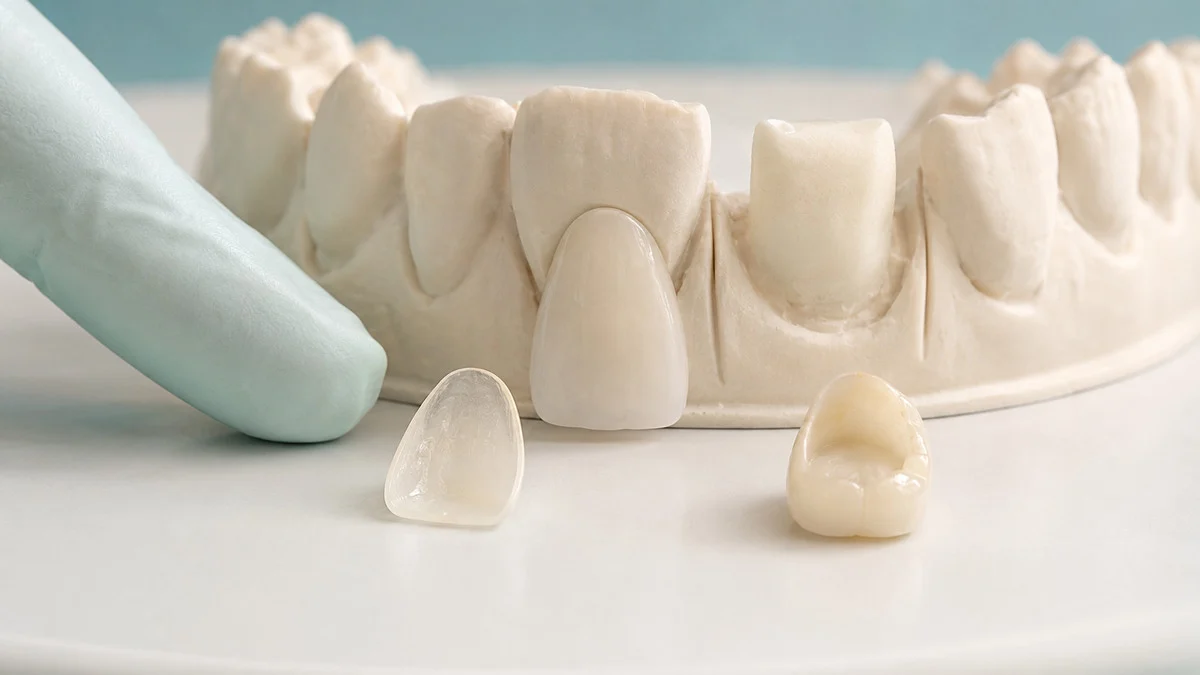
These are general categories, not a self-diagnosis tool. One patient may need a veneer on one tooth, a crown on another, and a completely different solution elsewhere. A treatment plan should explain why each restoration is proposed rather than applying one product to every tooth.
When might a veneer be discussed?
A dentist may discuss a veneer when the visible front of a tooth needs a controlled cosmetic change and the tooth, gums, and bite are appropriate for that approach. Veneers can be made from different materials, and the design should be matched to the tooth rather than copied from another person’s smile.
Some veneer plans involve only a small amount of preparation; others may require more. A “no-prep” or “minimal-prep” label is not a universal safety guarantee. The dentist still needs to assess tooth position, enamel thickness, lip support, the bite, the desired change in shape, and whether adding material would make the tooth look or feel too bulky.
A veneer cannot solve every problem. It is not a substitute for treating active decay or gum disease, and it may not be the right option for a tooth exposed to heavy grinding forces or a deep bite. If a plan does not explain the condition of the tooth before it explains the cosmetic result, that is a reason to ask more questions.
When might a crown be discussed?
A crown may be discussed when a tooth has lost substantial structure or needs support as well as a change in appearance. Examples can include a tooth weakened by a large filling or cavity, significant wear, a fracture, or a tooth that has already had root canal treatment. However, a crown is not automatically the better or more premium option simply because it covers more of the tooth.
Because a crown fits over a reshaped tooth, the treatment plan should explain why that level of coverage is needed. Ask whether the tooth can be repaired with a filling, inlay, onlay, veneer, or another conservative option. The best choice is not the one with the most dramatic name; it is the option that makes clinical sense for that specific tooth.
Tooth preparation: the part patients should understand before agreeing
Tooth preparation means changing part of the natural tooth so a restoration can fit, function, and look appropriate. The word “shaving” is often used online, but it is too vague to support informed consent. The important questions are what will be altered, why it is necessary, what could change after examination, and what happens to the tooth over time.
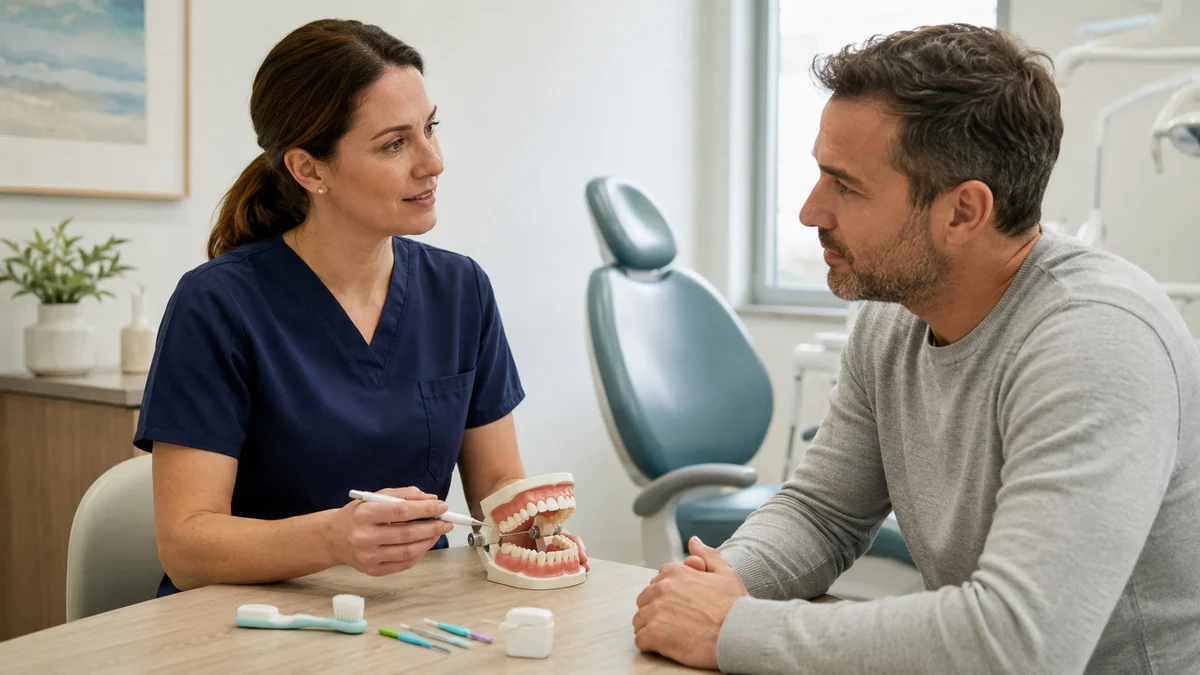
Before preparation, a responsible plan may include an examination, photographs, radiographs or other diagnostic records when clinically indicated, scans or impressions, and an assessment of the bite. The team should be able to explain the proposed changes in plain language. You should know which teeth are planned for veneers, which are planned for crowns, and whether any tooth might need a different approach after a closer assessment.
When enamel is removed, it does not grow back. That makes preparation an important long-term decision, even when the cosmetic result is attractive. For veneers, preserving enamel where clinically appropriate is often a valuable objective, but it is not something a patient can judge accurately from an online mock-up. For crowns, the amount of reshaping depends on the existing tooth, the planned material, the bite, and the restoration design.
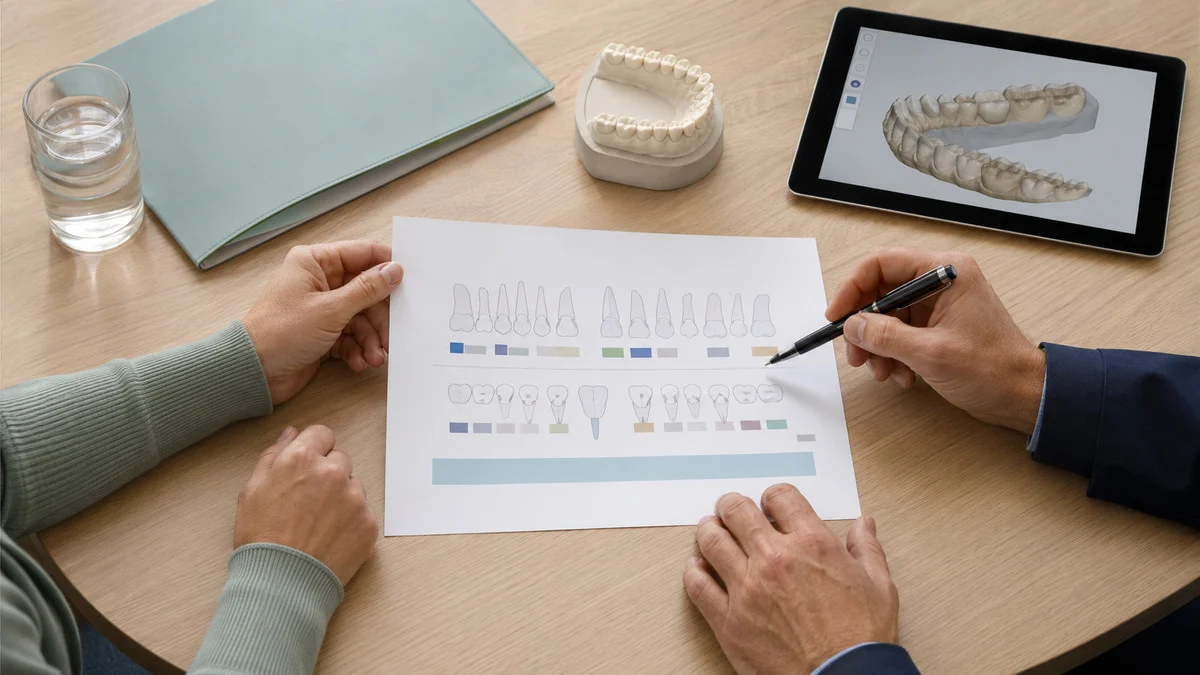
Ask to see a tooth-by-tooth plan before treatment begins. It should state the restoration proposed for each tooth, the reason for it, the expected preparation, the material being considered, and whether a temporary restoration may be used. If the plan changes after an in-person examination, request a clear explanation before additional irreversible work is done.

Irreversibility, risks, and long-term maintenance
Veneers and crowns can be useful restorations, but neither should be presented as a permanent, maintenance-free product. They may chip, crack, wear, loosen, stain at the edges, or need repair or replacement over time. The natural tooth and gum tissue also still need routine care. Decay can occur around or beneath a restoration, especially if oral hygiene and follow-up are neglected.
Risks and limitations vary by person and by treatment design, but the conversation should include:
- Sensitivity or discomfort after preparation.
- The possibility that previously hidden decay, cracks, or gum problems change the plan.
- The effect of clenching, grinding, or a deep bite on a restoration.
- The possibility of repair, replacement, or additional treatment in the future.
- The need for regular dental check-ups and cleaning.
- What support is available if a restoration feels high, chips, or becomes loose after you return home.
Do not rely on a promise that every restoration will last for a fixed number of years. Longevity depends on the tooth, material, preparation, bite, oral hygiene, maintenance, and unexpected events. If you develop severe pain, swelling, fever, trauma, or another urgent concern after dental treatment, contact the treating dental team or a qualified local dental professional promptly; seek emergency care where appropriate.
Who may need a different plan – or time to pause?
Cosmetic treatment should not begin by covering up an untreated problem. A dentist may need to address decay, gum disease, unstable bite issues, tooth grinding, or poor oral hygiene before deciding whether veneers or crowns are appropriate. A patient with heavily damaged teeth may need a restorative plan that is different from a person seeking a minor colour or shape change.
It can also be sensible to pause when the proposed treatment is based only on photographs, when the plan does not name the treating dentist, or when no one has explained what will happen to each tooth. Patients should be cautious about accepting a fixed “package” before diagnostic records and an in-person examination are reviewed.
The goal is not to rule out treatment abroad or to create fear. It is to make sure the decision is based on clinical information, clear consent, and realistic long-term planning rather than urgency or social-media pressure.
How to compare a dental plan in Turkey safely
International patients often compare plans from a distance. That can be useful for research, but a comparison should be more detailed than a total price or the number of teeth included. Use a written plan and ask the same questions of each provider.
- Who will examine you in person and make the final treatment decision?
- What is proposed for each individual tooth: veneer, crown, filling, implant-supported crown, extraction, or another option?
- What is the clinical reason for each restoration?
- How much preparation is anticipated, and could that change after examination?
- Which material and laboratory process are proposed, and why do they suit your case?
- Who will prepare the teeth, fit the restorations, check the bite, and handle follow-up?
- Will you receive temporary restorations, and how will fit, speech, and bite be checked?
- How many visits may be needed, and what happens if the final plan changes?
- What aftercare, records, repair policy, and communication route are available after you return home?
- What is included and excluded in the quotation?
For broader provider-checking questions, use Venoramed’s guide on how to choose a doctor and clinic in Turkey safely. It can help you verify the treating professional, match the specialty to the proposed treatment, and make sure responsibilities are not left vague.
Where implants and larger restoration plans fit
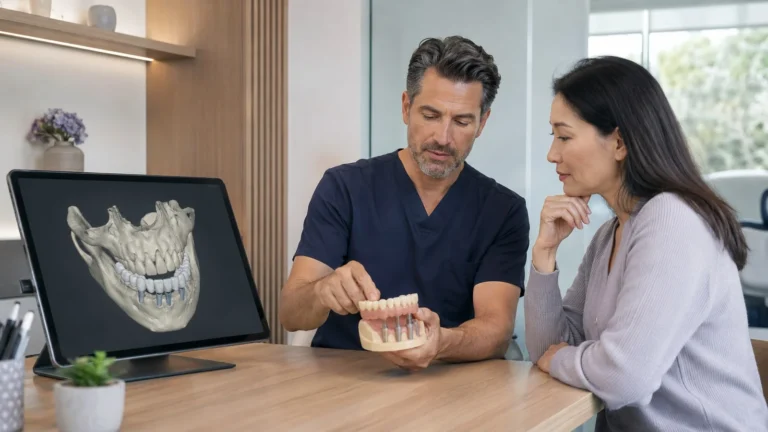
Veneers and crowns do not replace a missing tooth root. If a tooth is missing, severely compromised, or part of a wider bite and restorative problem, the discussion may include bridges, implants, implant-supported crowns, or a staged rehabilitation plan. Those are different pathways with their own diagnostic, surgical, restorative, travel, and aftercare questions.
Our guide to dental implants in Turkey explains why an implant fixture, an abutment, and the visible crown are separate parts of a treatment plan. It is especially useful when comparing quotations or trying to understand why a larger dental plan may require more than one clinical stage.
A plan involving several teeth should also make clear whether the focus is cosmetic improvement, rebuilding damaged teeth, replacing missing teeth, changing the bite, or a combination of these. The treatment sequence matters. A fast cosmetic answer is not always the same as a complete restorative answer.
For complex cases involving several teeth or treatment stages, review our guide to full mouth restoration in Turkey.
Questions to ask before saying yes
Bring these questions to a consultation or written treatment-planning discussion:
- What is the diagnosis or clinical reason for treatment on each tooth?
- Which teeth can be preserved without a crown or veneer?
- Which options are more conservative, and why are they not preferred in my case?
- Is active decay, gum disease, infection, or tooth grinding present?
- How will my bite be assessed before and after the restorations are fitted?
- What material is proposed for each tooth, and what are its limitations?
- Will I see a diagnostic preview, mock-up, scan, or temporary design before irreversible preparation?
- What could make the plan change after an in-person examination?
- Who will perform the preparation, laboratory coordination, fitting, and bite adjustment?
- How many appointments or trips may be required?
- What records will I receive for future dentists?
- What should I do if I have a problem after returning home?
Clear answers do not guarantee an outcome, but they make it easier to compare plans responsibly. Be cautious if you are pressured to decide before these questions are answered in writing.
The right way to interpret “Turkey teeth”
The phrase is often associated with highly uniform, bright smiles. But a uniform appearance is not automatically a healthy, suitable, or durable treatment plan. Teeth differ in shape, enamel thickness, position, gum level, bite forces, and previous dental work. A natural-looking result is also subjective, and an online image cannot show the clinical details that guide treatment.
The useful message is simple: ask for an individual plan, not a template. If a provider proposes many crowns or veneers, ask why each tooth needs that approach, what alternatives were considered, and how the plan protects the tooth structure that remains. Informed consent means understanding the likely benefits, limitations, alternatives, and long-term responsibilities before treatment starts.
Conclusion
Veneers and crowns can both have a place in modern dentistry, but they are not interchangeable. A veneer is generally a more limited front-surface restoration, while a crown provides broader coverage and may be considered when a tooth needs rebuilding. Neither option should be selected solely because of a marketing phrase, package price, or social-media image.
Before committing to irreversible tooth preparation, make sure you understand the condition of every tooth, the reasons for the proposed restoration, who will carry out each stage, what could change after examination, and how future maintenance will be managed. Final recommendations should always be based on an individual assessment by a qualified dental professional.
Explore options with Venoramed
Explore Dental Treatments on Venoramed and compare available dental doctor profiles before requesting a consultation or coordination support. Venoramed is a medical marketplace and coordination platform. It does not provide direct medical treatment or replace an individual consultation with a qualified healthcare professional.
Frequently Asked Questions
What is the main difference between a veneer and a crown?
A veneer is generally a thin restoration bonded to the front surface of a tooth, while a crown fits over a tooth that has been reshaped. Veneers are often discussed for appearance-focused changes; crowns may be discussed when a tooth also needs more structural rebuilding. The correct choice depends on the individual tooth, bite, gums, and treatment goal.
Do veneers always require tooth preparation?
Not always to the same extent. Some veneer designs may involve minimal or no preparation in selected cases, while others require removal of enamel so the restoration can fit properly. A dentist should assess tooth position, enamel, bite, and the proposed change before deciding what is appropriate.
Are veneers and crowns reversible?
If tooth structure or enamel is removed, that change is irreversible because the natural tissue does not grow back. A restoration may later need repair or replacement, so patients should understand the long-term maintenance commitment before treatment begins.
Can veneers or crowns be placed over unhealthy teeth?
They should not be used as a shortcut around untreated dental problems. Active decay, gum disease, infection, cracks, or other concerns may need assessment and treatment first. The treating dental professional should explain the health of the tooth and gums before proposing a cosmetic restoration.
How can I compare dental plans in Turkey?
Compare the tooth-by-tooth diagnosis, type of restoration, preparation plan, materials, named treating professionals, number of visits, aftercare, and what the quotation includes or excludes. Do not compare only a headline price or number of teeth.
What does “Turkey teeth” mean?
It is an informal marketing phrase rather than a clinical diagnosis. It can refer to veneers, crowns, implant-supported teeth, or other cosmetic and restorative treatments. It does not tell you which treatment is suitable for you.


Leave a Comment
Share your question or experience. Venoramed reviews comments before publishing.