

Ultrasonic rhinoplasty, also called piezo rhinoplasty, uses vibrating instruments rather than traditional mallets, chisels and rasps to reshape the bones of the nose. It is a heavily promoted term in nose surgery, often paired with promises of “no bruising” or even “non-surgical” results.
This guide explains how piezoelectric instruments actually work on bone, what the published research says about bruising and swelling, where the technique stops being relevant, and how it may affect cost. The aim is to help you judge whether it matters for your nose, rather than whether it sounds modern.
Quick answer: Ultrasonic rhinoplasty is conventional rhinoplasty surgery in which the nasal bones are cut and shaped with piezoelectric instruments that vibrate at ultrasonic frequencies, instead of osteotomes (chisels) and rasps. Trials suggest it may reduce early bruising and, less consistently, swelling. It does not reshape cartilage, change the tip or make the operation non-surgical.
Key takeaways
- Ultrasonic rhinoplasty changes the tool used on bone, not the overall operation: you still have anaesthesia, incisions and a recovery period.
- Randomised trials and meta-analyses point to less early bruising with piezo instruments; the effect on swelling is less consistent.
- Most studies follow patients for only about a week, so long-term benefits are not established.
- The instruments only work on bone, so they make no difference to tip or cartilage work.
- The equipment is more expensive than traditional tools, which may be reflected in some quotes.
What is ultrasonic rhinoplasty?
Ultrasonic rhinoplasty is rhinoplasty (nose reshaping surgery) in which the bony part of the nose is shaped with a piezoelectric device instead of mechanical instruments. Everything else, including the incisions, cartilage work and septal surgery, follows the same principles as any rhinoplasty.
“Piezo” comes from piezoelectricity: certain crystals vibrate when an electrical current passes through them. In surgery, that vibration drives fine cutting and rasping tips. A 2024 meta-analysis in the Journal of Clinical Medicine describes piezosurgery as a technique that uses high-frequency ultrasonic oscillations to cut bone precisely “while sparing soft tissue”.
In practice, the term is used for two related things:
- Ultrasonic osteotomies: controlled bone cuts that allow the nasal bones to be moved, for example to narrow a wide bridge.
- Ultrasonic rhinosculpture: shaving and contouring the bone surface, for example to refine a bony hump, sometimes without cutting the bones through at all.
Is piezo rhinoplasty the same as ultrasonic rhinoplasty?
Yes. “Piezo rhinoplasty”, “piezoelectric rhinoplasty” and “ultrasonic rhinoplasty” all describe the same approach: using piezoelectric instruments on the nasal bones. Some clinics use brand-style names for it, but the underlying technology is the same.
How do piezoelectric instruments work on bone?
Piezoelectric instruments cut by vibrating at very high frequency, which works efficiently on hard, mineralised tissue such as bone and much less on soft tissue such as skin and mucosa (the lining of the nose). That selectivity is the main reason surgeons use them.
Traditional rhinoplasty uses osteotomes, which are tapped with a small mallet to create a controlled fracture, and rasps, which file the bone down. In a 2024 review in Facial Plastic Surgery Clinics of North America, Gerbault and colleagues note that mechanical instruments can inadvertently cause radiating and comminuted (multi-fragment) fractures, which compromise bone stability. They describe piezoelectric instruments as selective, allowing precise rhinosculpture and osteotomies under direct visual control. The lead author discloses a consultancy role with a piezo device manufacturer, which is worth knowing when reading the review.
One of the key early descriptions of the technique is a 2016 case series in Aesthetic Surgery Journal describing 185 clinical cases and 30 cadaver dissections. The authors used an extended subperiosteal dissection, lifting the soft tissue off the bone, so that the bones could be seen and shaped directly. That detail matters: ultrasonic rhinoplasty often involves more exposure of the bony vault, not less.

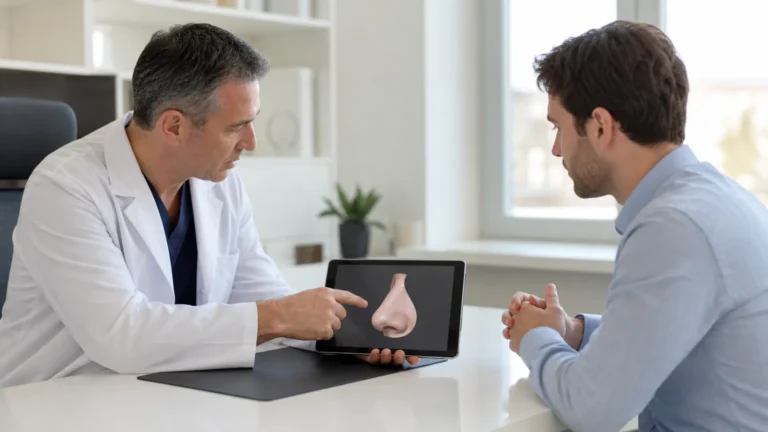
Before deciding whether the technique matters for you, it helps to have a surgeon look at your nose and explain which parts need changing.
Does ultrasonic rhinoplasty reduce bruising and swelling?
The evidence suggests it reduces early bruising, and it may reduce early swelling, although results are less consistent for swelling and most follow-up is short. Bruising around the eyes after traditional osteotomies is common: BAPRAS notes in its rhinoplasty patient guide that if the nose is broken during surgery, bruising around the eyes is noticeable for about seven to ten days.
What do the randomised trials and meta-analyses show?
The main pooled analyses, and what they actually found:
| Study | What was pooled | Main findings | Important caveats |
|---|---|---|---|
| Mirza et al., Laryngoscope, 2020 | 5 randomised controlled trials (RCTs) | Lower swelling and bruising scores with piezo on days 2–3 and day 7; less pain; no longer operative time | Small number of trials |
| Tsikopoulos et al., ORL, 2020 | Comparative studies of lateral osteotomies | Less early eyelid swelling and bruising, less pain and fewer mucosal injuries with piezo | Benefit most marked in osteotomies not done under direct vision |
| Kisel et al., Aesthetic Plastic Surgery, 2023 | 8 RCTs, 440 patients | Less early swelling in 75% of studies; lower bruising in 7 of 8 studies | Follow-up under 7 days; nearly all used lateral osteotomies |
| Safia et al., J Clin Med, 2024 | 12 RCTs, 292 piezo and 338 conventional cases | Lower degree of bruising on days 2, 4 and 7; lower degree of swelling on days 2 and 7; no significant difference in overall swelling risk | Authors rate certainty of evidence as low |
Individual trials tell a similar story. In a double-blind randomised trial of 20 patients published in the Journal of Oral and Maxillofacial Surgery in 2019, pain and bruising were lower in the piezo group at all time points, but the difference in swelling was significant on day 2 and not on day 7.
How should you read this evidence?
Read it as “probably less early bruising”, not “no bruising”. The trials are mostly small, swelling and bruising are usually graded visually, and the Kisel review notes that follow-up across studies was shorter than a week. The Safia review reports outcomes only up to day 7, rates the certainty of evidence as low and says long-term studies are still needed.
None of this tells you anything about the final shape of your nose. A trial showing less bruising on day 4 does not show a better result at one year.
What can ultrasonic rhinoplasty not do?
Ultrasonic rhinoplasty does not change cartilage, does not refine the tip and does not make rhinoplasty non-surgical. Piezo instruments act on bone, so they matter only for the upper, bony third of the nose.
Here is where the limits usually show:
- The nasal tip is cartilage. A bulbous, droopy or asymmetric tip is reshaped with sutures, trimming and grafts. Our guides to tip rhinoplasty and bulbous nose tip rhinoplasty explain that work.
- Many humps are partly cartilage. A dorsal hump often includes cartilage as well as bone, and the cartilage part is shaped with conventional instruments.
- The septum is mostly cartilage. Breathing-related septal correction relies largely on conventional techniques, even if piezo is used for bony parts.
- It is not non-invasive. You still need anaesthesia, incisions and recovery. The NHS nose reshaping guide describes a 1.5 to 3 hour operation under general anaesthetic, a splint for about seven days and up to two weeks off work, and that timeline still broadly applies.
- It does not remove the usual risks. The NHS lists risks such as breathing difficulty, septal damage, an altered sense of smell and nosebleeds for rhinoplasty in general.
If your concern is mostly the tip and the bones need no work, ultrasonic instruments may play no role in your operation at all.
Is ultrasonic rhinoplasty done open or closed?
Ultrasonic rhinoplasty is most often associated with an open approach, because the bones need to be seen directly, but it can also be done through closed approaches. A 2023 review of ultrasonic rhinoplasty and septoplasty describes performing osteotomies under direct visual control after “an open or closed extended approach”.
The choice of incision is a separate decision from the choice of bone instrument. Our guide to open vs closed rhinoplasty explains how surgeons decide between the two and what each means for scarring and recovery.

Who may benefit from ultrasonic rhinoplasty?
Patients who need significant work on the nasal bones are the most likely to benefit. That includes people who need narrowing of a wide bony bridge, reduction of a large bony hump, correction of a crooked nasal bone, or careful contouring in a revision.
Situations where piezo is often discussed:
- a wide or asymmetric bony vault that needs osteotomies;
- a prominent bony hump, where controlled sculpting may be preferred to rasping;
- a crooked nose after injury, where bone segments need precise repositioning;
- revision surgery, where irregular bone from a previous operation needs refining.
Revision cases are a specialist area. Our guide to revision rhinoplasty in Turkey covers what changes when surgery is repeated.
When may it make little difference?
Ultrasonic instruments may add little if the plan is mainly cartilage work: tip-only surgery, a small cartilaginous hump, or septoplasty for breathing without bony changes. In those cases, the surgeon’s skill with cartilage matters far more than the bone tool.
Ultrasonic vs traditional rhinoplasty: how do they compare?
The two approaches differ mainly in the bone instruments, so most of the comparison is about the early days after surgery rather than the final result.
| Factor | Ultrasonic (piezo) instruments | Traditional osteotomes and rasps |
|---|---|---|
| How bone is cut | High-frequency vibration, selective for bone | Controlled fracture with chisel and mallet; filing with rasps |
| Soft tissue | Designed to spare soft tissue and mucosa | Higher reported rate of mucosal injury in comparative studies |
| Early bruising | Lower in most trials | More common, especially around the eyes |
| Early swelling | Often lower in the first days; inconsistent later | Typical early swelling |
| Operative time | No significant difference in pooled analyses, although learning-period concerns are reported | Familiar to all rhinoplasty surgeons |
| Cartilage and tip | No role | No role (separate techniques for both) |
| Equipment cost | Higher | Lower |
| Long-term results | Not shown to differ in published trials | Long track record |
How much does ultrasonic rhinoplasty cost?
There is no reliable published price for ultrasonic rhinoplasty specifically, and quotes vary with the complexity of the whole operation. What we can say is that the equipment costs more. The Safia meta-analysis notes that piezoelectric technology is pricier than traditional osteotomy methods, citing a unit cost of around EUR 5,000 to 7,000 and tips of EUR 150 to 200 each.
On Venoramed, rhinoplasty doctor profiles in Istanbul currently display starting prices from EUR 2,400 to EUR 4,000, with one profile displaying USD 2,500 (November 2026). These are starting figures, not final quotes, and do not tell you which technique a surgeon will use; a final price follows an individual assessment. Our page on Turkey rhinoplasty package prices explains what packages usually include.
For UK comparison, the NHS gives a typical private rhinoplasty range of £4,000 to £7,000, which our guide to nose job costs in the UK explores further. If you are weighing travel, see rhinoplasty abroad: Turkey vs Europe.
Cost signals worth checking
- Does the quote state whether piezo instruments will be used, and for which steps?
- Is there a surcharge for ultrasonic techniques, and what exactly does it pay for?
- Is the surgeon using piezo because your bones need it, or because it is the default package?

Questions to ask before booking ultrasonic rhinoplasty
Ask these in your consultation and note the answers in writing.
- Which parts of my nose need bone work, and which need cartilage work?
- Will you use piezo instruments, traditional instruments or both, and for which steps?
- How many ultrasonic rhinoplasties do you perform each year, and for how long have you used the technique?
- Will you use an open or closed approach, and why?
- What bruising and swelling should I expect in the first two weeks?
- Does the technique change the price, and is that itemised?
- What would you do differently if I had traditional instruments instead?
- How do you handle revision if the bone shape is not as planned?
Our guide on how to choose a doctor and clinic in Turkey adds wider checks on credentials and hospital licensing.

Frequently asked questions
Is ultrasonic rhinoplasty better than traditional rhinoplasty?
Ultrasonic rhinoplasty is not automatically better; it uses a different tool for the bony part of the operation. Meta-analyses of randomised trials suggest less early bruising and, less consistently, less early swelling, with similar operative times. Long-term differences in the final shape have not been shown, and the technique has no effect on cartilage or tip work, so overall results still depend mainly on the surgeon.
Does ultrasonic rhinoplasty mean no bruising?
No. Ultrasonic rhinoplasty may reduce bruising, but it does not prevent it. A 2024 meta-analysis of 12 randomised trials found a lower degree of bruising on days 2, 4 and 7 with piezo instruments, yet patients in both groups still bruised. Swelling, tenderness and a splint for about a week remain part of recovery after any rhinoplasty involving the nasal bones.
Is ultrasonic rhinoplasty non-surgical?
Ultrasonic rhinoplasty is not non-surgical. It is a full rhinoplasty under anaesthesia, with incisions inside the nose or across the columella, in which the nasal bones are shaped with piezoelectric instruments. The word “ultrasonic” describes the vibrating tool, not an external treatment. Non-surgical nose reshaping usually refers to injectable fillers, which is an entirely different procedure.
Can ultrasonic rhinoplasty fix a bulbous tip?
Ultrasonic rhinoplasty cannot reshape a bulbous tip on its own, because the tip is made of cartilage and piezo instruments work on bone. Tip refinement relies on suturing, trimming or grafting cartilage, using conventional techniques. Piezo may still be used in the same operation if the bony bridge also needs narrowing or a bony hump needs reducing.
How long is recovery after ultrasonic rhinoplasty?
Recovery after ultrasonic rhinoplasty follows the usual rhinoplasty timeline. The NHS describes a splint for about seven days and up to two weeks off work, with swelling taking up to six months to settle. Trials suggest piezo may reduce bruising in the first week, but most studies follow patients for less than seven days, so later recovery is not shown to differ.
Does ultrasonic rhinoplasty cost more?
Ultrasonic rhinoplasty may cost more, because the equipment is more expensive than traditional instruments; one 2024 review cites unit costs of around EUR 5,000 to 7,000. Whether that appears in your quote depends on the surgeon and clinic. On Venoramed, rhinoplasty profiles in Istanbul currently show starting prices from EUR 2,400 to EUR 4,000, with final quotes after an individual assessment.
Next steps
If the bones of your nose need work, ultrasonic instruments may be worth discussing, but they are only one part of the plan. Share photographs with a surgeon, ask which steps need bone work, and compare written answers before deciding.
Browse surgeon profiles or request a free consultation to start that conversation.
This article is general educational information, not medical advice. Venoramed is a medical marketplace and coordination platform; it does not provide treatment, diagnose conditions or guarantee outcomes. Suitability, risks and recovery must be assessed individually by a qualified, treating clinician.



Leave a Comment
Share your question or experience. Venoramed reviews comments before publishing.